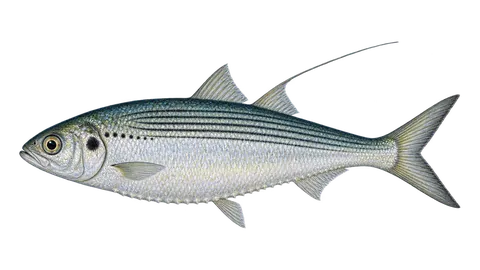
The sardine of the purse-seine fleet of Brazil's Southeast and South, in compact schools, in the sea between 5 and 60 m. For anglers it is top live bait, but it has strict minimum-size and closed-season rules.
Also called: sardinha-verdadeira, sardinha, escamuda, Brazilian sardinella, orangespot sardine
The Brazilian sardinella is the basis of the purse-seine fishery of Brazil's Southeast and South and a live bait widely used by pole-and-line tuna boats. It lives in coastal waters, from about 5 to 60 m, in compact schools, and reaches 27 cm according to FishBase, with a common size around 20 cm. It occurs from the Gulf of Mexico and the Caribbean to Brazil and northern Uruguay, but records outside Brazil are not always reliable. The stock between Cabo de São Tomé (RJ) and Cabo de Santa Marta (SC) is the most fished, and the 2009 federal rule described it as heavily overfished. The closed season protects the peaks of reproduction and recruitment, which that rule placed from November to February and from mid-June to July. There is a minimum size and a closed season; check the rules before catching or buying sardine as bait.
fun facts
Purse-seine effort for the species is limited by federal rule: the 2009 IN used 210 vessels as a reference.
Pole-and-line tuna boats use it as bait, under their own rules for those who fish tuna.
FishBase lists S. brasiliensis as a synonym of S. janeiro and treats its separation from the round sardinella as tentative: the group's taxonomy is still debated.
how to recognize it
identification
Elongated, compressed body with a dark blue back and silvery flanks, and a belly with a scute keel and black peritoneum. It has a single dorsal fin with no filamentous rays, and pelvic fins with one simple and eight branched rays. The Atlantic thread herring (sardinha-laje, Opisthonema oglinum) has a filamentous last dorsal ray. Separating the Brazilian sardinella from the round sardinella (Sardinella aurita) relies on the gill rakers (curved downward in S. brasiliensis, flat in S. aurita) and is tentative according to FishBase.
how brazilian sardinella fishing looks
Loading the next 7 days…
Each card shows the day's index (0 to 100) and, below it, a strip with the index for each hour, from 0h to 23h. from poor to excellent.
The main stock lies between Cabo de São Tomé (RJ, 22°S) and Cabo de Santa Marta (SC, 28°36'S), on the Southeast and South continental shelf, the same area covered by the closed-season and minimum-size rules. FishBase extends the species from the Gulf of Mexico and the Caribbean to northern Uruguay, but says identifications are not always reliable.
Habitat: Coastal and inner-shelf waters, from about 5 to 60 m, in compact schools; juveniles use bays and sheltered areas.
coast
Southeast CoastSouth Coastcoastalshelf
states
Rio de Janeiro, São Paulo, Paraná, Santa Catarina
calendar and clock
when to fish
best season
time of yearbest: Nov–Feb
JanFebSeaAprMayJunJulAugSepOctNovDec
In general there is more sardine near the coast in the warm months and less in winter (editorial estimate). From Oct 1 to Feb 28 the closed season applies in the Southeast and South.
best time of day
Daytime. Schools form by day near the surface or in mid-water; at night schools rise and disperse, and boat lights concentrate them.
weather, water and behavior
what affects the brazilian sardinella
sensitivity The little bars show how much each factor affects this species. Five full: it feels it a lot.
cold and cold fronts
Cold water upwelling pushes schools offshore and changes the fishing.
atmospheric pressure
Not very sensitive.
moon
On moonless nights, boat light concentrates the schools more.
rain
Very murky water and fresh runoff push schools out of the bays.
water level
Avoid fresh floodwater.
noise
The school scatters with engine noise and hull noise.
wind
Rough seas scatter the schools and make bait fishing harder.
Take only what you will use as bait and check the size: a Brazilian sardinella 17 cm or less may not be caught, and buying live bait requires a legal source. Unhook it with wet hands and put it straight into the live well without squeezing: it loses scales and dies quickly.
what the law says
rules for the brazilian sardinella
Summary of the regulations we found, with the source for each. Rules change; before keeping or transporting fish, check with the state environmental agency. Conservation: Data Deficient in the global assessment (IUCN 2017). Not on the Brazilian national list (Portaria GM/MMA nº 1.667/2026). Fishing is regulated by closed season and minimum size.
Minimum size 17 cm
17 cm (total length), with 10% weight toleranceNorth CoastNortheast CoastSoutheast CoastSouth Coast
Between Cabo de São Tomé (RJ, 22°S) and Cabo de Santa Marta (SC, 28°36'S) it is illegal to catch, land, store, transport, salt or sell Brazilian sardinella under 17 cm total length; enforcement tolerates up to 10% of the catch weight below that size. IN Ibama 16/2009, aimed at vessels, repeats the ban at any time and in any area. Only authorized pole-and-live-bait tuna boats may catch smaller sardines, for their own use as bait and never under 5 cm.
Closed season for Brazilian sardinella, Oct 1 to Feb 28
catch prohibited Oct 1 to Feb 2801/10 to 28/02RJSPPRSCSoutheast CoastSouth Coast
Between Cabo de São Tomé (RJ) and Cabo de Santa Marta (SC) it is prohibited to catch Brazilian sardinella from Oct 1 to Feb 28 each year. Landing is tolerated until Oct 3, and anyone who transports, stores, sells or processes the sardine must submit the stock declaration (the Ministry of Fisheries gives until Oct 9). Fiperj's (RJ) closed-season table notes that the closure applies to purse-seine fishing with traineiras; anyone fishing bait with cast nets or sabiki rigs should confirm its application with Ibama or the Ministry of Fisheries.
Live bait: only from authorized vessels and outside the closed season
sardine 17 cm or longer, from an authorized purse-seine boat, outside the closed seasonRJSPPRSCSoutheast CoastSouth Coastconfirm with the agency
Brazilian sardinella 17 cm or longer may only be sold, stored or transported as live bait by other fisheries outside the closed season, and only if bought from an authorized purse-seine vessel. The boat carrying it must prove its origin when boarded.
catch and release Releasing the fish alive, quickly and with a wet hand. During a closed season it isn't always allowed: what the regulation says applies.
Very fragile: if you won't use it as bait, put it back right away without holding it with a dry hand. It usually survives release poorly.
in the kitchen
Dark, flavorful, oily flesh. Good grilled, charcoal-roasted, canned, in escabeche or tinned. FishBase lists it as sold fresh and canned.
calculator
how much it weighs without taking it out of the water
Length-weight relationship W = a·Lb (a = 0.00759, b = 3.05; FishBase (relação peso-comprimento bayesiana, estimativa da própria espécie)). It's an average: a fat or lean fish can vary by 10% to 20%.
estimated weight
—
sources and references
The season weights (months), the time of day and the sensitivities (cold, pressure, moon, wind, rain, tide, strong light, murky water and noise) are the app's editorial estimates, based on the literature below and on field experience from anglers and guides. They are not official data or measurements made for this species and may vary by region and year. Closed seasons and legal rules appear in the rules section, with the rule and link. Common sizes and weights are ranges around the common length reported by FishBase, with the weight calculated from the length-weight relationship.