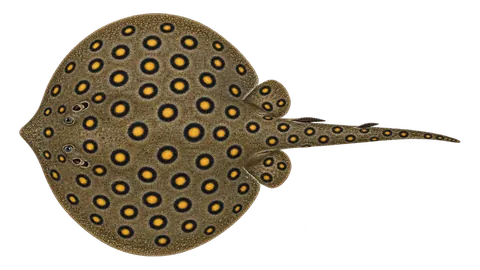
Freshwater stingray found only in the Xingu River, with a dark disc and pale blotches. It is Vulnerable, and catch becomes banned at the end of October 2026: if you hook one, release it and watch the sting.
Also called: arraia-do-Xingu, raia-do-Xingu, arraia, raia
Choose the place and the species. The index, from 0 to 100, combines weather, sun, moon and tide with each fish's habits. Up to 28 days, with each day's confidence.
location
Sample location: choose yours to see the forecast for where you fish.
period
Reading the weather across 3 global models and 31 simulations…
0—
index Score from 0 to 100 for the fishing conditions of each hour. It reads weather, sun, moon, tide and the species' habits. It doesn't promise fish: it tells you when the water is on your side. 0–24 poor · 25–44 fair · 45–64 good · 65–84 very good · 85–100 excellent.
today
—
confidence —
confidence How much you can trust the weather forecast for the day. It drops with distance and when the models disagree. It is not the chance of catching fish.
models and trend Up to 16 days, three global weather models (the European ECMWF, the American GFS and a high-resolution blend) read hour by hour; when they disagree, the light band on the chart widens. Beyond that it's a trend: 31 runs of the American GEFS model. Confirm when it's 1 week out.
window Consecutive hours with the index near the day's peak and no danger alert. It is the time to have the bait in the water.
hour by hour
tap or drag on the chart to read each hour · on a keyboard, arrow keys
see hour-by-hour table
why this index at —?
next 7 days
choose the day
chart: bar height = day's index · line = variation between models · striped = trend · fainter = less confidence
Each card shows the day's index (0 to 100) and, below it, a strip with the index for each hour, from 0h to 23h. from poor to excellent.
4-week calendar
the fishing month at a glance
plan a trip
what's the best window for the crew?
Choose how many fishing days. We compare each stretch by its average index, discount days with a warning or closed season, and show the 3 best.
trend for the coming weeks
Line: the middle value of 31 simulations of the American GEFS model. Band: where 8 out of 10 fall. Narrow, firm trend; wide, high uncertainty.
the species
everything about the white-blotched river stingray
overview
who is the white-blotched river stingray
The white-blotched river stingray is endemic to the Xingu River basin in Pará (Xingu and Fresco rivers). It lives on rock, pebble, and sand bottoms of a clear, transparent, mineral-poor river; by day it lies buried in the sand, and at night it hunts invertebrates, mainly snails. Reproduction follows the river's cycle: mating happens during the transition from dry to flood season (September to November), gestation lasts about 5 to 6 months, and the young are born mostly between May and July. In 166 stingrays sampled in the middle Xingu between 2003 and 2005, disc width ranged from 10.9 to 70 cm, and most adult females were pregnant. The IUCN classifies it as Vulnerable (2022), and it is exploited in the international aquarium trade: it has been in CITES Appendix II since February 2023. It enters the national list as Vulnerable in 2026, with a catch ban from the end of October 2026.
fun facts
The name honors King Leopold III of Belgium, according to FishBase.
In the stomachs of 158 stingrays examined in the middle Xingu, snails made up 94.3% of the diet's relative importance index (Charvet-Almeida, 2006).
During mating, males bite the pectoral fins of females.
In 2003-2005, 86% of the adult females sampled were pregnant: the middle Xingu stretch is an important breeding area (ISRA, 2025).
how to recognize it
identification
Freshwater stingray with a rounded, dark disc and pale blotches on the back. Its pattern and color change with age and with the stretch of river: a study of 241 stingrays described four dorsal color patterns and two local morphs in each place, so color alone does not identify the species. Short, thick tail with a serrated sting. In the middle Xingu it lives alongside Potamotrygon orbignyi and the fire stingray (arraia-de-fogo, Paratrygon aiereba, Critically Endangered), according to ISRA; the ocellate river stingray (Potamotrygon motoro) has yellow-orange ocelli with a dark edge.
Endemic to the Xingu River basin (Xingu and Fresco rivers) in Pará, within the Amazon basin. The Volta Grande stretch, with rapids and waterfalls, acts as a natural barrier to dispersal. It does not occur naturally in other basins.
Habitat: Rock, pebble, and sand bottoms of a clear-water river; it stays buried by day and hunts at night, at depths of 0 to 10 m.
native to the basins
Amazon
states
Pará
calendar and clock
when to fish
best season
time of yearbest: Aug–Nov
JanFebSeaAprMayJunJulAugSepOctNovDec
Estimate tied to the Xingu cycle: in the dry season (August to October) low water exposes rock fields and pebble bottoms, and the stingrays are easier to find; mating happens from September to November, and the young are born from May to July, as the water falls. Catch is banned from the end of October 2026; this information is useful for knowing when one may turn up by chance.
best time of day
Nighttime. By day it lies buried in the sand, and at night it goes out to hunt bottom invertebrates, according to FishBase.
weather, water and behavior
what affects the white-blotched river stingray
sensitivity The little bars show how much each factor affects this species. Five full: it feels it a lot.
cold and cold fronts
The region's climate has an annual mean of 25 to 26 °C, with little variation through the year (ISRA); sharp drops in water temperature are rare (estimate).
atmospheric pressure
Little known effect.
moon
Little known effect.
rain
High water (peak between February and April) tends to scatter the stingrays; low water concentrates them (estimate).
water level
Low water (August to October) exposes rock fields and pebble beaches: more encounters and a greater risk of stepping on a stingray (estimate).
noise
Not very sensitive; it stays still and buried.
wind
Little effect.
depth
From 0 to 10 m; in the shallows of beaches and rock fields.
technique, gear and bait
how to fish
rod
Catch banned: not applicable.
spinning / baitcasting reel
not applicable
line
not applicable
leader
not applicable
hook
not applicable
accessories
long-handled pliers
knife or scissors to cut the line
closed shoes or water boots
tip from an angler
Hooked a stingray in the Xingu? Don't pull it toward the boat or step on it on the bank. Keep the tail away from your legs and cut the line close to the mouth with long-handled pliers. Catch will be banned from the end of October 2026.
what the law says
rules for the white-blotched river stingray
Summary of the regulations we found, with the source for each. Rules change; before keeping or transporting fish, check with the state environmental agency. Conservation: New species on the national list in 2026 (it was not in Portaria MMA 148/2022): the bans apply from the end of October 2026. Global assessment: Vulnerable (IUCN, Mar 25, 2022). It has been in CITES Appendix II since Feb 23, 2023, because of the aquarium trade (according to FishBase and a 2023 article on freshwater stingrays).
Threatened species in Brazil: catch banned
full protection
The national list (Portaria GM/MMA nº 1.667/2026) classifies the species as VU. Under Portaria GM/MMA nº 1.666/2026 (art. 3), VU, EN, and CR species have full protection: catching, transporting, storing, processing, and trading them are banned. For species added to the list now, the ban applies 180 days after publication (DOU of Apr 28, 2026), that is, from the end of October 2026. If you hook one by accident, release it immediately, handling it as little as possible.
piracema closures in the basins where the species lives
Spawning closure (piracema) in Mato Grosso (all basins)
01/10 to 31/01MT
Allowed: All fishing modalities are prohibited in rivers, including catch and release (Law 9.096/2009, art. 19-A). Exceptions: subsistence fishing from shore (3 kg or 1 fish, no transport or sale) and scientific fishing. Law 13.159/2025 now allows licensed sport fishing in UHE/PCH hydropower reservoirs, natural lakes and border rivers, subject to a scientific study and a license from the environmental agency. We have not confirmed whether these licenses are already being issued.
Allowed: Recreational anglers with handline or rod, line and hook are outside the Annex II prohibitions, with a bag limit of 5 kg + 1 fish, unless a stricter state rule applies.
catch and release Releasing the fish alive, quickly and with a wet hand. During a closed season it isn't always allowed: what the regulation says applies.
This is not catch and release: it is the release of an accidental catch. The serrated tail sting cuts. Do not hold it by the tail or the disc; with the stingray in the water, cut the line close to the mouth with long-handled pliers. If stung: rinse the area with water, immerse it in hot water, as hot as the person can stand without burning, until the pain eases, and seek medical care: the wound often becomes necrotic. Do not apply a tourniquet, cut, or suck the wound.
in the kitchen
Catch and trade banned from the end of October 2026. For the aquarium trade, CITES rules apply. Do not buy it.
calculator
how much it weighs without taking it out of the water
Length-weight relationship W = a·Lb (a = 0.01, b = 3.04; FishBase (relação peso-comprimento bayesiana, estimativa)). It's an average: a fat or lean fish can vary by 10% to 20%.
estimated weight
—
sources and references
The season factors (months), the time of day, and the sensitivities (cold, pressure, moon, wind, rain, tide, strong light, murky water, and noise) are editorial estimates by the app, based on the literature cited below and on field experience of anglers and guides. They are not official data or measurements made for this species and may vary by region and year. Closed seasons and legal rules appear in the rules section, with the standard and link. The months indicate when the species is usually found near the coast or at the fishing spot, not a catch season. The water temperature range is also an editorial estimate, supported by FishBase values where they exist.
scientificFishBase: Potamotrygon leopoldi (ficha da espécie)Size, length-weight, depth, habitat, distribution, biology, and IUCN status. Page checked on Oct 13, 2026. The maximum size of 111 cm (disc width) is FishBase's; in middle Xingu samples the largest stingray measured 70 cm. The common range (43 to 65 cm) is that of adult females sampled in 2021.
The weather comes from three independent global models, cross-checked hour by hour: when they agree, confidence goes up; when they diverge, the band between them shows on the chart. Beyond 16 days, we use the GEFS ensemble of 31 simulations: if 20 of the 31 predict rain, the chance of rain is 65%. Sun and moon are calculated astronomically, with no uncertainty.
The index adds up, weighted for each species: time of day (species curve anchored to real sunrise and sunset), moon (transits, rise and set, phase), pressure (3 h trend and 24 h swing), water temperature (in rivers, estimated from air temperature; at sea, estimated by an ocean model), wind, rain, clouds, tide and the month in the species' cycle.
Accuracy measured in the reference project (4 regions, 93 days, forecast vs. observed): maximum temperature is off by 0.6 °C on average the next day and 1.7 °C at 7 days; rain of 5 mm or more is detected 76% of the time the next day and 57% at 7 days. Detection isn't everything: the false alarm rate isn't published here yet, and 93 days in 4 regions is still a small sample. We now also measure every day, at the app's destinations:
where are you going fishing?
Your location is saved only on this device and feeds the forecast, the map and the "today" on the home page.