Skip to content
fishing forecast

queen triggerfish

Balistes vetula · Balistidae · predator

SeaIUCN global: NT · near threatened

The most colorful triggerfish in the Atlantic, with blue bands on the face and filaments on the tail, living on reefs and rocky shores. It steals bait with strong teeth and fights by wedging its spine into the rocks. The flesh is good, but the liver can poison.

Also called: cangulo-rei, cangulo-real, cangulo-verdadeiro, cangulo-amarelo, cangulo-do-papo-amarelo, cangulo-papo-louro, cangulo-azul, gatilho-rainha, peixe-porco, queen triggerfish

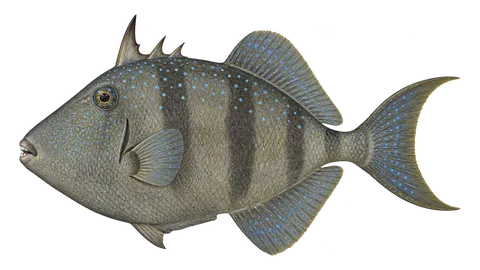
Scientific illustration of Queen triggerfish
common size
25–40 cm
maximum
60 cm
common weight
0.3–1.2 kg
record/max.
5.4 kg
depth
3–30 m
ideal water
24–28 °C
location

Sample location: choose yours to see the forecast for where you fish.

period

Reading the weather across 3 global models and 31 simulations…

the species

everything about the queen triggerfish

overview

who is the queen triggerfish

The queen triggerfish (cangulo-rei) is the showiest of the Atlantic triggerfish and occurs on both sides of the ocean. On the western side it lives on coral reefs and rocky areas, usually at 3 to 30 m, although there are records down to 275 m. It moves alone or in small groups, also over sand and seagrass. It eats bottom invertebrates, mainly sea urchins, and flips the urchin by blowing jets of water to attack it where the spines are short. It reaches 60 cm, 5.4 kg and 23 years of age. Artisanal fishers in Ceará and Pernambuco know it and catch it. It is a highly prized table fish, but FishBase warns that the liver can cause poisoning.

fun facts

  • It blows jets of water to flip sea urchins and attacks their belly, where the spines are short (FishBase).
  • It can live more than 20 years: the maximum recorded age is 23 years.
  • The English name, triggerfish, comes from the first dorsal spine, which locks upright and is released by the second, the trigger.
  • The gray triggerfish (Balistes capriscus), a close relative, was listed nationally as Endangered, with capture prohibited from Oct 25, 2026; the queen triggerfish is not on the list.
how to recognize it

identification

Deep, flattened-sided body, small eye on top of the head and small mouth with strong teeth. Greenish blue or gray on the back, and orange-yellow on the underside of the head and belly. Two curved blue bands run from the snout to the front of the pectoral fins, and a blue ring outlines the lips. A broad blue band crosses the caudal peduncle, and blue lines edge the soft dorsal, anal and caudal fins. The first dorsal has three spines. The gray triggerfish (Balistes capriscus) is grayish brown and lacks the blue bands.

distribution

where found

open on the large map

Tropical western and eastern Atlantic. In Brazil it lives on reefs and rocky shores; artisanal fishers in Pernambuco and Ceará record the species. FishBase's latitude range extends to 35°S, but the fish prefers warm water and becomes rarer where the water cools, south of the Southeast.

Habitat: Coral reefs and rocky bottoms from 3 to 30 m, with patches of sand and seagrass alongside; it can descend to 275 m.

coast

North CoastNortheast CoastSoutheast Coastcoastalshelf
calendar and clock

when to fish

best season

time of yearbest: Dec–Mar
JanFebSeaAprMayJunJulAugSepOctNovDec

Fished all year on tropical reefs; it bites best in warm, calm water from late spring to summer.

best time of day

0h6h12h18h sunrise ~6amsunset ~6pm

Daytime. Active by day, feeding on the bottom in the morning and afternoon; at night it retreats into holes in the rocks to rest.

weather, water and behavior

what affects the queen triggerfish
sensitivity The little bars show how much each factor affects this species. Five full: it feels it a lot.

cold and cold fronts

Warm-water fish: it disappears from shallow areas when the water cools.

atmospheric pressure

Small effect.

moon

Small effect.

rain

Dirty river water near the reef scatters the fish.

water level

Does not apply at sea. The equivalent is clear water over the reef.

noise

Small effect; anchor carefully so as not to drag the anchor over coral.

wind

Strong swell makes it hard to stay over the reef and keep the bait out of sight.

tide

Moderate current over the reef brings food and makes the fish more active.

depth

From 3 to 30 m in most catches.

technique, gear and bait

how to fish

rod
6'6" to 7', medium action, 12 to 25 lb
spinning / baitcasting reel
3000 to 5000 spinning reel
line
monofilament 15 to 30 lb or braid 20 to 30 lb
leader
fluorocarbon 30 to 50 lb, 50 cm (strong teeth and rough skin cut thin line)
hook
single 1/0 to 3/0, short and with a strong shank (small mouth)

lures

  • small jig of 20 to 40 g

natural baits

  • shrimp
  • clam or mussel
  • pieces of sea urchin
  • small crab

accessories

  • alicate
  • luvas
  • boga-grip

tip from an angler

It bites in short pecks and steals the bait: use a small, strong hook, wait for a firm pull and then lift the rod. Once hooked, it wedges into a crevice and locks its spine: keep the pressure on and pull it out of the hole.

what the law says

rules for the queen triggerfish

Summary of the regulations we found, with the source for each. Rules change; before keeping or transporting fish, check with the state environmental agency.
Conservation: Near Threatened (NT) in the IUCN global assessment, from 2011. Not on the Brazilian national list (Portaria GM/MMA nº 1.667/2026). In 2025, a US federal rule reduced the annual catch limits for the triggerfish complex (queen triggerfish, gray triggerfish and ocean triggerfish) around Puerto Rico.

Puerto Rico (federal waters): up to 5 per person per day

5 per person per day; 15 per boat with 3 or more people

In federal waters around Puerto Rico (outside territorial waters, from 9 miles offshore), recreational anglers may keep a maximum of 5 fish per day in total from angelfish, grunts, jacks and other carangids, surgeonfish, triggerfish and wrasses (up to 15 per boat when 3 or more people are aboard; no more than 1 surgeonfish per person). The queen triggerfish is part of the triggerfish complex in the federal management plan. The limit does not apply to anyone holding a commercial license from Puerto Rico or the US Virgin Islands.

Source: 50 CFR 622.444(a)(2) (NOAA Fisheries, US), wording from 90 FR 26940, of Jun 25, 2025
Mexico: up to 5 per species and 10 saltwater fish per day

5 specimens of the species per angler per day, within the limit of 10 saltwater fish

In recreational sport fishing in Mexican federal waters, each angler may keep up to 10 marine fish per day, with a maximum of 5 of the same species. The queen triggerfish is not among the species reserved for sport fishing and has no limit of its own. Anything over the limit goes back alive into the water, and sport-caught fish may not be sold. Anglers fishing from a boat need the recreational fishing permits required by the rule.

Source: Amendment to NOM-017-PESC-1994 (recreational sport fishing in federal waters of Mexico), published in the DOF on Nov 25, 2013, items 4.3, 4.9.1, 4.9.5 and 4.11 (Sagarpa/Conapesca)

catch and release
catch and release Releasing the fish alive, quickly and with a wet hand. During a closed season it isn't always allowed: what the regulation says applies.

Hold it from the side, away from the mouth (the bite is strong). The first dorsal spine locks upright and only lowers when the second spine, the trigger, is pressed. Release it quickly, with its head in the water.

in the kitchen

White, firm, tasty flesh; remove the thick, rough skin before preparing. Do not eat the liver or the guts: FishBase classifies the species as poisonous to eat because of the liver. Caribbean reef fish in general can also cause ciguatera; ask local fishers.

calculator

how much it weighs without taking it out of the water

Length-weight relationship W = a·Lb (a = 0.02818, b = 2.9; FishBase (relação peso-comprimento bayesiana, estimativa da própria espécie)). It's an average: a fat or lean fish can vary by 10% to 20%.

estimated weight

—

sources and references

The season weights (months), the time of day and the sensitivities (cold, pressure, moon, wind, rain, tide, strong light, murky water and noise) are the app's editorial estimates, based on the literature below and on the field experience of anglers and guides. They are not official data nor a measurement made for this species, and they may vary by region and year. Closed seasons and legal rules appear in the rules section, with the norm and a link.

  1. scientific FishBase: Balistes vetula (ficha da espécie)Size, length-weight, depth, habitat, distribution, biology and IUCN status. Page checked Oct 13, 2026. The common size range is an editorial estimate around the common length of 30 cm reported by FishBase.
  2. scientific FishBase: nomes populares de Balistes vetulaNames by country and language.
  3. official Portaria GM/MMA nº 1.667, de 27 de abril de 2026: Lista Nacional Oficial de Espécies da Fauna Ameaçadas de Extinção (peixes e invertebrados aquáticos)The species is not on the list. Checked in the DOU of April 28, 2026.
  4. scientific Pinto, M. F.; Mourão, J. S.; Alves, R. R. N. (2015). Use of ichthyofauna by artisanal fishermen at two protected areas along the coast of Northeast Brazil. Journal of Ethnobiology and Ethnomedicine.Common names recorded from artisanal fishers in Tamandaré (PE) and the Batoque Extractive Reserve (CE).
  5. official 50 CFR Part 622, Subpart S: FMP for the EEZ around Puerto Rico (NOAA Fisheries, EUA), § 622.444(a)(2), redação de 90 FR 26940 (25/06/2025)Recreational catch limit in federal waters around Puerto Rico and species list from the management plan. Text checked Oct 13, 2026.
  6. official NOAA Fisheries: Final rule to modify annual catch limits for the triggerfish complex in federal waters around Puerto RicoThe complex includes the queen triggerfish, the gray triggerfish (peixe-porco) and the ocean triggerfish (cangulo-preto); in force since July 25, 2025. Checked Oct 13, 2026.
  7. official NOM-017-PESC-1994 (pesca deportivo-recreativa em águas de jurisdição federal do México), modificação publicada no DOF em 25/11/2013 (Sagarpa/Conapesca)Limit of 10 marine fish per angler per day, no more than 5 of the same species (item 4.9.1), return of the excess (4.9.5) and ban on selling sport-caught fish (4.11). Text checked Oct 13, 2026. The rule sets no quota of its own for this species.
don't confuse

similar species