Skip to content
fishing forecast

american eel

Anguilla rostrata · Anguillidae · predator

EstuarySeaIUCN global: EN · endangered

An eel that grows in rivers, lagoons and estuaries of Mexico, Central America and the Caribbean, and goes to spawn in the Sargasso Sea. It is Endangered worldwide: if you hook one, release it.

Also called: enguia-americana, enguia, american eel, freshwater eel

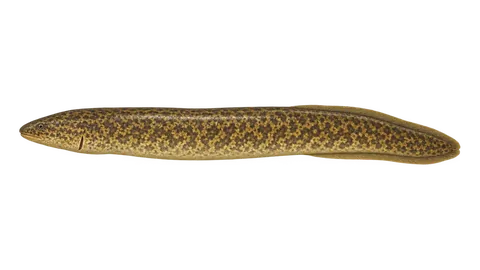
Scientific illustration of American eel
common size
40–70 cm
maximum
152 cm
common weight
0.1–0.7 kg
record/max.
7.3 kg
depth
0–464 m
ideal water
15–23 °C
location

Sample location: choose yours to see the forecast for where you fish.

period

Reading the weather across 3 global models and 31 simulations…

the species

everything about the american eel

overview

who is the american eel

The American eel has one of the strangest lives of any fish caught in Latin America. It is born in the Sargasso Sea, in the middle of the North Atlantic; transparent, leaf-shaped larvae drift to the coast and turn into young eels that swim up rivers, lagoons and swamps. There they spend one to several decades, hiding by day under banks, among logs and in deep pools, and hunting insect larvae, snails, small crustaceans and fish. In autumn the adults go back down the rivers and return to the sea to spawn. It reaches 152 cm, 7.3 kg and 43 years of age, according to FishBase. The IUCN has rated it Endangered since the 2020 assessment.

fun facts

  • Born in the Sargasso Sea; the transparent larvae, the leptocephali, are shaped like willow leaves and drift to the coast before turning into elvers.
  • It can exceed 40 years in fresh water before maturing; the oldest age record in FishBase is 43 years.
  • In 2025, at CITES CoP20, the proposal to regulate trade in all Anguilla eels (including this one) lost by 100 votes against, 35 in favor and 8 abstentions; countries adopted a resolution on sustainable management.
how to recognize it

identification

Long, rounded body like a snake's, with no pelvic fins and with the dorsal, caudal and anal fins joined in one continuous fin. Smooth, very slippery skin with tiny embedded scales. Long head, small eyes, thick lips, lower jaw longer than the upper, and well-developed pectoral fins, with the gill opening in front of them. Adults are brown to dark blue on the back and pale below; juveniles have some yellow on the edge of the dorsal and anal fins. Morays have no pectoral fins, and neither does the mussum (Synbranchus).

distribution

where found

open on the large map

Atlantic coast of the Americas, from Greenland to Panama, and much of the Antilles down to Trinidad. In Latin America it occurs in Mexico, Central America, the Caribbean islands and, in northern South America, Colombia and Venezuela. FishBase's country list does not include Brazil.

Habitat: Rivers, streams and lagoons with mud or silt bottoms, preferably with steady current, dug-out banks, logs and deep pools where it hides by day. It passes through estuaries and mangroves and goes out to sea, down to about 464 m, to spawn.

calendar and clock

when to fish

best season

time of yearbest: Sep–Oct
JanFebSeaAprMayJunJulAugSepOctNovDec

Yellow eels (the growth stage) are active all year in warm water. In autumn the adults go down to the sea on dark nights with high water, and in the Antilles young eels (elvers) enter rivers in winter; in the Dominican Republic the 2022-2023 elver season ran from 15/10 to 31/03.

best time of day

0h6h12h18h sunrise ~6amsunset ~6pm

Nighttime. Hides by day and goes out at night to hunt; activity is highest in the first hours after sunset.

weather, water and behavior

what affects the american eel
sensitivity The little bars show how much each factor affects this species. Five full: it feels it a lot.

cold and cold fronts

In cold water it stays still and barely feeds; the range reported by FishBase is 4 to 25 °C.

atmospheric pressure

Small effect.

moon

It prefers dark nights: on full-moon nights it goes out less, and the adults' downstream migration to the sea happens on moonless nights.

rain

Rising, muddy water after rain flushes the eel out of its hiding places and triggers the adults' migration.

water level

Low, clear river: only at night. With the water rising, it also becomes active at dusk.

noise

It senses vibration on the bank; step lightly and avoid shining a flashlight in the fish's face.

wind

Little effect.

tide

In estuaries, the ebb tide carries the adults out to sea during migration.

depth

By day it stays on the bottom, hidden; at night it moves up to the shallows and the banks.

technique, gear and bait

how to fish

rod
7', medium action, 10 to 20 lb
spinning / baitcasting reel
3000 reel
line
monofilament 12 to 20 lb
leader
monofilament 20 to 30 lb, 30 to 40 cm
hook
circle 1/0 to 2/0 (hooks in the corner of the mouth and injures less)

natural baits

  • minhoca
  • fish pieces
  • shrimp

accessories

  • wet cloth or glove
  • long-nose pliers
  • red light lantern

tip from an angler

Endangered species: if it swallows the hook, cut the leader close to the mouth instead of pulling it out; it survives better.

what the law says

rules for the american eel

Summary of the regulations we found, with the source for each. Rules change; before keeping or transporting fish, check with the state environmental agency.
Conservation: Endangered in the IUCN global assessment (criterion A2bd, assessed 08/11/2020). As it is outside the Brazilian fauna, it is not on the national list (Portaria GM/MMA nº 1.667/2026). In November 2025 CITES CoP20 rejected the proposal to list eels of the genus Anguilla in Appendix II.

Dominican Republic: eel fishing banned in protected areas

fishing banned, at all stages, in protected areas and buffer zones

In the Dominican Republic, fishing for eels (Anguilla rostrata) is permanently banned at all stages of development, including elvers, within the units of the National System of Protected Areas and their buffer zones.

Source: Decreto nº 418-21, of Jul 2, 2021, art. 3º (Presidency of the Dominican Republic)

Dominican Republic: eel capture only with registration and a special permit

special CODOPESCA permit to capture, sell and export; season and quota set by resolutionconfirm with the agency

CODOPESCA Resolution No. 02-22 requires a special permit to exploit, sell and export the American eel, limits capture to fishers registered for the species, and prohibits carrying more than 100 g outside the card zone. For 2022-2023 it opened the elver season from 15/10/2022 to 31/03/2023, closed fishing and trade of all stages from 01/04 to 14/10/2023, and set a maximum quota of 1,500 kg. These dates apply to that period; we did not check a more recent resolution. Check with CODOPESCA before fishing.

Source: Resolución CODOPESCA nº 02-22 (Dominican Council for Fisheries and Aquaculture, Law nº 307-04), arts. 1 to 7

catch and release
catch and release Releasing the fish alive, quickly and with a wet hand. During a closed season it isn't always allowed: what the regulation says applies.

Always release: the species is Endangered and long-lived, and large eels are very old. Hold it with a wet cloth or glove, horizontally, and release it in deep water with current. If the hook is deep, cut the line close to the mouth.

in the kitchen

Fatty, firm flesh, traditionally smoked or grilled in many cultures. In the Dominican Republic, the trade in elvers (angulas) is regulated by special permit. Because it is Endangered, the recommendation is to release it.

calculator

how much it weighs without taking it out of the water

Length-weight relationship W = a·Lb (a = 0.00087, b = 3.19; FishBase (relação peso-comprimento bayesiana, estimativa da própria espécie)). It's an average: a fat or lean fish can vary by 10% to 20%.

estimated weight

—

sources and references

The season weights (months), the time of day and the sensitivities (cold, pressure, moon, wind, rain, tide, strong light, murky water and noise) are the app's editorial estimates, based on the literature below and on the field experience of anglers and guides. They are not official data nor a measurement made for this species, and they may vary by region and year. Closed seasons and legal rules appear in the rules section, with the norm and a link.

  1. scientific FishBase: Anguilla rostrata (ficha da espécie)Size, length-weight, depth, habitat, distribution, biology and IUCN status. Page checked Oct 13, 2026. The common size range is an editorial estimate around the common length of 50 cm reported by FishBase.
  2. scientific FishBase: nomes populares de Anguilla rostrataNames by country and language.
  3. official Decreto nº 418-21, de 02/07/2021 (Presidência da República Dominicana)Art. 3º: permanent ban on eel fishing in protected areas and buffer zones. Text checked on 13/10/2026.
  4. official Resolução CODOPESCA nº 02-22 (República Dominicana), registro do FAOLEXSeason, closed period, permits and quota for the American eel in 2022-2023. Text checked on 13/10/2026; we found no more recent resolution. Resolution No. 02-19, cited in the FAOLEX record, set a season from 1/11 to 1/04 each year and was not read in full.
  5. press Mongabay (02/2026): anguilas, extinción y República Dominicana retira protecciones comercialesResult of the CITES CoP20 vote on eels (100 against, 35 in favor, 8 abstentions; two-thirds were required) and the withdrawal, in January 2026, of the Dominican request to list the species in Appendix III.
don't confuse

similar species