


the right time
to be on the water
Choose the place and the species. The index, from 0 to 100, combines weather, sun, moon and tide with each fish's habits. Up to 28 days, with each day's confidence.
Loading the forecast…
—
hour by hour
slide your finger or mouse over the chart to see each hoursee hour-by-hour table
why this index at —?
choose the day
the fishing month at a glance
what's the best window for the crew?
Choose how many fishing days. We compare each stretch by its average index, discount days with a warning or closed season, and show the 3 best.
trend for the coming weeks
Line: the middle value of 31 simulations of the American GEFS model. Band: where 8 out of 10 fall. Narrow, firm trend; wide, high uncertainty.
everything about the banded astyanax
how to recognize it
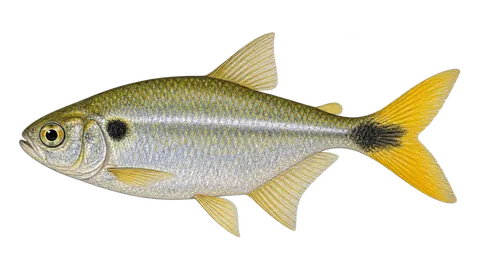
A spindle-shaped, silvery body, with the red tail that gives the fish its name. Among the lambaris, it is told apart from the yellow-tailed lambari (Astyanax lacustris) by tail color: red here, yellow to orange there. The branca (Oligosarcus jenynsii), from the south, is a relative, but it reaches 31 cm and has a larger mouth with visible teeth, while this lambari does not exceed 17 cm.
Also called: lambari-do-rabo-vermelho, piaba-rabo-vermelho, lambari, colirroja, banded astyanax
don't confuse with:
We don't have tips on season, bait or technique for this species yet.
where found
open on the large mapWhere to look: Streams and rivers without strong current, as well as still areas such as lagoons and backwaters.
It occurs in almost all freshwater basins of Latin America, from Mexico to Argentina. In Brazil it appears in rivers of the Northeast, Southeast and South.
native to the basins
rules for the banded astyanax
Rules change; before keeping or transporting fish, check with the state environmental agency.
We found no species-specific rule beyond the region's general rules.
piracema and closed seasons
Each bar is the period when fishing is prohibited or restricted. The green line is today. Tap the name to see what is still allowed.
Spawning closure (piracema) in the Paraná River basin
Allowed: Recreational fishing only for non-native species and hybrids (peacock bass, tilapia, black bass, carp, croaker, etc.; piauçu remains prohibited), with handline, simple pole, or rod with spinning or baitcasting reel, up to 10 kg + 1 fish. In rivers, from shore only; in reservoirs, from a boat or from shore. Prohibited: floodplain lakes, aquatic-animal bait, within 1,500 m of dams and waterfalls, and within 500 m of confluences. Tournaments only in reservoirs and only with non-native species.
Source: IN IBAMA nº 25/2009
Spawning closure (piracema) in Minas Gerais (state rule)
Allowed: Only exotic or hybrid species, 3 kg + 1 fish per day, with handline, rod, simple pole, or spinning or baitcasting reel. Nets prohibited. Keep the minimum distances from dams and reservoirs.
Source: Portarias IEF nº 154/2011 (São Francisco), 155/2011 (East) and 156/2011 (Grande/Paranaíba)
Closed season in Goiás (state rule)
Allowed: Sport and guided fishing only in reservoirs, catch and release with barbless hooks (no keeping, transporting or eating). Subsistence: up to 5 kg per day, for household consumption only.
Spawning closure (piracema) in the Pantanal of Mato Grosso do Sul
Allowed: Subsistence fishing by riverside residents and authorized scientific fishing. Decree 15.166/2019 (art. 11, §5) allows catch and release only in February and only in the channels of the Paraguay and Paraná rivers. For the rest of the period, not even catch and release is allowed. Check the Imasul portaria for each season.
Source: Decreto estadual MS nº 15.166/2019, art. 11; IN IBAMA nº 201/2008
Spawning closure (piracema) in Mato Grosso (all basins)
Allowed: All fishing modalities are prohibited in rivers, including catch and release (Law 9.096/2009, art. 19-A). Exceptions: subsistence fishing from shore (3 kg or 1 fish, no transport or sale) and scientific fishing. Law 13.159/2025 now allows licensed sport fishing in UHE/PCH hydropower reservoirs, natural lakes and border rivers, subject to a scientific study and a license from the environmental agency. We have not confirmed whether these licenses are already being issued.
Spawning closure (piracema) in the São Francisco River basin (rivers and reservoirs)
Allowed: Recreational fishing from a boat or from shore with handline, rod, spinning or baitcasting reel, up to 5 kg + 1 fish. Prohibited within 1,000 m of dams, waterfalls and rapids, and within 500 m of confluences. Floodplain lakes have a longer closed season (see next item).
Source: Portaria IBAMA nº 50/2007
São Francisco: floodplain lakes
Allowed: No fishing in the floodplain lakes during the period.
Source: Portaria IBAMA nº 50/2007
Spawning closure (piracema) in the Uruguay River basin
Allowed: Recreational fishing from shore, or from a boat without motor. Only handline or rod, line and hook, one gear per angler, up to 5 kg. Prohibited in floodplain lakes, within 1,500 m of dams, within 500 m of confluences, and in stretches listed in the rule (e.g., Turvo River).
Source: IN IBAMA nº 193/2008
Spawning closure (piracema) in the southern basins (RS and SC, outside the Uruguay)
Allowed: Recreational fishing from a boat or from shore, with a single hook, one gear per angler, up to 5 kg.
Source: IN IBAMA nº 197/2008
Spawning closure (piracema) in the Southeast basins
Allowed: In rivers, shore fishing only; in reservoirs, from a boat or from shore. Only non-native species, hybrids, and giant river prawn (camarão-gigante-da-malásia), up to 10 kg + 1 fish. Prohibited in floodplain lakes and within 1,000 m of dams.
Source: IN IBAMA nº 195/2008
Spawning closure (piracema) in the East basins
Allowed: Same rules as the Southeast basins: only non-native species and hybrids, up to 10 kg + 1 fish; in rivers, shore fishing only.
Source: IN IBAMA nº 196/2008
Closed season in the Ceará basins
Allowed: Recreational fishing with handline or rod is outside the prohibition.
Source: Portaria IBAMA nº 04/2008
Conservation: Not on the Brazilian national list (Ministerial Ordinance GM/MMA No. 1.667/2026).
how much it weighs without taking it out of the water
estimated weight
—
how we calculate
Length-weight relationship W = a·Lb (a = 0.01318, b = 3.07; FishBase (relação peso-comprimento bayesiana, estimativa da própria espécie)). It's an average: a fat or lean fish can vary by 10% to 20%.
more about the banded astyanax
The red-tailed lambari belongs to the family Acestrorhamphidae and reaches 17 cm, with a common size of 12 cm. It lives in streams and rivers without strong current and in still areas such as lagoons and backwaters. It occurs in almost all freshwater basins of Latin America, from Mexico to Argentina. It is an active, lively fish that eats small fish and pieces of meat. It has little commercial use and sometimes ends up on the table, with tasty flesh full of bones. Because of its small size, it turns up on the line of anglers using light rods.
Family: Acestrorhamphidae · omnivore
in the kitchen
Sometimes it ends up on the table: the flesh is tasty, but it has many bones.
similar species

sources and references (3)
Essential profile: size, length-weight, depth, countries and conservation come from FishBase and the cited regulations, and the texts were written from those sources. Season, time of day, sensitivities, technique and baits and lures are not included yet, because we did not find a good source for this species.
- scientific FishBase: Psalidodon fasciatus (ficha da espécie)Size, length-weight, depth, habitat, distribution, biology, and IUCN status. Page checked on Oct 13, 2026.
- scientific FishBase: nomes populares de Psalidodon fasciatusNames by country and language.
- official Portaria GM/MMA nº 1.667, de 27 de abril de 2026: Lista Nacional Oficial de Espécies da Fauna Ameaçadas de Extinção (peixes e invertebrados aquáticos)The species is not on the list. Checked in the DOU of April 28, 2026.
how we calculatewhere each number comes from
The weather comes from three independent global models, cross-checked hour by hour: when they agree, confidence goes up; when they diverge, the band between them shows on the chart. Beyond 16 days, we use the GEFS ensemble of 31 simulations: if 20 of the 31 predict rain, the chance of rain is 65%. Sun and moon are calculated astronomically, with no uncertainty.
The index adds up, weighted for each species: time of day (species curve anchored to real sunrise and sunset), moon (transits, rise and set, phase), pressure (3 h trend and 24 h swing), water temperature (in rivers, estimated from air temperature; at sea, estimated by an ocean model), wind, rain, clouds, tide and the month in the species' cycle.
sources for this lookup
how accurate the forecast is
Accuracy measured in the reference project (4 regions, 93 days, forecast vs. observed): maximum temperature is off by 0.6 °C on average the next day and 1.7 °C at 7 days; rain of 5 mm or more is detected 76% of the time the next day and 57% at 7 days. Detection isn't everything: the false alarm rate isn't published here yet, and 93 days in 4 regions is still a small sample. We now also measure every day, at the app's destinations: