Skip to content
fishing forecast

pacu-manteiga

Mylossoma albiscopum · Serrasalmidae · omnivore

Freshwater

A small, silver pacu from the Amazon várzea, one of the best-selling fish in Amazonas markets. It eats fruit and seeds and nibbles small hooks.

Also called: pacu-manteiga, pacu-comum, pacu, pacu-branco

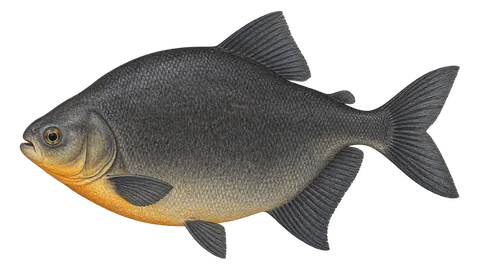
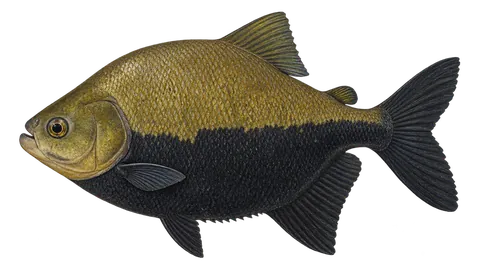
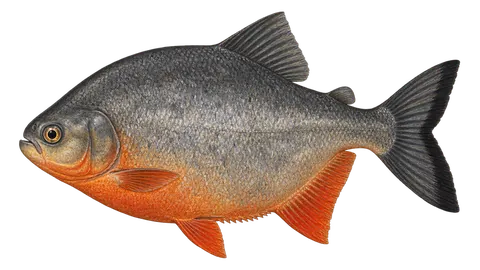
Scientific illustration of Pacu-manteiga
common size
15–22 cm
maximum
25 cm
common weight
0.1–0.4 kg
record/max.
0.6 kg
depth
0.5–5 m
ideal water
26–31 °C
location

Sample location: choose yours to see the forecast for where you fish.

period

Reading the weather across 3 global models and 31 simulations…

the species

everything about the pacu-manteiga

overview

who is the pacu-manteiga

Disc-shaped pacu that lives in whitewater rivers and in the várzea lakes and channels of the Amazon. It eats fruit, seeds and insect larvae, and enters the flooded forest during the flood. Spawning is prolonged, with two peaks during the rise. It is one of the most important species in Brazilian Amazon commercial fishing. Until 2018, all Amazonian pacu-manteiga were called Mylossoma duriventre; the revision of the genus separated two very similar Amazonian species, M. albiscopum and M. aureum, which reach the markets together. On a small hook with fruit or dough, it fights well for its size.

fun facts

  • The name Mylossoma comes from Greek and refers to the grinding teeth.
  • The separation of the Amazonian species was confirmed by DNA before the 2018 revision.
how to recognize it

identification

Tall, disc-shaped, very compressed and silver body; the belly has a keel of spines (serrilha). Small head and short snout, with crushing teeth, without the cutting teeth of piranhas. Dark spot on the gill cover, missing or faint in M. aureum. Much smaller than the pacu and tambaqui.

distribution

where found

open on the large map

Whitewater rivers and várzea lakes of the Amazon basin (Solimões-Amazonas, Madeira, Purus, Juruá). In the Tocantins-Araguaia the pacu-manteiga is another species, Mylossoma unimaculatum, and in the Pantanal the pacu-peva is M. duriventre.

Habitat: Várzea lakes, paranás, channels and flooded forest in the flood; river channel during migration.

native to the basins

Amazon

states

Amazonas, Pará, Amapá, Acre, Rondônia, Roraima

calendar and clock

when to fish

best season

time of yearbest: Aug–Nov
JanFebSeaAprMayJunJulAugSepOctNovDec

In falling water and the dry season (August to November in central Amazonia) the fish concentrates in lakes and channels. In the flood it disappears into the flooded forest. There is a closed season from Nov 15 to Mar 15 in several states.

best time of day

0h6h12h18h sunrise ~6amsunset ~6pm

Daytime. Feeds during the day, most active in the early morning and late afternoon.

weather, water and behavior

what affects the pacu-manteiga
sensitivity The little bars show how much each factor affects this species. Five full: it feels it a lot.

cold and cold fronts

Cold snaps (friagem) shut down activity for a few days.

atmospheric pressure

Stable pressure helps.

moon

Little known effect.

rain

Light rain doesn't bother it.

water level

A falling lake concentrates the school.

noise

Wary: approach quietly.

wind

Little effect.

depth

Shallow to mid-water, 0.5 to 3 m.

technique, gear and bait

how to fish

rod
3 to 4 m cane pole or light 5'6" to 6' rod, 6 to 12 lb
spinning / baitcasting reel
spinning reel 1000 to 2500
line
monofilament 0.20 to 0.25 mm
leader
optional
hook
small and strong, #4 to 1, short shank

natural baits

  • fruit and seeds from the bank
  • boiled corn
  • flour dough
  • minhoca

accessories

  • small float
  • groundbait of corn or fruit

tip from an angler

Bait on the float, close to the vegetation on the bank. Strike quickly: it nibbles and lets go.

what the law says

rules for the pacu-manteiga

Summary of the regulations we found, with the source for each. Rules change; before keeping or transporting fish, check with the state environmental agency.
Conservation: Not on the national list (Ordinance GM/MMA 1.667/2026). ICMBio assessed the related species M. aureum and M. duriventre; we found no national entry under the name M. albiscopum.

Amazonian closed season (AM, AC, PA, AP)

catch, transport and sale prohibited (commercial fishing)15/11 to 15/03AMACPAAPAmazon

In AM, AC, PA and AP the pacu (Mylossoma spp.) is in Annex II of the ordinance, with fishing prohibited from Nov 15 to Mar 15. Under art. 2 of the ordinance, anglers fishing with a handline or pole, line and hook are exempt from this ban, unless a stricter state rule applies; during the period the angler's limit is 5 kg + 1 fish.

Source: Portaria IBAMA nº 48/2007, Annexes I and II

piracema closures in the basins where the species lives

Spawning closure (piracema) in Mato Grosso (all basins)

01/10 to 31/01MT

Allowed: All fishing modalities are prohibited in rivers, including catch and release (Law 9.096/2009, art. 19-A). Exceptions: subsistence fishing from shore (3 kg or 1 fish, no transport or sale) and scientific fishing. Law 13.159/2025 now allows licensed sport fishing in UHE/PCH hydropower reservoirs, natural lakes and border rivers, subject to a scientific study and a license from the environmental agency. We have not confirmed whether these licenses are already being issued.

Source: IN Interministerial MAPA/MMA nº 10/2017; Resolução Cepesca-MT nº 1/2026; Lei estadual MT nº 9.096/2009, arts. 19-A and 27 (Leis 12.434/2024 and 13.159/2025)

Closed season in the rivers of Marajó Island (PA)

01/01 to 30/04PA

Allowed: The same recreational-angler exceptions as in Portaria 48/2007 apply (handline or rod, 5 kg + 1 fish), unless a stricter state rule applies.

Source: Portaria IBAMA nº 48/2007

Closed season in the Amazon basin in Amapá

15/11 to 15/03AP

Allowed: Recreational anglers with handline or rod, line and hook are outside the Annex II prohibitions, with a bag limit of 5 kg + 1 fish, unless a stricter state rule applies.

Source: Portaria IBAMA nº 48/2007

Border rivers MT/RO and MT/PA

05/11 to 28/02MTROPA

Allowed: See the exceptions in Portaria 48/2007 and the state rules for each bank.

Source: Portaria IBAMA nº 48/2007

catch and release
catch and release Releasing the fish alive, quickly and with a wet hand. During a closed season it isn't always allowed: what the regulation says applies.

Small, hardy fish: remove the hook in the water and release it.

in the kitchen

Fatty, tasty meat. Grilled over coals, fried or in caldeirada; very common at Manaus markets.

calculator

how much it weighs without taking it out of the water

Length-weight relationship W = a·Lb (a = 0.02455, b = 3.0; FishBase). It's an average: a fat or lean fish can vary by 10% to 20%.

estimated weight

—

sources and references

The season weights (months), the time of day and the sensitivities (cold, pressure, moon, wind, rain, tide, strong light, murky water and noise) are the app's editorial estimates, based on the literature below and on the field experience of anglers and guides. They are not official data nor a measurement made for this species, and they may vary by region and year. Closed seasons and legal rules appear in the rules section, with the norm and a link.

  1. scientific FishBase — Mylossoma albiscopum (ficha da espécie)Names, distribution, biology, length-weight relationship and references. Page checked on October 13, 2026.
  2. official Portaria GM/MMA nº 1.667, de 27 de abril de 2026 — Lista Nacional Oficial de Espécies da Fauna Ameaçadas de Extinção (peixes e invertebrados aquáticos)Most recent national list. The species is not on it (search by scientific name in the text published in the DOU, checked on October 13, 2026).
  3. scientific IUCN Red List — Mylossoma albiscopum (avaliação global: Pouco Preocupante, LC, 05/12/2020)Global assessment. Link given on the FishBase entry (Red List, version 2025-2).
  4. scientific Mateussi, N. T. B.; Oliveira, C.; Pavanelli, C. S. (2018). Taxonomic revision of the cis-Andean species of Mylossoma Eigenmann & Kennedy, 1903 (Teleostei: Characiformes: Serrasalmidae). Zootaxa 4387(2): 275–309.Revision recognizing M. albiscopum and M. aureum in the Amazon, M. unimaculatum in the Tocantins-Araguaia and M. duriventre in the Plata basin. DOI and abstract checked in Crossref.
  5. scientific Ferreira, E. J. G.; Zuanon, J. A. S.; Santos, G. M. (1998). Peixes comerciais do médio Amazonas: região de Santarém, Pará. Brasília: Ibama. 211 p.Printed work; it treats the pacu-manteiga under its old name, Mylossoma duriventre. The URL is the FishBase bibliographic record.
  6. scientific Mérona, B. de; Rankin-de-Mérona, J. (2004). Food resource partitioning in a fish community of the central Amazon floodplain. Neotropical Ichthyology 2(2): 75–84.Diet of the species of the Amazonian várzea; the pacu appears under the old name M. duriventre. DOI checked in Crossref.
don't confuse

similar species