Skip to content
fishing forecast

surubim-do-magdalena

Pseudoplatystoma magdaleniatum · Pimelodidae · predator

FreshwaterIUCN global: EN · endangered

The large bagre rayado of the Magdalena basin in Colombia, a relative of the surubim and cachara. Critically Endangered in the country: it has a minimum size and a closed season, and the best option for the species is to release it.

Also called: surubim-do-magdalena, bagre rayado, pintadillo

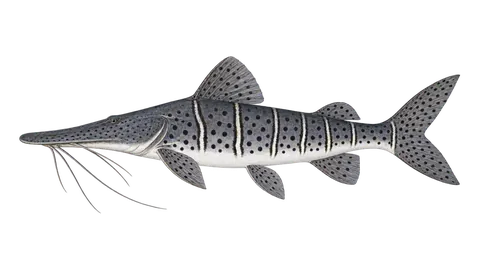
Scientific illustration of Surubim-do-magdalena
common size
50–90 cm
maximum
150 cm
common weight
2–10 kg
record/max.
70.0 kg
depth
2–15 m
ideal water
26–30 °C
location

Sample location: choose yours to see the forecast for where you fish.

period

Reading the weather across 3 global models and 31 simulations…

the species

everything about the surubim-do-magdalena

overview

who is the surubim-do-magdalena

An iconic catfish of the Magdalena River and the largest fish in the basin, with records of up to 1.5 m and 70 kg. Until 2007 it was treated as Pseudoplatystoma fasciatum, a name once used for surubim across South America; the revision of the genus showed that the Magdalena fish is a species of its own, endemic to Colombia, in the Magdalena, Cauca and San Jorge rivers and the floodplain swamps (ciénagas). In the 1970s it made up more than half of the subienda catch (migratory run); since then catches have dropped more than 90% and average size has plunged, due to overfishing and habitat degradation. The Colombian Libro Rojo classifies it as Critically Endangered, and the IUCN as Endangered. Fishing is legal with a minimum size and outside the closed season, but for sport anglers the recommendation is to release.

fun facts

  • Until the 1960s it was the staple of fish consumption in the Magdalena basin; as catches fell, consumption shifted to bocachico.
  • Males mature at about 65 cm and females at 89 cm standard length, above the average size caught today.
how to recognize it

identification

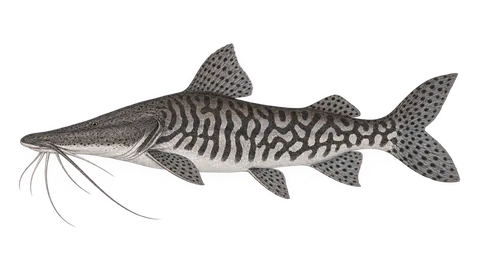
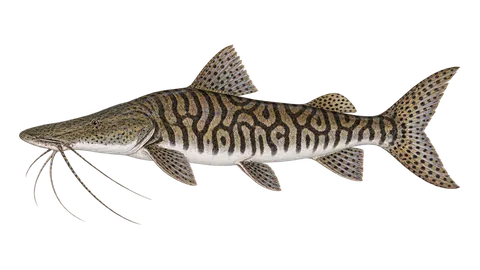
Elongated body, large flattened head, long barbels. Dark grey back, white belly and broad, straight, vertical dark bands on the flank, without the loops and net pattern on the nape of other surubim. Pale pectoral fins without spots, dorsal with few or no spots and adipose fin with 6 or 7 large spots. It is the only surubim of the Magdalena basin.

distribution

where found

open on the large map

Does not occur in Brazil. Endemic to the Magdalena basin in Colombia: Magdalena, Cauca and San Jorge rivers and their ciénagas.

Habitat: Channels of large rivers and floodplains; the juveniles spend high water in the ciénagas of the middle and lower Magdalena.

calendar and clock

when to fish

best season

time of yearbest: Aug and Dec–Mar
JanFebSeaAprMayJunJulAugSepOctNovDec

It makes two migrations a year, in low-water periods, when fish concentrate in the channel. Spawning peaks in high water, from April to June and in September-October, when the closed season applies.

best time of day

0h6h12h18h sunrise ~6amsunset ~6pm

Night and twilight. Hunts more at night and at dusk; by day it stays on the channel bottom.

weather, water and behavior

what affects the surubim-do-magdalena
sensitivity The little bars show how much each factor affects this species. Five full: it feels it a lot.

cold and cold fronts

Little relevance in the Magdalena.

atmospheric pressure

Little effect on the bottom.

moon

Effect not measured.

rain

A rising river triggers spawning.

water level

Low water concentrates fish in the channel.

noise

Not very sensitive.

wind

Little effect.

depth

Channel bottom, 3 to 12 m.

technique, gear and bait

how to fish

rod
6'6" to 7', heavy action, 30 to 60 lb
spinning / baitcasting reel
baitcasting reel 300 or spinning reel 6000 to 8000
line
braided line 50 to 65 lb
leader
monofilament 80 to 100 lb, 1 m
hook
circle hook 7/0 to 9/0, barbless

natural baits

  • live fish or cut pieces (bocachico, nicuro)

accessories

  • olive sinker 50 to 120 g
  • long-handled pliers
  • luvas

tip from an angler

Barbless circle hook and a short fight. Don't take a big fish out of the water: photo with it in the water and release it facing the current.

what the law says

rules for the surubim-do-magdalena

Summary of the regulations we found, with the source for each. Rules change; before keeping or transporting fish, check with the state environmental agency.
Conservation: In Colombia, the Libro Rojo de peces dulceacuícolas (2012) classifies it as Critically Endangered (CR): catches fell more than 90% in 30 years and average size dropped from 92 cm (1973) to 42 cm (2010) in Mompox. Release it.

Colombia: minimum size of 80 cm

80 cm standard length (60 cm without head)

In the Magdalena, Cauca and San Jorge basin, bagre rayado may only be kept at 80 cm standard length with head (60 cm without head). Studies cited in the Libro Rojo show that most fish caught today fall below this size.

Source: Resolución INDERENA nº 430/1982 (AUNAP minimum size table in force)

catch and release
catch and release Releasing the fish alive, quickly and with a wet hand. During a closed season it isn't always allowed: what the regulation says applies.

Release it: the species is critically endangered in Colombia. Use a barbless circle hook, don't hang it by the mouth, support the body in the water and revive it facing the current until it swims off on its own.

in the kitchen

It was the most prized fish of the Magdalena. Given the species' condition, in sport fishing it is better to release it.

calculator

how much it weighs without taking it out of the water

Length-weight relationship W = a·Lb (a = 0.00407, b = 3.14; FishBase). It's an average: a fat or lean fish can vary by 10% to 20%.

estimated weight

—

sources and references

The season weights (months), the time of day and the sensitivities (cold, pressure, moon, wind, rain, tide, strong light, murky water and noise) are the app's editorial estimates, based on the literature below and on the field experience of anglers and guides. They are not official data nor a measurement made for this species, and they may vary by region and year. Closed seasons and legal rules appear in the rules section, with the norm and a link.

  1. scientific FishBase — Pseudoplatystoma magdaleniatum (ficha da espécie)Diagnosis (straight bands, adipose fin with 6 to 7 spots), distribution, length-weight relationship and country list. Page checked on Oct 13, 2026.
  2. scientific IUCN Red List — Pseudoplatystoma magdaleniatum (avaliação global: Em Perigo, EN, 10/10/2014)Global assessment. Link given on the FishBase entry (Red List, version 2025-2).
  3. scientific Buitrago-Suárez, U. A.; Burr, B. M. (2007). Taxonomy of the catfish genus Pseudoplatystoma Bleeker (Siluriformes: Pimelodidae) with recognition of eight species. Zootaxa 1512: 1-38.Description of the species, formerly treated as P. fasciatum. DOI checked on Crossref.
  4. official Mojica, J. I.; Usma, J. S.; Álvarez-León, R.; Lasso, C. A. (eds.) (2012). Libro rojo de peces dulceacuícolas de Colombia 2012. Instituto Humboldt, Universidad Nacional de Colombia, WWF Colombia e Universidad de Manizales.Species profile of P. magdaleniatum: national category CR (A1d), size up to 1.5 m and 70 kg, drop in catches, maturity, spawning peaks and management measures. Page checked on Oct 13, 2026.
  5. official AUNAP — Normatividad tallas mínimas vigentesBagre rayado of the Magdalena: 80 cm with head (60 cm without head), Resolución INDERENA 430/1982. Page checked on Oct 13, 2026.
  6. official AUNAP — Vedas vigentes (Colômbia)Closed season May 1 to 30 and September 15 to October 15 in the Magdalena basin (Acuerdo 009/1996 and Resolución 0242/1996). The table is from 2021; confirm it is still in force with AUNAP before the trip. Page checked on Oct 13, 2026.
don't confuse

similar species