


the right time
to be on the water
Choose the place and the species. The index, from 0 to 100, combines weather, sun, moon and tide with each fish's habits. Up to 28 days, with each day's confidence.
Loading the forecast…
—
hour by hour
slide your finger or mouse over the chart to see each hoursee hour-by-hour table
why this index at —?
choose the day
the fishing month at a glance
what's the best window for the crew?
Choose how many fishing days. We compare each stretch by its average index, discount days with a warning or closed season, and show the 3 best.
trend for the coming weeks
Line: the middle value of 31 simulations of the American GEFS model. Band: where 8 out of 10 fall. Narrow, firm trend; wide, high uncertainty.
everything about the great white shark
how to recognize it
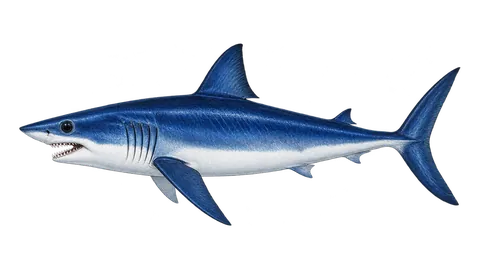
A huge, spindle-shaped shark with a conical, blunt snout, clearly visible black eyes and a large mouth with triangular, serrated-edged teeth. Lead grey to brown or black on top, lighter on the flanks and white below, with a sharp boundary between the two colors; a black patch at the rear base of the pectoral fin. The first dorsal fin usually starts above the inner edge of the pectoral, and the tail is crescent-shaped. The mako (Isurus oxyrinchus) is slimmer, with a long, pointed snout and thin, smooth teeth; the porbeagle (Lamna nasus) is much smaller and has a white patch on the tip of the first dorsal fin.
Also called: tubarão-branco
don't confuse with:
where found
open on the large mapWhere to look: Continental shelf and islands, often near the surf zone and in shallow bays, and also open sea; 0 to 250 m most of the time.
Worldwide, from cold to tropical waters. In the southwestern Atlantic FishBase lists Brazil, Uruguay and Argentina; records in Brazil are scattered and we did not check them region by region, so all coasts are shown. In the eastern Pacific, the FishBase country list includes Mexico, Colombia, Ecuador, Peru and Chile.
coast
when to fish
best season
Estimate: in Brazil the presence is rare and unpredictable, with no known season. Capture is banned at any time of year.
best time of day
Any time. No study of daily timing for Brazil in the sources checked. Hunts by day and by night, with no known peak hour (estimate).
what affects the great white shark
cold and cold fronts
Tolerates 5 to 25 °C (FishBase), one of the widest ranges among fish.
atmospheric pressure
Little known effect.
moon
No study for Brazil.
rain
Little known effect.
water level
Not applicable at sea.
noise
No study for Brazil.
wind
Little direct effect.
tide
Enters shallow bays and areas near the surf, where the tide moves its prey (estimate).
depth
From the surface to 250 m most of the time.
how to fish
tip from an angler
Capture banned in Brazil. If a white shark bites by accident, do not try to bring it aboard or touch it: keep it in the water, cut the line as close to the mouth as possible and move away from the line.
- rod
- Catch banned: not applicable.
- spinning / baitcasting reel
- not applicable
- line
- not applicable
- leader
- not applicable
- hook
- not applicable
accessories
- cutting pliers for steel cable
- long hook remover
- thick gloves
catch and release
If it bites by accident, do not bring it aboard or touch it: the animal is large and dangerous. Leave it in the water, cut the line flush with the mouth and move the boat away; do not try to remove the hook. Never swim or dive near a hooked white shark.
rules for the great white shark
Rules change; before keeping or transporting fish, check with the state environmental agency.
Threatened species in Brazil: catch banned
full protection details
The national list (Portaria GM/MMA nº 1.667/2026) classifies the species as VU. Under Portaria GM/MMA nº 1.666/2026 (art. 3º), VU, EN and CR species have full protection: catch, transport, storage, processing and sale are banned. If you hook one by accident, release it at once, handling it as little as possible.
Source: Portaria GM/MMA nº 1.666/2026, art. 3º, and Portaria GM/MMA nº 1.667/2026
Mexico: capture and retention banned (white shark)
catch and retention prohibited; return to the water if caught by chance details
NOM-029-PESC-2006 (responsible fishing of sharks and rays) prohibits, in any case, catching and retaining the white shark (Carcharodon carcharias), sawfishes (Pristis perotteti, P. pectinata and P. microdon), whale shark, basking shark and giant mantas. A specimen caught by chance must go back into the water; it may not be retained alive, dead, whole or in parts, nor eaten or sold (section 4.2.2). The text is addressed to holders of shark and ray fishing permits and to those who catch them incidentally (section 1.2); sport fishing has its own rule, NOM-017-PESC-1994. When in doubt, release it.
Chile: white shark protected (killing or keeping it is banned)
catching it so that it dies and keeping it alive are banned; trade and transport too details
Decree nº 81 of 13/03/2009 (Subsecretaría de Pesca) permanently bans, in all waters under Chilean jurisdiction, catching whale shark, white shark and basking shark with fatal results and keeping them alive, and bans trading, transporting, processing and storing these species, alive or dead, whole or in parts (art. 1). Art. 2 allows catching the white shark only in cases of serious and imminent risk to people's lives and safety. The text does not expressly ban catch followed by release, but do not seek out the species.
Colombia: marine sharks and rays are not fishery resources
commercial or sport extraction not permitted (according to the decree's recitals)confirm with the agency details
In 2021 Colombia stopped treating marine sharks and rays as fishery resources (AUNAP Resolution 0380/2021) and began treating them as hydrobiological resources; the recitals of Decree 281/2021 say they may not be extracted for commercial or sport purposes, and the decree creates an environmental protection plan and sets who enforces it. The articles include no list of species or sizes, and we did not check later AUNAP rules on incidental catch. When in doubt, release it in the water.
Ecuador: targeted shark fishing banned
fishing whose specific target is shark is bannedconfirm with the agency details
Executive Decree nº 486 of 20/07/2007 bans, throughout the national territory, fishing whose specific target is shark (art. 2) and finning (art. 5). Art. 9 requires that the white shark, whale shark, basking shark, sardinero shark and mielga (spurdog) be returned immediately to the sea when caught as bycatch, but art. 17 limited that article to six months in force, and we did not check whether it was reissued or changed later. Confirm with Ecuador's fisheries authority.
Source: Decreto Ejecutivo nº 486, of Jul 20, 2007, arts. 2º, 5º, 9º and 17 (Presidency of Ecuador)
Argentina: directed fishing for sharks and rays banned for the federal fleet; incidental sharks returned to the sea
directed fishing for chondrichthyans banned; return live sharks without gaff; finning bannedconfirm with the agency details
Federal Fisheries Council Resolution 8/2021 (Consejo Federal Pesquero) bans directed fishing for chondrichthyans (sharks, rays and chimaeras), finning (cutting off the fins and discarding the body) and the use of gaffs to return live animals to the sea, and requires that sharks caught by chance be returned quickly and with minimal trauma, except cazón, gatuzo, pez ángel, espinoso and pintarroja. The text refers to trips and vessels, that is, the federal commercial fleet, and invites the provinces to adopt similar measures. For sport anglers, good practice is to release the shark in the water, without a gaff.
Conservation: Capture banned throughout Brazil. It was already on the previous list (Portaria MMA 148/2022) as VU. Global assessment: Vulnerable (IUCN, 07/11/2018). Listed in Appendix II of CITES and Appendices I and II of CMS (according to FishBase).
how much it weighs without taking it out of the water
estimated weight
—
how we calculate
Length-weight relationship W = a·Lb (a = 0.00871, b = 3.05; FishBase (relação peso-comprimento bayesiana, estimativa da própria espécie)). It's an average: a fat or lean fish can vary by 10% to 20%.
more about the great white shark
The white shark has a worldwide distribution and is one of the fish with the widest habitat range. It lives mostly on the continental shelf and around islands, often near the surf zone and inside shallow bays, but also crosses ocean areas. It is usually solitary or in pairs, and may gather with others in feeding areas. It eats bony fish, sharks, rays, seals, dolphins, seabirds, squid and carrion. It is ovoviviparous, with oophagy: the embryos eat eggs produced by the mother, and 7 to 14 pups of 120 to 150 cm are born. In the southwestern Atlantic it occurs from Brazil to Argentina and Uruguay, and in Brazil records are scattered. It is on the national list as Vulnerable (as it already was in 2022), is Vulnerable according to the IUCN, and is listed in Appendix II of CITES and in Appendices I and II of CMS. Capture is banned in Brazil, Mexico and Chile: if you hook one by accident, release it and move away.
Family: Lamnidae · predator
fun facts
- The pups are born at 120 to 150 cm, and the embryos feed on eggs the mother produces for them (oophagy).
- Like the other lamnids, it retains metabolic heat in its body and is warmer than the surrounding water (regional endothermy), according to the ICCAT manual on the porbeagle.
- FishBase gives 640 cm total length as the maximum, but notes that the maximum size is highly speculative.
- Teeth and jaws become ornaments, and the fins go into shark-fin soup, according to FishBase.
in the kitchen
Capture and trade banned in Brazil. FishBase records use of the meat (fresh, salted and dried or smoked), the skin, the liver and the fins. Do not buy.
similar species


sources and references (14)
The season factors (months), the time of day, and the sensitivities (cold, pressure, moon, wind, rain, tide, strong light, murky water, and noise) are editorial estimates by the app, based on the literature cited below and on field experience of anglers and guides. They are not official data or measurements made for this species and may vary by region and year. Closed seasons and legal rules appear in the rules section, with the standard and link. The months indicate when the species is usually found near the coast or at the fishing spot, not a catch season. The water temperature range is also an editorial estimate, supported by FishBase values where they exist.
- scientific FishBase: Carcharodon carcharias (ficha da espécie)Size, length-weight, depth, habitat, distribution, biology and IUCN status. Page checked on 13/10/2026. The maximum weight was left blank: FishBase does not publish a weight for the species (the base record had 0).
- scientific FishBase: nomes populares de Carcharodon carchariasNames by country and language.
- official Portaria GM/MMA nº 1.667, de 27 de abril de 2026: Lista Nacional Oficial de Espécies da Fauna Ameaçadas de Extinção (peixes e invertebrados aquáticos)The species is on the list. Checked in the DOU of April 28, 2026.
- official Portaria GM/MMA nº 1.666, de 27 de abril de 2026: regras de proteção das espécies ameaçadas da lista nacionalArt. 3: VU, EN, and CR species are fully protected (catching, transporting, holding, and trading banned); § 4: an animal caught by chance must be released alive on the spot; art. 12: for species that enter the list for the first time, the bans apply 180 days after publication. Checked in the DOU of Apr 28, 2026.
- official Portaria MMA nº 148, de 7 de junho de 2022: anexos da lista de espécies ameaçadas (versão anterior)Previous list, used here only to compare the species' category. Checked in the text published in the DOU.
- official Fiperj: Peixes cartilaginosos marinhos ameaçados de extinção (Portarias GM/MMA 1.666 e 1.667/2026), atualizado em 11/05/2026Poster from Rio de Janeiro's fisheries agency with the common names and the categories of the 2026 list. Checked on Oct 13, 2026.
- scientific IUCN Red List: Carcharodon carcharias (avaliação global: Vulnerável, VU, 07/11/2018)Global assessment. Link given in the FishBase profile (IUCN Red List, version 2025-2); the assessment page was not opened.
- scientific Compagno, L. J. V. (2001). Sharks of the world. Vol. 2. Bullhead, mackerel and carpet sharks (Heterodontiformes, Lamniformes and Orectolobiformes). FAO Species Catalogue for Fishery Purposes nº 1, vol. 2. Roma: FAO.FAO online edition; the title page gives 2002 as the edition date.
- official México: NOM-029-PESC-2006, Pesca responsable de tiburones y rayas. Especificaciones para su aprovechamiento (DOF de 14/02/2007)Copy of the text published in the DOF, in the Secretaría de Economía's catalog of norms; items 1.2 and 4.2.2 and Appendix A checked on Oct 13, 2026. We did not check whether it was later amended.
- official Chile: Decreto nº 81, de 13/03/2009, que proíbe a captura de tubarão-baleia, tubarão-branco e tubarão-peregrino (Diário Oficial nº 39.407, de 09/07/2009)Official gazette text checked on 13/10/2026 (arts. 1 to 4).
- official Colômbia: Decreto 281 de 2021 (proteção e conservação de tubarões, raias marinhas e quimeras), Gestor Normativo da Função PúblicaText checked 13/10/2026. Later AUNAP changes on incidental catch were not checked.
- official Equador: Decreto Executivo nº 486, de 20/07/2007 (pesca incidental de tiburón, comercialização e exportação)Text checked on 13/10/2026. Art. 17 limits the validity of arts. 6 to 9 and 11 to six months; later amendments were not checked.
- official Argentina: Resolução CFP nº 8/2021 (medidas de manejo de condrictios), Consejo Federal PesqueroText checked on Oct 13, 2026 (Annex I, arts. 1, 6, 7, 8 and 12).
- scientific ICCAT Manual, cap. 2.2.1.3: Porbeagle (Lamna nasus). Forselledo, R.; Domingo, A.; Mas, F.; Miller, P. (atualizado em agosto de 2022).Used only for the regional endothermy of lamnids. Checked on 13/10/2026.
how we calculatewhere each number comes from
The weather comes from three independent global models, cross-checked hour by hour: when they agree, confidence goes up; when they diverge, the band between them shows on the chart. Beyond 16 days, we use the GEFS ensemble of 31 simulations: if 20 of the 31 predict rain, the chance of rain is 65%. Sun and moon are calculated astronomically, with no uncertainty.
The index adds up, weighted for each species: time of day (species curve anchored to real sunrise and sunset), moon (transits, rise and set, phase), pressure (3 h trend and 24 h swing), water temperature (in rivers, estimated from air temperature; at sea, estimated by an ocean model), wind, rain, clouds, tide and the month in the species' cycle.
sources for this lookup
how accurate the forecast is
Accuracy measured in the reference project (4 regions, 93 days, forecast vs. observed): maximum temperature is off by 0.6 °C on average the next day and 1.7 °C at 7 days; rain of 5 mm or more is detected 76% of the time the next day and 57% at 7 days. Detection isn't everything: the false alarm rate isn't published here yet, and 93 days in 4 regions is still a small sample. We now also measure every day, at the app's destinations: