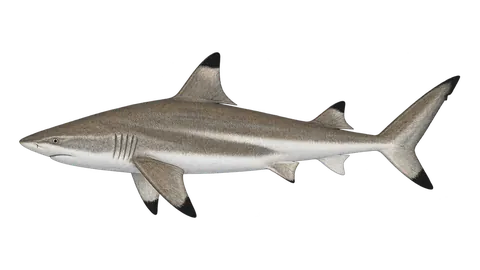
Threatened species (CR): capture banned in Brazil from the end of October 2026
full protection: capture, transport, storage, keeping and trade banned (from the end of October 2026)
The national list (Portaria GM/MMA nº 1.667/2026) classifies the silky shark (lombo-preto, Carcharhinus falciformis) as CR, and the species was added to the list only in 2026. Under Portaria GM/MMA nº 1.666/2026 (art. 3), species listed as VU, EN and CR have full protection: capture, transport, storage, keeping, processing and sale are banned. As it was not on the previous list, the deadline in art. 12 applies: the bans take effect 180 days after publication (28/04/2026), that is, around 25/10/2026 (Fiperj, the fisheries agency of Rio de Janeiro, gives 27/10/2026). Incidental capture with immediate release of the live animal is outside the ban (art. 3, § 4). The rule does not authorize targeted fishing, not even with release: in Brazil, do not seek out this species. If you hook one by accident, release it right away, with minimal handling.
Source: Portaria GM/MMA nº 1.667/2026 (list) and Portaria GM/MMA nº 1.666/2026, arts. 3º and 12 (Ministry of Environment and Climate Change)
Silky shark (lombo-preto): fishing already banned since 2014 (IN Interministerial 8/2014)
targeted fishing, retention, landing, transport and trade bannedconfirm with the agency
Interministerial Normative Instruction MPA/MMA nº 8, of 6/11/2014, bans targeted fishing, retention on board, transshipment, landing, storage, transport and sale of the silky shark (Carcharhinus falciformis) in Brazilian waters. In incidental capture the animal must be returned whole to the sea. The ICMBio text links the rule to surface horizontal longline fisheries; we did not check whether it was changed later. For anglers, the full protection of the 2026 ordinances applies in any case.
Source: Instrução Normativa Interministerial MPA/MMA nº 8, of Nov 6, 2014, art. 1º (Ministry of Fisheries and Aquaculture and Ministry of Environment)
Finning banned: sharks and rays only whole, with their fins
fins naturally attached to the body
In Brazil, finning is banned: catching sharks and rays and keeping only the fins, discarding the body (art. 3). Sharks and rays landed must arrive with all fins naturally attached to the body; carrying an animal aboard without fins or with loose fins, and transferring sharks and rays between fishing vessels, is prohibited. This applies to any species that may be retained.
Source: Instrução Normativa Interministerial MPA/MMA nº 14, of Nov 26, 2012, arts. 2º and 3º (Ministry of Fisheries and Aquaculture and Ministry of Environment)
Mexico: no more than 1 shark per angler per day
1 specimen per angler per day (counts as 5 against the quota of 10)
In recreational sport fishing in Mexican marine waters, the limit for sharks is one fish per angler per day, which counts as five toward the total limit of ten fish (item 4.9.1 b). Fish over the limit must be returned alive to the water (item 4.9.5), and recreational catch may not be sold (item 4.11). Fish that are released do not count toward the limit: prefer to release it.
Source: NOM-017-PESC-1994 (recreational sport fishing), amendment published in the DOF, items 4.9.1 b, 4.9.5 and 4.11 (Sagarpa/Conapesca)
Colombia: marine sharks and rays are not fishery resources
commercial or sport extraction not permittedconfirm with the agency
In 2021 Colombia stopped treating marine sharks and rays as fishery resources and began treating them as hydrobiological resources. The recitals of Decree 281/2021 state that they may not be extracted for commercial or sport purposes, and the decree created an environmental protection plan. Later AUNAP rules addressed incidental catch in artisanal fishing; we did not check the consolidated text. When in doubt, release them into the water.
Source: Decreto nº 281, of Mar 18, 2021 (Ministry of Environment and Sustainable Development), which adds Section 27 to Decree 1076/2015; Resolución AUNAP nº 0380/2021
Panama: sharks and rays may not be caught in recreational fishing
catch, retention, and landing banned (from about Dec 10, 2026)
Executive Decree 9/2026 (art. 19) bans, throughout the national territory and in sport, recreational, or tourism fishing, the catch, retention, handling for recreational purposes, use, and landing of sharks and rays (subclass Elasmobranchii). If one is hooked by accident, it must be released immediately, without taking it fully out of the water and without unnecessary handling. It is also prohibited to promote them as targets in tournaments (art. 19) and to sell the catch (art. 20). The decree takes effect six months after its promulgation on June 10, 2026 (art. 40), around Dec 10, 2026, and repeals Resuelto ADM/ARAP 002/2012 (art. 39). Confirm the date with ARAP.
Source: Decreto Ejecutivo nº 9, of Jun 10, 2026, arts. 19, 20, 39 and 40 (Ministry of Agricultural Development / Panama Aquatic Resources Authority, Gaceta Oficial nº 30543-E)
Bahamas: sharks protected since 2011, release them all
shark fishing not permitted; a shark hooked must be released unharmedconfirm with the agency
The official fishing guide of the Bahamas states that shark fishing is not allowed, that sharks have been protected since a 2011 amendment, that they may only be taken under special permits for very specific purposes, and that a shark hooked in any fishing must be released unharmed. The page does not cite the number of the rule.
Source: Ministry of Tourism, Investments & Aviation of the Bahamas, Fishing Regulations & FAQ (reference to the 2011 amendment to the Fisheries Resources (Jurisdiction and Conservation) Act)
Costa Rica: Isla del Coco National Park is a shark sanctuary and bans fishing
fishing banned in Isla del Coco National Park
Executive Decree 43477-MINAE (20/04/2022) designated the marine protected area of Isla del Coco National Park as a Shark Natural Sanctuary. The considerations recall that fishing is already banned in the park (National Parks Service Law 6084 and Decree 37023-MINAE) and list the whitetip reef shark, the silky shark and the silvertip shark among the park's 15 sharks. Outside the park, check the INCOPESCA rules.
Source: Decreto Ejecutivo nº 43477-MINAE, of Apr 20, 2022 (President of the Republic and Minister of Environment and Energy), arts. 1º to 4º and considerations XI, XII and XV
Costa Rica: silky shark is on the SINAC list of threatened species
catching a marine species declared threatened is a crime (1 to 3 years in prison, according to the press)confirm with the agency
Resolution R-SINAC-CONAC-008-2021 (La Gaceta nº 93, of 17/05/2021) establishes the official list of species in danger and with reduced or threatened populations. According to the Costa Rican press, the list includes the silky shark (Carcharhinus falciformis), and art. 140 of the Fisheries and Aquaculture Law provides for 1 to 3 years in prison for anyone who catches, transfers or trades a marine species declared threatened. We did not check the text of the list or of the article; when in doubt, release the shark in the water.
Source: Resolución R-SINAC-CONAC-008-2021 (National Council of Conservation Areas), cited in Decreto Ejecutivo 43477-MINAE; art. 140 of the Ley de Pesca y Acuicultura, per Semanario Universidad