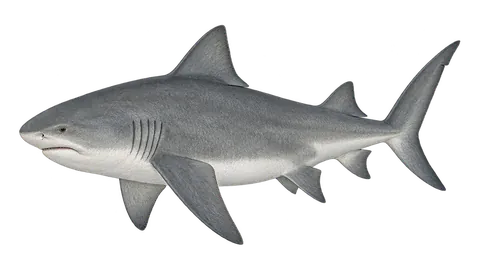
Threatened species in Brazil: catch banned
full protection
The national list (Portaria GM/MMA nº 1.667/2026) classifies the species as CR. Under Portaria GM/MMA nº 1.666/2026 (art. 3), VU, EN and CR species have full protection: catch, transport, storage, processing and trade are banned. If you hook one by accident, release it right away, with minimal handling.
Source: Portaria GM/MMA nº 1.666/2026, art. 3º, and Portaria GM/MMA nº 1.667/2026
Finning prohibited: shark only whole, with its fins
fins naturally attached to the body
In Brazil, finning is banned: cutting off the fins and discarding the rest of the body. The rule covers landing, transport, and trade by fishing vessels: every shark or ray must arrive whole, with its fins naturally attached to the body (partially folding them against the body is allowed); carrying an animal aboard without fins or with loose fins, and transferring sharks and rays between vessels, is prohibited. This does not authorize catching this species, which is banned.
Source: Instrução Normativa Interministerial MPA/MMA nº 14, of Nov 26, 2012, art. 3º (Ministry of Fisheries and Aquaculture and Ministry of Environment)
ICCAT (Rec. 10-07): retaining on board, transshipping, landing or selling the oceanic whitetip shark (Carcharhinus longimanus) is prohibited
retaining, landing, storing and selling the species, whole or in parts, is prohibitedconfirm with the agency
ICCAT Recommendation 10-07 requires member countries to prohibit, in any fishery, retaining on board, transshipping, landing, storing, selling or offering for sale the oceanic whitetip shark (Carcharhinus longimanus), whole or in parts. It is an obligation for countries, not a rule for the angler: how each country applies it to recreational fishing varies, and we did not check each country's domestic rules or the current ICCAT compendium. When in doubt, release it in the water.
Source: ICCAT Recommendation 10-07 (International Commission for the Conservation of Atlantic Tunas)
Puerto Rico (USA): retention of the oceanic whitetip shark banned for HMS license holders
retention banned; release alive
In NOAA Fisheries' compliance guide for recreational Atlantic highly migratory species (HMS) fishing, the oceanic whitetip shark is on the prohibited retention list: it must be released. Since 2 February 2024 it has been illegal to possess or retain the oceanic whitetip in the US exclusive economic zone. The rule applies to HMS license holders wherever they fish, and includes the US Caribbean. The guide says to release any shark with an interdorsal ridge when identification is in doubt. Confirm Puerto Rico's local rules with the competent agency.
Source: NOAA Fisheries, HMS Compliance Guide: Recreational Fishing (published August 2025), section VIII, 'Prohibited retention' list; 50 CFR part 635
Mexico: no more than 1 shark per angler per day
1 specimen per angler per day (counts as 5 against the quota of 10)
In recreational sport fishing in Mexican saltwaters, the limit for sharks is one specimen per angler per day, which counts as five toward the total limit of ten fish. Fish caught in sport fishing may not be sold. Catch and release does not count toward the limit: prefer releasing.
Source: NOM-017-PESC-1994 (recreational sport fishing), amendment published in the DOF, items 4.9.1 b, 4.9.5 and 4.11 (Sagarpa/Conapesca)
Colombia: marine sharks and rays are not fishery resources
commercial or sport extraction not permittedconfirm with the agency
In 2021 Colombia stopped considering sharks and marine rays a fishery resource and began treating them as a hydrobiological resource; the recitals of Decree 281/2021 state that they may not be extracted for commercial or sport purposes, and the decree created an environmental protection plan. Later AUNAP rules dealt with incidental catch in artisanal fishing; we did not check the consolidated text. When in doubt, release it into the water.
Source: Decreto nº 281, of Mar 18, 2021 (Ministry of Environment and Sustainable Development), which adds Section 27 to Decree 1076/2015; Resolución AUNAP nº 0380/2021
Argentina: directed fishing for sharks and rays banned for the federal fleet; incidental sharks returned to the sea
directed fishing for chondrichthyans banned; return live sharks without gaff; finning bannedconfirm with the agency
Federal Fisheries Council Resolution 8/2021 (Consejo Federal Pesquero) bans directed fishing for chondrichthyans (sharks, rays and chimaeras), finning (cutting off the fins and discarding the body) and the use of gaffs to return live animals to the sea, and requires that sharks caught by chance be returned quickly and with minimal trauma, except cazón, gatuzo, pez ángel, espinoso and pintarroja. The text refers to trips and vessels, that is, the federal commercial fleet, and invites the provinces to adopt similar measures; we did not find a specific rule for sport fishing in Buenos Aires. For sport anglers, good practice is to release the shark in the water, without a gaff.
Source: Resolución CFP nº 8/2021, of Jun 3, 2021, Annex I, arts. 1º, 6º, 7º, 8º and 12 (Federal Fisheries Council, B.O. Jun 11, 2021)
Panama: shark finning banned in its jurisdictional waters
banned: cutting off the fins and throwing the body back into the sea
Law 9 of 2006 bans finning in Panama's jurisdictional waters. The law's definition of shark fishing covers directed or incidental catch by artisanal, commercial, industrial and sport vessels. The fine for artisanal fishing reaches 1,000 balboas, without prejudice to criminal liability. In the sources we checked, we did not find a specific Panamanian rule on retention or release for sport anglers.
Source: Ley nº 9, of Mar 16, 2006 (National Assembly of Panama), Gaceta Oficial nº 25.506, of Mar 20, 2006, arts. 1º, 2º and 13