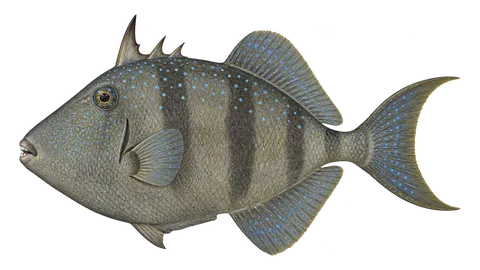
smooth puffer
Lagocephalus laevigatus
The smooth puffer (baiacu-arara), the largest puffer on the coast, with smooth skin and a beak that cuts line and bait. It may contain tetrodotoxin, a poison that is not destroyed by cooking: do not eat it.
Also called: baiacu-arara, baiacu-ará, baiacu-guará, baiacu-liso, baiacu-branco, peixe-coelho

- common size
- 40–60 cm
- maximum
- 100 cm
- common weight
- 0.8–2.5 kg
- record/max.
- 4.9 kg
- depth
- 3–80 m
- ideal water
- 22–28 °C
who is the smooth puffer
The smooth puffer (baiacu-arara) is a large tetraodontid, reaching 1 m and almost 5 kg, on both sides of the Atlantic; on the American side it ranges from New England to Argentina. It lives on the coast and near it, over sand and mud, alone or in loose groups; juveniles stay on coastal banks. It eats fish and shrimp, and its beak of fused teeth cuts line, fine hooks and bait easily, which is why it is considered a pest in bottom fishing. Like other puffers, it can accumulate tetrodotoxin, especially in the skin and viscera. The toxin acts on the nervous system, is not destroyed by cooking, frying, salting or freezing, and has no antidote. FishBase classifies it as poisonous and recommends not eating it.
fun facts
- It inflates by swallowing water, which greatly increases the body's volume and makes it hard for predators to swallow.
- The four fused teeth forming a beak give the name to the puffer order, Tetraodontiformes ("four teeth").
identification
Elongated, rounded body with smooth skin and small spines only on the belly; grayish green to bluish back, silvery flanks and white belly. Inflates with water or air when threatened. Beak with four strong teeth, two above and two below. Small dorsal and anal fins set far back, without spines; tail concave to crescent-shaped, which separates it from the smaller spotted puffers (genus Sphoeroides), which have straight or rounded tails.
Loading the next 7 days…
Each card shows the day's index (0 to 100) and, below it, a strip with the index for each hour, from 0h to 23h. from poor to excellent.
where found
All of the Brazilian coast. In the western Atlantic, from New England to Argentina, including the Gulf of Mexico and the Caribbean; also on the west coast of Africa.
Habitat: Coastal strip and shelf of sand and mud, bays, channels and estuary mouths; adults also in midwater.
coast
states
Amapá, Pará, Maranhão, Piauí, Ceará, Rio Grande do Norte, Paraíba, Pernambuco, Alagoas, Sergipe, Bahia, Espírito Santo, Rio de Janeiro, São Paulo, Paraná, Santa Catarina, Rio Grande do Sul
when to fish
best season
Present all year; in the Southeast and South it is more common close to shore in the warm-water months.
best time of day
Daytime. Active by day, around schools and fishing scraps; it shows up often when there is bait on the bottom.
what affects the smooth puffer
sensitivity The little bars show how much each factor affects this species. Five full: it feels it a lot.
cold and cold fronts
Cold water pushes it away from the coast in the South.
atmospheric pressure
Not very sensitive.
moon
Little effect.
rain
Little effect.
water level
Not applicable at sea.
noise
Not very sensitive; it is attracted by the movement of other hooked fish.
wind
Little effect.
tide
Tidal movement spreads the bait scent and attracts the puffers.
depth
3 to 40 m for most catches.
how to fish
- rod
- 6'0" to 7'0", 15 to 30 lb
- spinning / baitcasting reel
- 3000 to 5000 spinning reel
- line
- braid 20 to 30 lb
- leader
- thin steel leader or heavy monofilament (0.70 mm or more): the beak cuts line
- hook
- circle or long-shank hook 2/0 to 5/0
lures
- spoons and metal jigs (vinyl gets cut on the first bite)
natural baits
- sardinha
- lula
- shrimp
accessories
- long-nose pliers
- luvas
- damp cloth
tip from an angler
If the puffers are cutting every bait, move to another spot: where there are many, other fish can't reach the bait.
rules for the smooth puffer
Summary of the regulations we found, with the source for each. Rules change; before keeping or transporting fish, check with the state environmental agency.
Conservation: Not on the national list (Portaria GM/MMA 1.667/2026). We found no specific Brazilian federal rule on catching or selling the species; the risk is health-related (tetrodotoxin).
We found no species-specific rule beyond the region's general rules.
catch and release
catch and release Releasing the fish alive, quickly and with a wet hand. During a closed season it isn't always allowed: what the regulation says applies.
Never put your finger near the beak: the bite cuts deep. Use long pliers, hold it from the back with a damp cloth and release it quickly. If it has inflated with air, hold it underwater until it releases the air and swims. Do not leave dead puffers on the sand: they are dangerous to pets.
in the kitchen
Do not eat it. Tetrodotoxin can be present in the skin, liver, gonads and sometimes the flesh; it varies from fish to fish and is not destroyed by cooking, frying, salting or freezing. Poisoning can kill within hours through respiratory paralysis and has no antidote: at the first tingling in the mouth after eating fish, seek emergency care.
how much it weighs without taking it out of the water
Length-weight relationship W = a·Lb (a = 0.02138, b = 2.85; FishBase (estimativa bayesiana, comprimento total)). It's an average: a fat or lean fish can vary by 10% to 20%.
estimated weight
—
sources and references
The season weights (months), the time of day and the sensitivities (cold, pressure, moon, wind, rain, tide, strong light, murky water and noise) are the app's editorial estimates, based on the literature below and on the field experience of anglers and guides. They are not official data nor a measurement made for this species, and they may vary by region and year. Closed seasons and legal rules appear in the rules section, with the norm and a link.
- scientific FishBase — Lagocephalus laevigatus (ficha da espécie)Names, distribution, biology, length-weight relationship, country list and references. Page checked on 13/10/2026. Classifies the species as poisonous and recommends not eating it; records that the skin and viscera may be toxic.
- official Portaria GM/MMA nº 1.667, de 27 de abril de 2026 — Lista Nacional Oficial de Espécies da Fauna Ameaçadas de Extinção (peixes e invertebrados aquáticos)Most recent national list. The species is not on it (search by scientific name in the text published in the DOU, checked on October 13, 2026).
- official ICMBio/SALVE — Ficha de Lagocephalus laevigatus (avaliação nacional do risco de extinção)National extinction risk assessment by ICMBio, published in 2025. DOI checked on Crossref.
- scientific IUCN Red List — Lagocephalus laevigatus (avaliação global: Pouco Preocupante, LC, 08/06/2011)Global assessment. Link given on the FishBase entry (Red List, version 2025-2).