Skip to content
catalog Balistidae · predator

rough triggerfish

Canthidermis maculata

Sea

Dark, rough-skinned triggerfish of the open sea, which spends almost its whole life at the surface, near logs, sargassum and other floating objects. It forms schools and takes small bait.

Also called: cangulo-áspero, rough triggerfish

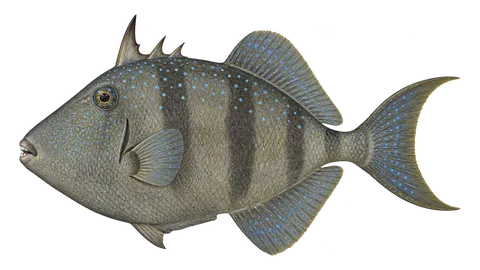
Scientific illustration of Rough triggerfish
common size
28–40 cm
maximum
50 cm
common weight
0.3–0.9 kg
record/max.
— kg
depth
1–110 m
ideal water
24–28 °C
overview

who is the rough triggerfish

The rough triggerfish (cangulo-áspero) is an open-water triggerfish that spends almost its whole life at the surface, alongside floating objects, but also in coastal waters and on deep rocky slopes. It is circumglobal in warm seas, except the Mediterranean. Catches in fixed nets show it forms large schools. It eats zooplankton. It reaches 50 cm; FishBase gives 35 cm as the common size. It is sold fresh, but there are records of ciguatera. For the angler, it is the triggerfish that shows up around buoys, logs and fish-aggregating devices in open water.

fun facts

  • It spends almost its whole life at the surface, often alongside floating objects, unlike most triggerfish, which live near the bottom.
  • The elongated white spots of adults may fade with growth.
  • The English name, rough triggerfish, and the Portuguese name refer to the rough skin.
how to recognize it

identification

Tall-bodied, dark, almost black triggerfish with rough skin to the touch. Head, body and fins of adults are dark; the body has elongated white spots that may fade with growth. Three spines in the first dorsal, 23 to 25 soft rays in the second dorsal and 20 to 22 in the anal. The ocean triggerfish (Canthidermis sufflamen) has a brown blotch at the base of the pectoral fins and a very elongated front on the soft dorsal and anal fins; the rough triggerfish has the elongated white spots.

how rough triggerfish fishing looks

Loading the next 7 days…

Each card shows the day's index (0 to 100) and, below it, a strip with the index for each hour, from 0h to 23h. from poor to excellent.

distribution

where found

open on the large map

Circumglobal in warm seas, except the Mediterranean. According to FishBase, the Latin American country list runs from Mexico and the Caribbean through Central America and the Pacific coast down to Peru, plus Argentina, French Guiana and Suriname. Brazil is not on the list.

Habitat: Shallow coastal waters and open sea, near the surface, almost always alongside logs, sargassum and other floating objects; also deep rocky slopes, from 1 to 110 m.

calendar and clock

when to fish

best season

time of year
JanFebSeaAprMayJunJulAugSepOctNovDec

Present all year in tropical waters; fishing depends more on finding a floating object or attractor than on the season.

best time of day

0h6h12h18h sunrise ~6amsunset ~6pm

Daytime. Active by day, in schools near the surface; at night it disperses and hardly takes bait.

weather, water and behavior

what affects the rough triggerfish
sensitivity The little bars show how much each factor affects this species. Five full: it feels it a lot.

cold and cold fronts

Warm-water fish: it disappears from sargassum patches when the water cools.

atmospheric pressure

Small effect.

moon

Small effect.

rain

Little effect in open sea.

water level

Does not apply at sea. The equivalent is finding a floating object or an attractor buoy.

noise

Small effect.

wind

Rough seas make it hard to stay beside the floating object and see the school.

tide

Little effect in open sea; the current carries the object and the school along together.

depth

Almost always from the surface to about 30 m, beside the floating object.

technique, gear and bait

how to fish

rod
6'6" to 7', fast action, 10 to 25 lb
spinning / baitcasting reel
spinning reel 3000 to 4000
line
braided line 15 to 25 lb
leader
fluorocarbon 30 to 40 lb, 80 cm (teeth cut thin line)
hook
single 1/0 to 2/0, short and with a strong shank

lures

  • small jig of 15 to 40 g
  • silicone bait imitating shrimp

natural baits

  • squid strips
  • shrimp
  • fish pieces

accessories

  • alicate
  • luvas

tip from an angler

Near a buoy or drifting log, cast the small bait to the side and let it sink slowly; it rises in a school and strikes on the first passes.

what the law says

rules for the rough triggerfish

Summary of the regulations we found, with the source for each. Rules change; before keeping or transporting fish, check with the state environmental agency.
Conservation: Outside the Brazilian fauna in the sources consulted, so it is not on the national list (Portaria GM/MMA nº 1.667/2026). Outside Mexico we found no specific rule for the species.

Mexico: up to 5 per species and 10 saltwater fish per day

5 specimens of the species per angler per day, within the limit of 10 saltwater fish

In recreational sport fishing in Mexican federal waters, each angler may keep up to 10 marine fish per day, with a maximum of 5 of the same species. The rough triggerfish is not among the species reserved for sport fishing and has no limit of its own. Anything over the limit goes back alive into the water, and sport-caught fish may not be sold. Anglers fishing from a boat need the recreational fishing permits required by the rule.

Source: Amendment to NOM-017-PESC-1994 (recreational sport fishing in federal waters of Mexico), published in the DOF on Nov 25, 2013, items 4.3, 4.9.1, 4.9.5 and 4.11 (Sagarpa/Conapesca)

catch and release
catch and release Releasing the fish alive, quickly and with a wet hand. During a closed season it isn't always allowed: what the regulation says applies.

Hold it from the side, away from the mouth (the teeth are strong). The first dorsal spine locks upright and only lowers when the second one, the trigger, is pressed. Release it quickly, with its head in the water.

in the kitchen

Fresh flesh is sold. FishBase records ciguatera cases with this species: check with local fishers before eating, and avoid the guts and liver.

calculator

how much it weighs without taking it out of the water

Length-weight relationship W = a·Lb (a = 0.02399, b = 2.87; FishBase (relação peso-comprimento bayesiana, estimativa da própria espécie)). It's an average: a fat or lean fish can vary by 10% to 20%.

estimated weight

—

sources and references

The season weights (months), the time of day and the sensitivities (cold, pressure, moon, wind, rain, tide, strong light, murky water and noise) are the app's editorial estimates, based on the literature below and on the field experience of anglers and guides. They are not official data nor a measurement made for this species, and they may vary by region and year. Closed seasons and legal rules appear in the rules section, with the norm and a link.

  1. scientific FishBase: Canthidermis maculata (ficha da espécie)Size, length-weight, depth, habitat, distribution, biology and IUCN status. Page checked Oct 13, 2026. The common size range is an editorial estimate around the common length of 35 cm reported by FishBase.
  2. scientific FishBase: nomes populares de Canthidermis maculataNames by country and language.
  3. official NOM-017-PESC-1994 (pesca deportivo-recreativa em águas de jurisdição federal do México), modificação publicada no DOF em 25/11/2013 (Sagarpa/Conapesca)Limit of 10 marine fish per angler per day, no more than 5 of the same species (item 4.9.1), return of the excess (4.9.5) and ban on selling sport-caught fish (4.11). Text checked Oct 13, 2026. The rule sets no quota of its own for this species.
don't confuse

similar species