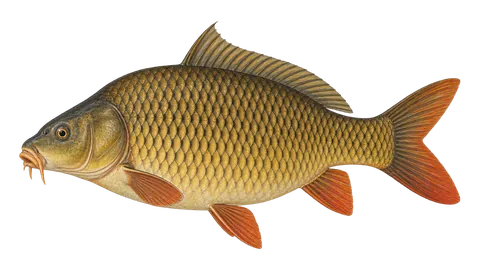
crucian carp
Carassius carassius
Carp native to Eurasia, exotic in Chile, where it was introduced. Reaches 64 cm and is considered a sport fish.
Also called: carpa-cruciana, carpín, crucian carp

- maximum
- 64 cm
- record/max.
- 3.0 kg
who is the crucian carp
Fish of the family Cyprinidae, reaching 64 cm and 3 kg. It is native to Eurasia, in the basins of the North, Baltic, White, Barents, Black and Caspian seas, east to Siberia. It lives in lagoons with dense vegetation and in arms of rivers with slow current, and tolerates low oxygen and cold. It eats plankton, bottom invertebrates, plants and detritus, and feeds all day, but mostly at night. It spawns in dense submerged vegetation, from May to June. It is commercially fished and sold fresh and frozen, and is also used as bait.
Essential profile. Identification, where it occurs and rules, with data from FishBase and the cited regulations. Season, time of day, technique and bait are added once we have a good source for the crucian carp; in the meantime, see the similar species.
fun facts
- Each female lays 130,000 to 250,000 eggs, which stick to plants.
- In the dry season or in winter, it buries itself in the mud and can live up to 10 years.
identification
Freshwater carp with a fusiform body and a golden-greenish color, reaching 64 cm. It has no barbels, which sets it apart from the common carp. The last rays of the dorsal and anal fins are strong and slightly serrated. It is easily confused with Carassius gibelio, a very similar relative, and with the kinguio. It lives in lagoons and river arms with dense vegetation.
Loading the next 7 days…
Each card shows the day's index (0 to 100) and, below it, a strip with the index for each hour, from 0h to 23h. from poor to excellent.
Essential profile: the index uses a general fish model (weather, sun, moon and tide), without a season or time of day specific to this species.
where found
Native to Eurasia, in the basins of the North, Baltic, White, Barents, Black and Caspian seas, east to Siberia. In Chile, where it was introduced, it is exotic.
Habitat: Lagoons and river arms with dense vegetation, slow current, muddy bottom.
rules for the crucian carp
Summary of the regulations we found, with the source for each. Rules change; before keeping or transporting fish, check with the state environmental agency.
We found no species-specific rule beyond the region's general rules.
catch and release
catch and release Releasing the fish alive, quickly and with a wet hand. During a closed season it isn't always allowed: what the regulation says applies.
It has strong, serrated rays in the dorsal and anal fins, so hold it with care. It is considered a pest in some places: do not release it into water where it is not native.
in the kitchen
Sold fresh and frozen, and is usually fried, grilled or baked.
how much it weighs without taking it out of the water
Length-weight relationship W = a·Lb (a = 0.01349, b = 3.04; FishBase (relação peso-comprimento bayesiana, estimativa da própria espécie)). It's an average: a fat or lean fish can vary by 10% to 20%.
estimated weight
—
sources and references
Essential profile: size, length-weight, depth, countries and conservation come from FishBase and the cited regulations, and the texts were written from those sources. Season, time of day, sensitivities, technique and baits and lures are not included yet, because we did not find a good source for this species.
- scientific FishBase: Carassius carassius (ficha da espécie)Size, length-weight, depth, habitat, distribution, biology, and IUCN status. Page checked on Oct 13, 2026.
- scientific FishBase: nomes populares de Carassius carassiusNames by country and language.