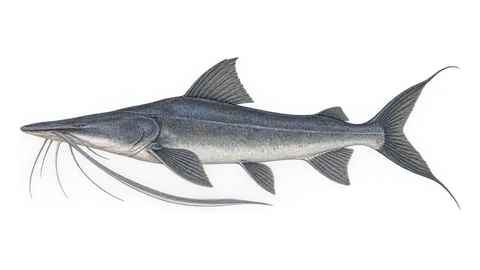
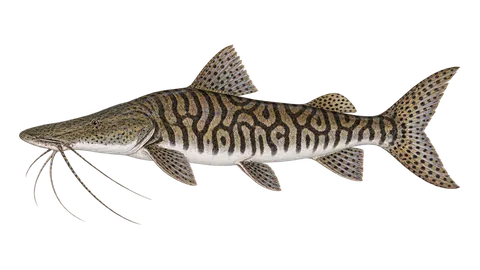
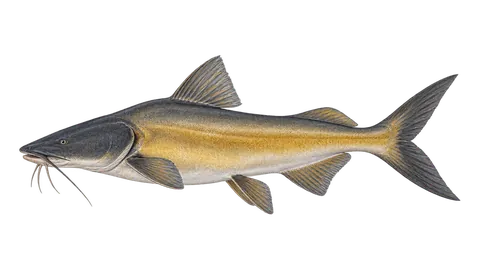
Amazon catfish striped like a zebra, with dark cross bands and a tail with filaments. A handsome channel fish that turns up in bottom fishing with fish bait.
Also called: dourada-zebra, zebra, surubim-flamengo, flamengo
Pimelodid catfish of the same genus as the dourada and piraíba, but much smaller: in Colombia the largest recorded size is 80 cm standard length and 5.7 kg, with average catches between 55 and 63 cm. It lives in the channel and large tributaries of whitewater rivers in the Amazon and Orinoco basins and eats fish. It makes long migrations, including across countries: in the Orinoco it migrates with the babão during the falling water, from October to January, and in the upper Putumayo it spawns in January and February, in the dry season. There are records near the Amazon estuary. In Brazil it is caught occasionally on bottom fishing with fish bait, and is often photographed and released for its beauty. In Colombia it is on the national red list as Vulnerable.
fun facts
In Colombia it has curious names, such as camiseta, manta negra and siete babas.
Portaria MPA nº 532/2025 adopts 'dourada-zebra' as the official trade name of the species.
how to recognize it
identification
Elongated body, flattened head and very small eyes, with 9 to 11 dark transverse bands of similar width over a light yellowish to grey background. Long maxillary barbels reaching the base of the pectoral fin. Adipose fin longer than the anal fin, and forked tail with filament tips. The caparari has spots and bands forming a net, with no filaments on the tail. The name zebra is also used in trade for another species of the genus, B. tigrinum.
how zebra catfish fishing looks
Loading the next 7 days…
Each card shows the day's index (0 to 100) and, below it, a strip with the index for each hour, from 0h to 23h. from poor to excellent.
Channel and large whitewater tributaries of the Amazon basin, from Peru and Colombia to Pará, with records near the estuary; Orinoco basin in Colombia and Venezuela.
Habitat: Main channel of whitewater rivers, pools and banks with current.
native to the basins
Amazon
states
Amazonas, Pará, Acre, Rondônia, Mato Grosso
calendar and clock
when to fish
best season
time of yearbest: Aug–Nov
JanFebSeaAprMayJunJulAugSepOctNovDec
Falling water and drought (July to November) concentrate catfish in the channel; spawning migrations vary from river to river.
best time of day
Night and twilight. More active at night and at dusk; stays on the bottom by day.
weather, water and behavior
what affects the zebra catfish
sensitivity The little bars show how much each factor affects this species. Five full: it feels it a lot.
cold and cold fronts
Cold spells reduce activity for a short time.
atmospheric pressure
Little effect on the bottom.
moon
Effect not measured; many anglers prefer dark nights for catfish.
rain
Little effect; it is a murky-water fish.
water level
With the river falling, fish concentrate in the channel pools.
baitcasting reel 200 to 300 or spinning reel 4000 to 5000
line
braid 30 to 50 lb
leader
monofilament 60 lb, 1 m
hook
circle hook 5/0 to 7/0
natural baits
fish pieces (sardine, piau, curimatã)
whole small fish
accessories
olive sinker 30 to 100 g
alicate
tip from an angler
Fish piece on the bottom, at the drop-off between the channel and the pool. A good-looking fish: have your camera ready and release it quickly.
what the law says
rules for the zebra catfish
Summary of the regulations we found, with the source for each. Rules change; before keeping or transporting fish, check with the state environmental agency. Conservation: Not on the Brazilian national list (Portaria GM/MMA nº 1.667/2026). In Colombia, the Libro Rojo (2012) lists it as Vulnerable (VU), due to low abundance and overfishing.
Colombia (Orinoquía): minimum size of 50 cm
50 cm standard length
In the Orinoco basin, in Colombia, the minimum catch size for apuy or cebra is 50 cm standard length.
piracema closures in the basins where the species lives
Spawning closure (piracema) in Mato Grosso (all basins)
01/10 to 31/01MT
Allowed: All fishing modalities are prohibited in rivers, including catch and release (Law 9.096/2009, art. 19-A). Exceptions: subsistence fishing from shore (3 kg or 1 fish, no transport or sale) and scientific fishing. Law 13.159/2025 now allows licensed sport fishing in UHE/PCH hydropower reservoirs, natural lakes and border rivers, subject to a scientific study and a license from the environmental agency. We have not confirmed whether these licenses are already being issued.
Allowed: Recreational anglers with handline or rod, line and hook are outside the Annex II prohibitions, with a bag limit of 5 kg + 1 fish, unless a stricter state rule applies.
catch and release Releasing the fish alive, quickly and with a wet hand. During a closed season it isn't always allowed: what the regulation says applies.
Support the body horizontally, without hanging it by the mouth. Remove the hook with pliers and release it quickly.
in the kitchen
Light flesh of a skinned fish, sold as catfish in Amazon markets.
calculator
how much it weighs without taking it out of the water
Length-weight relationship W = a·Lb (a = 0.00589, b = 3.1; FishBase). It's an average: a fat or lean fish can vary by 10% to 20%.
estimated weight
—
sources and references
The season weights (months), the time of day and the sensitivities (cold, pressure, moon, wind, rain, tide, strong light, murky water and noise) are the app's editorial estimates, based on the literature below and on the field experience of anglers and guides. They are not official data nor a measurement made for this species, and they may vary by region and year. Closed seasons and legal rules appear in the rules section, with the norm and a link.
scientificFishBase — Brachyplatystoma juruense (ficha da espécie)Names, distribution, length-weight relationship (estimate based on the group's body shape) and country list. FishBase gives 60 cm as maximum length and marks Bolivia, Colombia and Ecuador as possible occurrence; the Colombian Libro Rojo confirms the species in Colombia and records larger fish. Page checked on Oct 13, 2026.