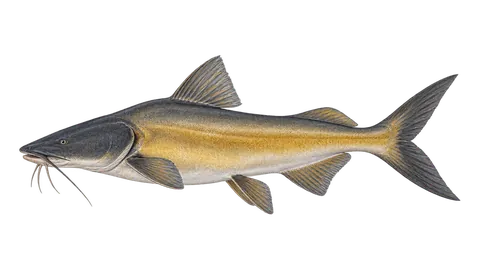
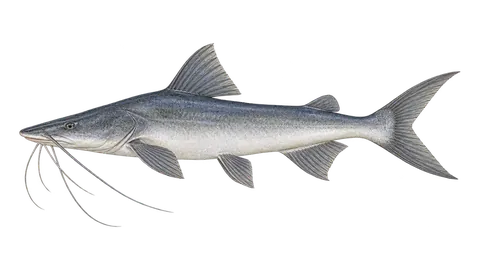
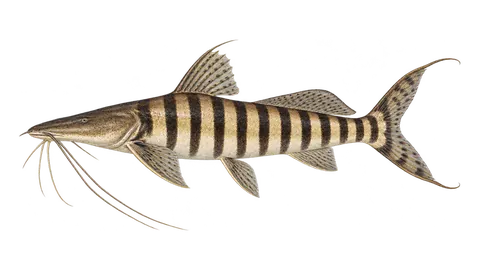
Large migratory catfish of the family Pimelodidae, a relative of the dourada and piramutaba. It lives in the main channel of whitewater rivers in the Amazon and Orinoco basins, in deep water, and makes long upstream migrations to spawn, in the Orinoco during the falling water, from September to January. In Colombia there are records of up to 107 cm standard length (127 cm total), and growth estimates point to fish of 13 to 16 kg. It is a commercial fishery species in the Amazon: according to the Colombian Libro Rojo, almost all the babão landed in Leticia comes from Brazilian waters. In sport fishing it is caught on the bottom, with fish bait, in pools and channel edges. In Colombia it is on the national red list as Vulnerable and has a minimum size.
fun facts
In English, FishBase calls it 'slobbering catfish', the catfish that drools, like its Portuguese and Spanish names babão and baboso.
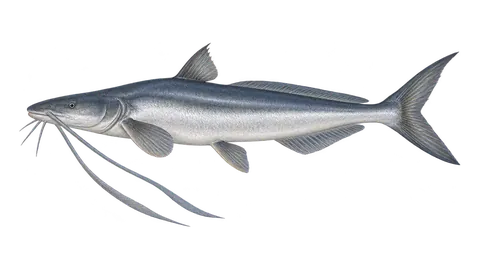
Ribbon-shaped barbels are rare among large Amazon catfish and help identify the species from a distance.
how to recognize it
identification
Flattened head, projecting upper jaw, tiny eyes set far back on the head, and very long, flattened, ribbon-like barbels reaching mid-body. Grey to bluish-grey body, pale belly, forked caudal fin with filament tips. The ribbon barbels tell the babão apart from the dourada and piramutaba; the barbado (Pinirampus), which also has ribbon barbels, is silver and has a very long, low adipose fin, much bigger than the babão's.
how slobbering catfish fishing looks
Loading the next 7 days…
Each card shows the day's index (0 to 100) and, below it, a strip with the index for each hour, from 0h to 23h. from poor to excellent.
Main channel and large whitewater tributaries of the Amazon basin, from Peru and Bolivia to Pará, and the Orinoco basin (Colombia and Venezuela).
Habitat: Main channel of whitewater rivers, deep pools and channel edges with current.
native to the basins
Amazon
states
Amazonas, Pará, Acre, Rondônia, Mato Grosso
calendar and clock
when to fish
best season
time of yearbest: Aug–Nov
JanFebSeaAprMayJunJulAugSepOctNovDec
With the river falling and dry (July to November), catfish concentrate in the channel. Spawning migrations vary by river: in the Orinoco, during the falling water; in the upper Putumayo, in July and August.
best time of day
Night and twilight. Feeds more at night and at dusk; by day it stays on the channel bottom.
weather, water and behavior
what affects the slobbering catfish
sensitivity The little bars show how much each factor affects this species. Five full: it feels it a lot.
cold and cold fronts
Cold spells reduce activity for a short time.
atmospheric pressure
Little effect on the channel bottom.
moon
Catfish anglers prefer dark nights; effect not measured.
rain
Little effect; muddy water is its habitat.
water level
Falling water and drought: fish concentrate in the channel and pools.
baitcasting reel 300 to 400 or spinning reel 6000 to 8000
line
braided line 50 to 80 lb
leader
monofilament 80 to 100 lb, 1 m
hook
circle hook 7/0 to 10/0
natural baits
whole fish or cut pieces (mandi, sardine, curimatã)
accessories
olive sinker 50 to 150 g
alicate
luvas
tip from an angler
Fish bait on the bottom, at the channel edge and at the mouth of the pools. With a circle hook, don't yank: let the line tighten and work the fight unhurried.
what the law says
rules for the slobbering catfish
Summary of the regulations we found, with the source for each. Rules change; before keeping or transporting fish, check with the state environmental agency. Conservation: Not on the Brazilian national list (Portaria GM/MMA nº 1.667/2026). In Colombia, the Libro Rojo de peces dulceacuícolas (2012) lists it as Vulnerable (VU), due to declining catches.
Colombia (Amazon): minimum size of 70 cm
70 cm standard length
In the Colombian Amazon basin (Caquetá and Amazonas), the minimum catch size for babão is 70 cm standard length (tail excluded).
piracema closures in the basins where the species lives
Spawning closure (piracema) in Mato Grosso (all basins)
01/10 to 31/01MT
Allowed: All fishing modalities are prohibited in rivers, including catch and release (Law 9.096/2009, art. 19-A). Exceptions: subsistence fishing from shore (3 kg or 1 fish, no transport or sale) and scientific fishing. Law 13.159/2025 now allows licensed sport fishing in UHE/PCH hydropower reservoirs, natural lakes and border rivers, subject to a scientific study and a license from the environmental agency. We have not confirmed whether these licenses are already being issued.
Allowed: Recreational anglers with handline or rod, line and hook are outside the Annex II prohibitions, with a bag limit of 5 kg + 1 fish, unless a stricter state rule applies.
catch and release Releasing the fish alive, quickly and with a wet hand. During a closed season it isn't always allowed: what the regulation says applies.
Large skinned fish: don't hang it by the mouth or gill cover. Support the body horizontally, wet, remove the circle hook with pliers and release it quickly, facing the current.
in the kitchen
Light flesh of a skinned fish, sold as steaks and fillets in Amazon markets.
calculator
how much it weighs without taking it out of the water
Length-weight relationship W = a·Lb (a = 0.00589, b = 3.1; FishBase). It's an average: a fat or lean fish can vary by 10% to 20%.
estimated weight
—
sources and references
The season weights (months), the time of day and the sensitivities (cold, pressure, moon, wind, rain, tide, strong light, murky water and noise) are the app's editorial estimates, based on the literature below and on the field experience of anglers and guides. They are not official data nor a measurement made for this species, and they may vary by region and year. Closed seasons and legal rules appear in the rules section, with the norm and a link.
scientificFishBase — Brachyplatystoma platynemum (ficha da espécie)Names, distribution, biology, length-weight relationship (estimate based on the group's body shape) and country list. The species has no global IUCN assessment. Page checked on Oct 13, 2026.
officialAUNAP — Normatividad tallas mínimas vigentesOfficial table of Colombia's fisheries authority, with Acuerdo 075/1989 and Resolución 2086/1981. Page checked on Oct 13, 2026.