Skip to content
catalog Doradidae · omnivore

catfish (focinho-de-porco)

Oxydoras kneri

Freshwater

A large armored catfish of the Plata basin, with a pig-like snout, which gives it the name 'chancho' (pig). Omnivorous, it searches for food among stones and sand and makes sounds when it leaves the water. Occasional bottom-fishing catch; it turns up in commercial fishing on the Paraná.

Also called: focinho-de-porco, armão, botoado

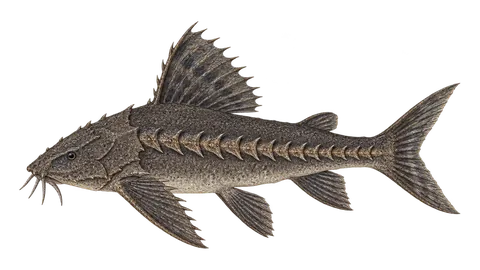
Scientific illustration of Catfish (focinho-de-porco)
common size
35–55 cm
maximum
70 cm
common weight
0.6–2.4 kg
record/max.
9.0 kg
depth
2–12 m
ideal water
22–28 °C
overview

who is the catfish (focinho-de-porco)

A doradid catfish of the Plata basin (Argentina, Bolivia, Brazil, Paraguay and Uruguay), with bony plates along its body that give it the name armado. It reaches 70 cm and 9 kg according to FishBase; Argentine species accounts cite up to 80 cm. It is demersal and omnivorous: it eats insects, crustaceans, mollusks and other invertebrates, as well as plant material, and its mouth lets it search for food among stones and sand. It is oviparous with external fertilization, and there are no reports of captive breeding. In Argentina it is caught with longlines, gillnets and trawls and sold on the domestic market. For sport anglers it is an occasional bottom fish, caught in large rivers with natural bait.

fun facts

  • Out of the water, it makes sounds.
  • The shape of its mouth lets it search for food among stones and sand.
  • In Argentina it is known as armado chancho ('chancho' means pig in Spanish).
how to recognize it

identification

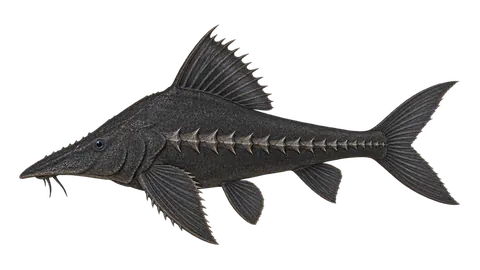
Grayish-brown to dark brown body, lighter on the belly, covered in bony plates that form the 'armado', with a small head relative to the body and a snout that resembles a pig's, hence the name. Strong spines on the pectoral and dorsal fins. It is confused with the common armado (Pterodoras granulosus), which Santa Fe species accounts give as about 70 cm and 4.5 kg, while the pig-snouted fish reaches 9 kg. When in doubt, treat both as armado.

how catfish (focinho-de-porco) fishing looks

Loading the next 7 days…

Each card shows the day's index (0 to 100) and, below it, a strip with the index for each hour, from 0h to 23h. from poor to excellent.

distribution

where found

open on the large map

Plata basin: Paraná, Paraguay and Uruguay rivers and the Río de la Plata. In Brazil, in parts of the Paraná, Paraguay and Uruguay basins; outside Brazil, Argentina, Paraguay, Uruguay and Bolivia.

Habitat: Channels and backwaters of large rivers, over stone and sand bottoms, where it stirs up the substrate looking for food.

native to the basins

ParanáParaguay (Pantanal)Uruguay
calendar and clock

when to fish

best season

time of yearbest: Oct–Dec
JanFebSeaAprMayJunJulAugSepOctNovDec

The spawning season has not been confirmed. In the Plata basin, bottom catfish fishing tends to be better with warm water, from September to February.

best time of day

0h6h12h18h sunrise ~6amsunset ~6pm

Any time. Little studied. It searches for food on the bottom, with no clearly defined schedule; bottom fishing usually produces from late afternoon into early evening.

weather, water and behavior

what affects the catfish (focinho-de-porco)
sensitivity The little bars show how much each factor affects this species. Five full: it feels it a lot.

cold and cold fronts

It cools and becomes less active in winter; fishing improves with lukewarm water.

atmospheric pressure

Little effect.

moon

Small effect.

rain

Heavy rain and high water cloud the water and scatter the fish.

water level

A stable or falling river concentrates fish in the channels and backwaters.

noise

Moderate: avoid knocking the hull.

wind

Little effect on the bottom.

depth

Bottom of backwaters and channels, 3 to 10 m.

technique, gear and bait

how to fish

rod
6'6" to 7', medium-heavy action, 20 to 40 lb
spinning / baitcasting reel
5000 to 6000 spinning reel or low-profile baitcaster 300
line
braid 30 to 50 lb
leader
heavy 0.60 to 0.80 mm monofilament, 60 cm, to withstand rubbing from the plates
hook
2/0 to 5/0, forged

natural baits

  • minhoca
  • ripe fruit
  • fish pieces
  • caramujo

accessories

  • thick gloves
  • long-nose pliers
  • boga-grip

tip from an angler

Enough sinker to hold the bait on the bottom in the current, and strong-smelling bait such as worm or ripe fruit. Set the hook when the line tightens, and wear gloves when removing the hook.

what the law says

rules for the catfish (focinho-de-porco)

Summary of the regulations we found, with the source for each. Rules change; before keeping or transporting fish, check with the state environmental agency.
Conservation: Not on the Brazilian national list (Ministerial Ordinance GM/MMA No. 1.667/2026).

Santa Fe (AR): minimum size 45 cm

45 cm total lengthconfirm with the agency

Santa Fe Provincial Law 12.212, art. 10, sets 45 cm for the armado chancho (Oxydoras kneri) in the commercial fishing table in the alluvial valley of the Paraná River; for sport fishing in environments and species not listed, the measures are left to the enforcement authority. According to the press, sport fishing in Santa Fe has its own rules (resolutions of the Environment Ministry, with mandatory release and on-site consumption within size and quota limits). We did not check these texts or the rules of Corrientes, Entre Ríos, Misiones and Chaco.

Source: Ley provincial de Santa Fe nº 12.212, art. 10 (copy published by the press)

Paraguay: annual closed season for fishing in shared rivers

in 2025/26: November 2 to December 20 (waters shared with Argentina) and until January 31, 2026 (waters shared with Brazil); boat fishing, sport or commercial, transport and sale prohibitedconfirm with the agency

Paraguay's Ministry of the Environment (MADES) sets the closed season each year, by resolution, for rivers shared with Argentina and Brazil. In 2025/26 it began on November 2, 2025 and ended on December 20 in waters shared with Argentina and on January 31, 2026 in waters shared with Brazil. All boat fishing, sport or commercial, the use of gear, transport and sale of fish, and the sale of live bait are prohibited; licensed farmed fish are excluded. Dates for 2026/27 have not yet been published. The resolution number has not been confirmed.

Source: MADES (Paraguay) Resolution on the 2025/26 fishing closed season, per Prensa Mercosur

piracema closures in the basins where the species lives

Spawning closure (piracema) in the Paraná River basin

01/11 to 28/02SPPRMGGOMSDF

Allowed: Recreational fishing only for non-native species and hybrids (peacock bass, tilapia, black bass, carp, croaker, etc.; piauçu remains prohibited), with handline, simple pole, or rod with spinning or baitcasting reel, up to 10 kg + 1 fish. In rivers, from shore only; in reservoirs, from a boat or from shore. Prohibited: floodplain lakes, aquatic-animal bait, within 1,500 m of dams and waterfalls, and within 500 m of confluences. Tournaments only in reservoirs and only with non-native species.

Source: IN IBAMA nº 25/2009

Closed season in Goiás (state rule)

01/11 to 28/02GO

Allowed: Sport and guided fishing only in reservoirs, catch and release with barbless hooks (no keeping, transporting or eating). Subsistence: up to 5 kg per day, for household consumption only.

Source: IN Semad-GO nº 17/2026, arts. 8º to 11

Spawning closure (piracema) in the Pantanal of Mato Grosso do Sul

05/11 to 28/02MS

Allowed: Subsistence fishing by riverside residents and authorized scientific fishing. Decree 15.166/2019 (art. 11, §5) allows catch and release only in February and only in the channels of the Paraguay and Paraná rivers. For the rest of the period, not even catch and release is allowed. Check the Imasul portaria for each season.

Source: Decreto estadual MS nº 15.166/2019, art. 11; IN IBAMA nº 201/2008

Spawning closure (piracema) in Mato Grosso (all basins)

01/10 to 31/01MT

Allowed: All fishing modalities are prohibited in rivers, including catch and release (Law 9.096/2009, art. 19-A). Exceptions: subsistence fishing from shore (3 kg or 1 fish, no transport or sale) and scientific fishing. Law 13.159/2025 now allows licensed sport fishing in UHE/PCH hydropower reservoirs, natural lakes and border rivers, subject to a scientific study and a license from the environmental agency. We have not confirmed whether these licenses are already being issued.

Source: IN Interministerial MAPA/MMA nº 10/2017; Resolução Cepesca-MT nº 1/2026; Lei estadual MT nº 9.096/2009, arts. 19-A and 27 (Leis 12.434/2024 and 13.159/2025)

Spawning closure (piracema) in the Uruguay River basin

01/10 to 31/01RSSC

Allowed: Recreational fishing from shore, or from a boat without motor. Only handline or rod, line and hook, one gear per angler, up to 5 kg. Prohibited in floodplain lakes, within 1,500 m of dams, within 500 m of confluences, and in stretches listed in the rule (e.g., Turvo River).

Source: IN IBAMA nº 193/2008

catch and release
catch and release Releasing the fish alive, quickly and with a wet hand. During a closed season it isn't always allowed: what the regulation says applies.

Wear thick gloves and watch the pectoral and dorsal spines and the lateral plates. Hold the fish firmly by the body, remove the hook with long pliers, and release it slowly, facing the current.

in the kitchen

It turns up in commercial fishing on the Paraná and is sold on the Argentine domestic market. The thick skin and plates call for careful cleaning; it is usually served fried, roasted or in a stew (caldeirada).

calculator

how much it weighs without taking it out of the water

Length-weight relationship W = a·Lb (a = 0.01479, b = 2.99; FishBase (relação peso-comprimento bayesiana, estimativa)). It's an average: a fat or lean fish can vary by 10% to 20%.

estimated weight

—

sources and references

The season weights (months), the time of day and the sensitivities (cold, pressure, moon, wind, rain, tide, strong light, murky water and noise) are the app's editorial estimates, based on the literature below and on the field experience of anglers and guides. They are not official data nor a measurement made for this species, and they may vary by region and year. Closed seasons and legal rules appear in the rules section, with the norm and a link.

  1. scientific FishBase: Oxydoras kneri (ficha da espécie)Size, length-weight, depth, habitat, distribution, biology and IUCN status. Page checked on October 13, 2026. The typical size and depth range are editorial estimates for sport fish; the typical weight comes from the length-weight relationship. The maximum length of 70 cm and weight of 9 kg are the published values; Santa Fe species accounts cite 80 cm total length. We found no Brazilian rule that names this species: the armado in the Paraná and Paraguay rules is Pterodoras granulosus.
  2. scientific FishBase: nomes populares de Oxydoras kneriNames by country and language.
  3. official Portaria GM/MMA nº 1.667, de 27 de abril de 2026: Lista Nacional Oficial de Espécies da Fauna Ameaçadas de Extinção (peixes e invertebrados aquáticos)The species is not on the list. Checked in the DOU of April 28, 2026.
  4. official Acuario del Río Paraná (Santa Fe, Argentina): ficha do armado chancho (Oxydoras kneri)Size up to 70 cm, bony plates, small head, coloration, omnivorous diet, oviparous reproduction, sounds out of water, and a mouth for searching for food among stones and sand. Species account checked on October 13, 2026.
  5. official Província de Santa Fe: Características biológicas (material do Guarda Pesca Honorário), fichas da SAGPyAArmado chancho: distribution in the Plata basin, omnivorous diet, up to 80 cm total length and 9 kg, caught with longline, gillnet and trawl. Document checked on October 13, 2026.
  6. press Ley provincial de Santa Fe nº 12.212 (pesca)Art. 10: table of minimum sizes, with the armado chancho (Oxydoras kneri) at 45 cm. Copy of the text published by a newspaper; the official text is on the Province's portal. Checked on October 13, 2026.
  7. press Prensa Mercosur: inicia veda pesquera y MADES refuerza tareas de concienciación y control (02/11/2025)Dates of the 2025/26 closed season in waters shared with Argentina and Brazil, and what is prohibited. The MADES resolution number does not appear in the article. Checked on October 13, 2026.
don't confuse

similar species