Closed season in Goiás (state rule)
01/11 to 28/02GO
Allowed: Sport and guided fishing only in reservoirs, catch and release with barbless hooks (no keeping, transporting or eating). Subsistence: up to 5 kg per day, for household consumption only.
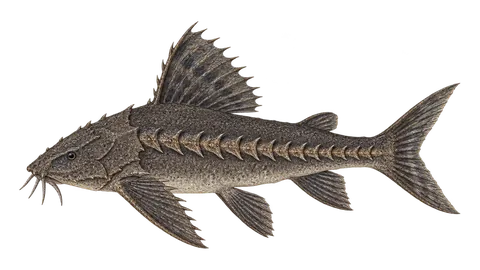
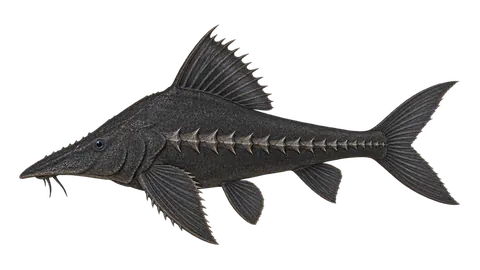
Megalodoras uranoscopus
A large armored catfish of the slow-water rivers and lakes of the Amazon. It eats snails and fruit that fall into the water, migrates to spawn, and has strong spines on its pectoral fins. It turns up now and then in bottom fishing.
Also called: rebeca, bacu

Doradid, a catfish with spines and bony plates, reaching 53 cm standard length and 2.9 kg. It lives in the Amazon, Tocantins and Essequibo basins (Brazil, Bolivia, Colombia, Ecuador and Peru, per FishBase's country list) and was described from Lake Hyanuary, near Manaus. It seeks slow or still water, in tributaries, igarapés and swamps, sheltering among roots and submerged vegetation. It lives in small groups, sometimes forming shoals, and is mainly diurnal. It is omnivorous: it eats snails and fruit that fall into the water, such as those of Licania longipetala and jauari (Astrocaryum jauari). It makes seasonal migrations linked to spawning. It turns up in commercial fishing and, now and then, on the bottom hook of anglers fishing in the Amazon.
Elongated, robust body with a row of pointed bony plates along the middle of the flank, a broad, flattened head, three pairs of barbels and strong spines on the pectoral and dorsal fins. Females are larger and stockier than males. Among the doradids of the Amazon it is one of the largest; identify the species by its plates, spines and barbels together and, when in doubt, treat the fish as an armored catfish, taking care with the spines.
Loading the next 7 days…
Each card shows the day's index (0 to 100) and, below it, a strip with the index for each hour, from 0h to 23h. from poor to excellent.
Rivers, igarapés and slow-water lakes of the Amazon and Tocantins basins, such as Lake Hyanuary, near Manaus (AM), where it was described. Outside Brazil, Bolivia, Colombia, Ecuador, Peru and the Essequibo basin.
Habitat: Slow or still water in tributaries, igarapés, swamps and lakes, among roots and submerged vegetation. It probably also uses main channels and flooded areas.
native to the basins
states
Amazonas
It makes seasonal migrations linked to spawning, on a poorly known schedule. In the dry season, with the river low, fish concentrate in pools and channels, and bottom fishing is best then.
Daytime. Mainly diurnal, according to FishBase, in small groups that move among roots and vegetation.
Cold spells (friagem) reduce activity for a few days.
Little effect.
Small effect.
Heavy rain muddies the water and scatters the fish, but the species already lives in dark water.
A falling river and dry season concentrate fish in pools and channels; at high water it spreads through the flooded area.
Moderate: avoid knocking the hull.
Little effect on the bottom.
Bottom of pools and banks with roots, 2 to 8 m.
natural baits
accessories
Ripe fruit or a snail on the bottom, next to roots, and set the hook firmly. Once the fish is hooked, avoid contact with its body: plates and spines cut.
Summary of the regulations we found, with the source for each. Rules change; before keeping or transporting fish, check with the state environmental agency.
Conservation: Not on the Brazilian national list (Ministerial Ordinance GM/MMA No. 1.667/2026).
We found no species-specific rule beyond the region's general rules.
Allowed: Sport and guided fishing only in reservoirs, catch and release with barbless hooks (no keeping, transporting or eating). Subsistence: up to 5 kg per day, for household consumption only.
Allowed: All fishing modalities are prohibited in rivers, including catch and release (Law 9.096/2009, art. 19-A). Exceptions: subsistence fishing from shore (3 kg or 1 fish, no transport or sale) and scientific fishing. Law 13.159/2025 now allows licensed sport fishing in UHE/PCH hydropower reservoirs, natural lakes and border rivers, subject to a scientific study and a license from the environmental agency. We have not confirmed whether these licenses are already being issued.
Allowed: Recreational fishing only in reservoirs, with handline, rod, or spinning or baitcasting reel. Fish may only be eaten on site, not transported. Competitions prohibited. Subsistence: 3 kg + 1 fish. State rules (GO and TO) may be stricter.
Allowed: Recreational fishing only in reservoirs, with on-site consumption. Subsistence: 5 kg + 1 fish. State rules may be stricter.
Allowed: In 2025/26: catch and release with barbless hooks and recreational fishing card; subsistence fishing on foot or from a rowboat, with simple pole or handline.
Source: Portaria Naturatins nº 244/2025 (2025/26 season); INIs MPA/MMA nº 12 and 13/2011
Allowed: The same recreational-angler exceptions as in Portaria 48/2007 apply (handline or rod, 5 kg + 1 fish), unless a stricter state rule applies.
Source: Portaria IBAMA nº 48/2007
Allowed: Recreational anglers with handline or rod, line and hook are outside the Annex II prohibitions, with a bag limit of 5 kg + 1 fish, unless a stricter state rule applies.
Source: Portaria IBAMA nº 48/2007
Allowed: Subsistence fishing only.
Source: Portaria IBAMA nº 48/2007
Allowed: See the exceptions in Portaria 48/2007 and the state rules for each bank.
Source: Portaria IBAMA nº 48/2007
Use thick gloves and hold the fish firmly by the body, away from the pectoral and dorsal spines and the side plates, which cut. Remove the hook with long pliers and release slowly, in water with little current.
It shows up in commercial fishing. The thick skin and bony plates call for careful cleaning; the meat is catfish-type, good in caldeirada.
Length-weight relationship W = a·Lb (a = 0.0123, b = 3.0; FishBase (relação peso-comprimento bayesiana, estimativa da própria espécie)). It's an average: a fat or lean fish can vary by 10% to 20%.
estimated weight
—
The season weights (months), the time of day and the sensitivities (cold, pressure, moon, wind, rain, tide, strong light, murky water and noise) are the app's editorial estimates, based on the literature below and on the field experience of anglers and guides. They are not official data nor a measurement made for this species, and they may vary by region and year. Closed seasons and legal rules appear in the rules section, with the norm and a link.
Your location is saved only on this device and feeds the forecast, the map and the "today" on the home page.