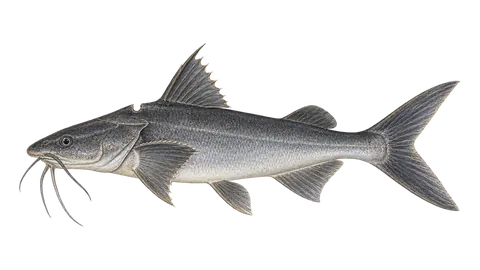
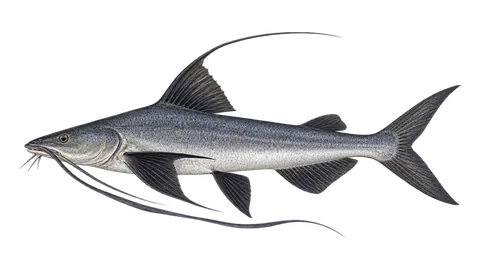
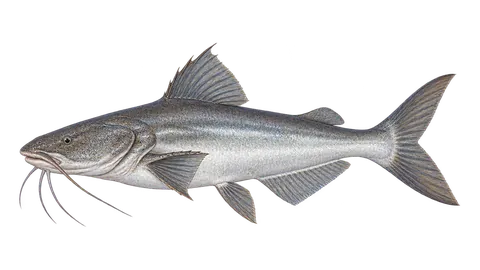
The gurijuba, a giant catfish of the Amazon coast, with a yellowish body, over 1.5 m long. It is Vulnerable on the national list: catching it follows its own rules, and sport anglers should prioritize release.
The gurijuba is the largest marine catfish on the northern coast of South America, from the Guianas to northern Brazil. It lives in murky water over mud bottoms, on the coast, in estuaries and in the lower course of rivers, and reaches 1.9 m and 50 kg. It matures at about two years and produces few offspring, which are born large, at 6 to 6.5 cm. Commercial longline and gillnet fishing, for the flesh and the swim bladder (grude), reduced the population, and the species was listed as threatened nationally. Today it may only be caught under the rules of the recovery plan: minimum size of 55 cm and closed season from Nov 17 to Mar 31. For sport anglers, the best practice is release.
fun facts
The young are born large, at 6 to 6.5 cm.
The dried swim bladder (grude) is one of the products of commercial fishing and appears in the stock declaration required during the closed season.
how to recognize it
identification
Large, sturdy catfish with a yellowish body in life, broad head with granulated bony plates exposed around and behind the eyes, and a nape plate shaped like a shield. Three pairs of barbels and serrated spines on the dorsal and pectoral fins. It differs from the uritinga in having a nape plate without a notch at the front and a larger rear chamber of the swim bladder, details that require holding the fish; the yellowish tone of the live fish helps in the field.
how gillbacker sea catfish fishing looks
Loading the next 7 days…
Each card shows the day's index (0 to 100) and, below it, a strip with the index for each hour, from 0h to 23h. from poor to excellent.
North coast of Brazil, from Amapá to Maranhão, under the influence of the Amazon rivers. Outside Brazil, French Guiana, Suriname, Guyana and Venezuela.
Habitat: Murky water over mud bottoms on the coast, in estuaries, bays and the lower course of rivers.
coast
North Coastcoastal
states
Amapá, Pará, Maranhão
calendar and clock
when to fish
best season
time of yearbest: Jul–Sep
JanFebSeaAprMayJunJulAugSepOctNovDec
From Nov 17 to Mar 31, directed fishing is prohibited (closed season). For the rest of the year, the dry season in the second half of the year concentrates fish in the channels and at river mouths.
best time of day
Night and twilight. Like other catfish, it feeds more at night and in murky water; by day it bites on the bottom of the channels.
weather, water and behavior
what affects the gillbacker sea catfish
sensitivity The little bars show how much each factor affects this species. Five full: it feels it a lot.
cold and cold fronts
No significant effect on the equatorial coast.
atmospheric pressure
Not very sensitive; rough sea hurts fishing more than the fish.
moon
Spring tides (new and full moon) stir the bottom and increase activity.
rain
Adapted to muddy water; rain doesn't shut down activity.
water level
In the dry season, salt water pushes further into the estuaries and fish move up with it.
noise
Not very sensitive to murky water.
wind
Strong wind with the tide against it makes the bay dangerous for small boats.
tide
Fish the tide change in the channels; in strong current the bait won't stay on the bottom.
high-profile baitcasting reel or spinning reel 6000 to 10000
line
braided line 50 to 80 lb
leader
monofilament 1.0 to 1.2 mm (80 to 120 lb)
hook
circle 8/0 to 12/0, preferably barbless
natural baits
whole fish or steaks
large shrimp
accessories
long pliers and thick gloves
headlamp
line cutter
tip from an angler
Respect the closed season and minimum size. Use a circle hook: the fish hooks in the corner of the mouth, and release is quick and safe.
what the law says
rules for the gillbacker sea catfish
Summary of the regulations we found, with the source for each. Rules change; before keeping or transporting fish, check with the state environmental agency. Conservation: Already in earlier lists. Use is only allowed under the recovery plan rules (PI SG-PR/MMA 43/2018: 55 cm and closed season from Nov 17 to Mar 31), which remain in place during the review foreseen in Portaria 1.666/2026 (art. 11).
Vulnerable species: catch only under the recovery plan rules
outside the plan (under 55 cm or in closed season), release is mandatoryNorth CoastNortheast CoastSoutheast CoastSouth Coast
The gurijuba is on the national list as Vulnerable (VU). VU species have full protection, except use allowed by a recovery plan. For the gurijuba, use follows Portaria Interministerial SG-PR/MMA nº 43/2018, which remains in force during the review foreseen in Portaria GM/MMA nº 1.666/2026 (art. 11). A fish under 55 cm or caught in the closed season must be released alive immediately.
55 cm (total length)North CoastNortheast CoastSoutheast CoastSouth Coast
It is only permitted to catch, keep, transport and sell gurijuba that are 55 cm total length or more. A smaller specimen caught by chance must be released immediately.
directed fishing, transport, landing and sale prohibited17/11 to 31/03North CoastNortheast CoastSoutheast CoastSouth Coast
From November 17 to March 31, directed fishing, transport, landing and sale of gurijuba and its by-products are prohibited, for all methods and vessels, in all Brazilian waters. Retention on board and landing are tolerated only until November 20.
catch and release Releasing the fish alive, quickly and with a wet hand. During a closed season it isn't always allowed: what the regulation says applies.
Threatened species: release is the best choice, and it is mandatory below 55 cm and during the closed season. The serrated spines of the dorsal and pectoral fins cause painful cuts: use gloves, hold it from behind the spines, supporting the belly, and keep the fish in the water as long as possible. If the hook has been swallowed, cut the line close to the mouth.
in the kitchen
Firm, traditional marine catfish flesh on the north coast. It may only be taken at 55 cm or more, outside the closed season and within the plan's rules.
calculator
how much it weighs without taking it out of the water
Length-weight relationship W = a·Lb (a = 0.00851, b = 3.12; FishBase (estimativa bayesiana com dados da espécie e da subfamília, comprimento total)). It's an average: a fat or lean fish can vary by 10% to 20%.
estimated weight
—
sources and references
The season weights (months), the time of day and the sensitivities (cold, pressure, moon, wind, rain, tide, strong light, murky water and noise) are the app's editorial estimates, based on the literature below and on the field experience of anglers and guides. They are not official data nor a measurement made for this species, and they may vary by region and year. Closed seasons and legal rules appear in the rules section, with the norm and a link.