

- common size
- 60–110 cm
- maximum
- 190 cm
- common weight
- 3–15 kg
- record/max.
- 50.0 kg
- depth
- 2–20 m
- ideal water
- 27–30 °C

the right time
to be on the water
Choose the place and the species. The index, from 0 to 100, combines weather, sun, moon and tide with each fish's habits. Up to 28 days, with each day's confidence.
Loading the forecast…
—
Looking for alerts within 30 km…
Looking for what anglers have logged near here…
what you need to fish herelicense, certification and boat documents
fish likely at this spot
Tap a fish to see its forecast.
hour by hour
slide your finger or mouse over the chart to see each hoursee hour-by-hour table
why this index at —?
choose the day
the fishing month at a glance
what's the best window for the crew?
Choose how many fishing days. We compare each stretch by its average index, discount days with a warning or closed season, and show the 3 best.
trend for the coming weeks
Line: the middle value of 31 simulations of the American GEFS model. Band: where 8 out of 10 fall. Narrow, firm trend; wide, high uncertainty.
everything about the gillbacker sea catfish
how to recognize it
Large, sturdy catfish with a yellowish body in life, broad head with granulated bony plates exposed around and behind the eyes, and a nape plate shaped like a shield. Three pairs of barbels and serrated spines on the dorsal and pectoral fins. It differs from the uritinga in having a nape plate without a notch at the front and a larger rear chamber of the swim bladder, details that require holding the fish; the yellowish tone of the live fish helps in the field.
Also called: gurijuba, guarijuba, ariaçu, cangatá
don't confuse with:
where found
open on the large mapWhere to look: Murky water over mud bottoms on the coast, in estuaries, bays and the lower course of rivers.
North coast of Brazil, from Amapá to Maranhão, under the influence of the Amazon rivers. Outside Brazil, French Guiana, Suriname, Guyana and Venezuela.
coast
states
Amapá, Pará, Maranhão
when to fish
best season
From Nov 17 to Mar 31, directed fishing is prohibited (closed season). For the rest of the year, the dry season in the second half of the year concentrates fish in the channels and at river mouths.
best time of day
Night and twilight. Like other catfish, it feeds more at night and in murky water; by day it bites on the bottom of the channels.
what affects the gillbacker sea catfish
cold and cold fronts
No significant effect on the equatorial coast.
atmospheric pressure
Not very sensitive; rough sea hurts fishing more than the fish.
moon
Spring tides (new and full moon) stir the bottom and increase activity.
rain
Adapted to muddy water; rain doesn't shut down activity.
water level
In the dry season, salt water pushes further into the estuaries and fish move up with it.
noise
Not very sensitive to murky water.
wind
Strong wind with the tide against it makes the bay dangerous for small boats.
tide
Fish the tide change in the channels; in strong current the bait won't stay on the bottom.
depth
3 to 20 m, in channels and holes.
how to fish
natural baits
- whole fish or steaks
- large shrimp
tip from an angler
Respect the closed season and minimum size. Use a circle hook: the fish hooks in the corner of the mouth, and release is quick and safe.
- rod
- 7'0" to 7'6", 30 to 60 lb, heavy action
- spinning / baitcasting reel
- high-profile baitcasting reel or spinning reel 6000 to 10000
- line
- braided line 50 to 80 lb
- leader
- monofilament 1.0 to 1.2 mm (80 to 120 lb)
- hook
- circle 8/0 to 12/0, preferably barbless
accessories
- long pliers and thick gloves
- headlamp
- line cutter
catch and release
Threatened species: release is the best choice, and it is mandatory below 55 cm and during the closed season. The serrated spines of the dorsal and pectoral fins cause painful cuts: use gloves, hold it from behind the spines, supporting the belly, and keep the fish in the water as long as possible. If the hook has been swallowed, cut the line close to the mouth.
rules for the gillbacker sea catfish
Rules change; before keeping or transporting fish, check with the state environmental agency.
Vulnerable species: catch only under the recovery plan rules
outside the plan (under 55 cm or in closed season), release is mandatoryNorth CoastNortheast CoastSoutheast CoastSouth Coast details
The gurijuba is on the national list as Vulnerable (VU). VU species have full protection, except use allowed by a recovery plan. For the gurijuba, use follows Portaria Interministerial SG-PR/MMA nº 43/2018, which remains in force during the review foreseen in Portaria GM/MMA nº 1.666/2026 (art. 11). A fish under 55 cm or caught in the closed season must be released alive immediately.
Minimum size of 55 cm
55 cm (total length)North CoastNortheast CoastSoutheast CoastSouth Coast details
It is only permitted to catch, keep, transport and sell gurijuba that are 55 cm total length or more. A smaller specimen caught by chance must be released immediately.
Source: Portaria Interministerial SG-PR/MMA nº 43/2018, art. 2º
Gurijuba closed season (Nov 17 to Mar 31)
directed fishing, transport, landing and sale prohibited17/11 to 31/03North CoastNortheast CoastSoutheast CoastSouth Coast details
From November 17 to March 31, directed fishing, transport, landing and sale of gurijuba and its by-products are prohibited, for all methods and vessels, in all Brazilian waters. Retention on board and landing are tolerated only until November 20.
Source: Portaria Interministerial SG-PR/MMA nº 43/2018, art. 3º
Conservation: Already in earlier lists. Use is only allowed under the recovery plan rules (PI SG-PR/MMA 43/2018: 55 cm and closed season from Nov 17 to Mar 31), which remain in place during the review foreseen in Portaria 1.666/2026 (art. 11).
how much it weighs without taking it out of the water
estimated weight
—
how we calculate
Length-weight relationship W = a·Lb (a = 0.00851, b = 3.12; FishBase (estimativa bayesiana com dados da espécie e da subfamília, comprimento total)). It's an average: a fat or lean fish can vary by 10% to 20%.
more about the gillbacker sea catfish
The gurijuba is the largest marine catfish on the northern coast of South America, from the Guianas to northern Brazil. It lives in murky water over mud bottoms, on the coast, in estuaries and in the lower course of rivers, and reaches 1.9 m and 50 kg. It matures at about two years and produces few offspring, which are born large, at 6 to 6.5 cm. Commercial longline and gillnet fishing, for the flesh and the swim bladder (grude), reduced the population, and the species was listed as threatened nationally. Today it may only be caught under the rules of the recovery plan: minimum size of 55 cm and closed season from Nov 17 to Mar 31. For sport anglers, the best practice is release.
Family: Ariidae · predator
fun facts
- The young are born large, at 6 to 6.5 cm.
- The dried swim bladder (grude) is one of the products of commercial fishing and appears in the stock declaration required during the closed season.
in the kitchen
Firm, traditional marine catfish flesh on the north coast. It may only be taken at 55 cm or more, outside the closed season and within the plan's rules.
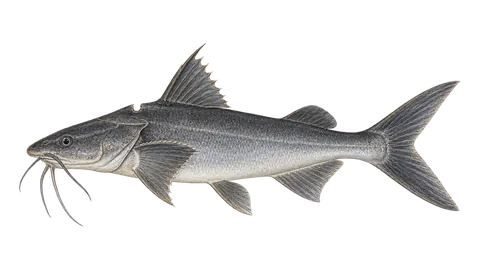
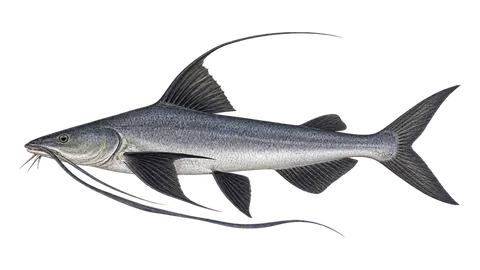
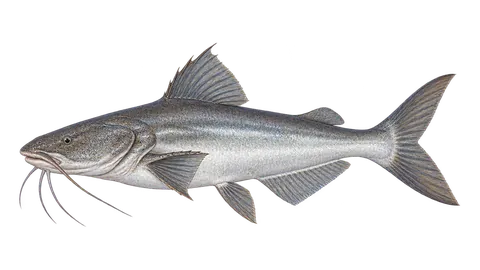
similar species
sources and references (6)
The season weights (months), the time of day and the sensitivities (cold, pressure, moon, wind, rain, tide, strong light, murky water and noise) are the app's editorial estimates, based on the literature below and on the field experience of anglers and guides. They are not official data nor a measurement made for this species, and they may vary by region and year. Closed seasons and legal rules appear in the rules section, with the norm and a link.
- scientific FishBase — Sciades parkeri (ficha da espécie)Names, distribution, biology, length-weight relationship, country list and references. Page checked on Oct 13, 2026.
- official Portaria GM/MMA nº 1.667, de 27 de abril de 2026 — Lista Nacional Oficial de Espécies da Fauna Ameaçadas de Extinção (peixes e invertebrados aquáticos)Most recent national list, published in Brazil's Official Gazette (DOU) of 28/04/2026. The species is listed as Vulnerable (VU) (checked against the published text on 13/10/2026).
- official Portaria GM/MMA nº 1.666, de 27 de abril de 2026 — regras de proteção das espécies da lista nacionalArt. 3: VU, EN and CR species are fully protected (catching, transport, keeping and trade prohibited); § 4: a specimen caught by chance must be released alive immediately. Arts. 4 and 11: use only under a recovery plan, and existing plans remain valid during the review.
- official Portaria Interministerial SG-PR/MMA nº 43, de 27 de julho de 2018 — regulamenta a pesca de Sciades parkeri (gurijuba) nas águas jurisdicionais brasileirasText published in the DOU of 30/07/2018 (Section 1, pp. 6 and 7), checked against the Ibama PDF on 13/10/2026. Arts. 2 (55 cm) and 3 (closed season from Nov 17 to Mar 31, tolerance until Nov 20).
- official ICMBio/SALVE — Ficha de Sciades parkeri (avaliação nacional do risco de extinção)National extinction risk assessment by ICMBio, published in 2025. DOI checked on Crossref.
- scientific IUCN Red List — Sciades parkeri (avaliação global: Vulnerável, VU, 17/08/2011)Global assessment. Link given on the FishBase entry (Red List, version 2025-2).
how we calculatewhere each number comes from
The weather comes from three independent global models, cross-checked hour by hour: when they agree, confidence goes up; when they diverge, the band between them shows on the chart. Beyond 16 days, we use the GEFS ensemble of 31 simulations: if 20 of the 31 predict rain, the chance of rain is 65%. Sun and moon are calculated astronomically, with no uncertainty.
The index adds up, weighted for each species: time of day (species curve anchored to real sunrise and sunset), moon (transits, rise and set, phase), pressure (3 h trend and 24 h swing), water temperature (in rivers, estimated from air temperature; at sea, estimated by an ocean model), wind, rain, clouds, tide and the month in the species' cycle.
sources for this lookup
how accurate the forecast is
Accuracy measured in the reference project (4 regions, 93 days, forecast vs. observed): maximum temperature is off by 0.6 °C on average the next day and 1.7 °C at 7 days; rain of 5 mm or more is detected 76% of the time the next day and 57% at 7 days. Detection isn't everything: the false alarm rate isn't published here yet, and 93 days in 4 regions is still a small sample. We now also measure every day, at the app's destinations: