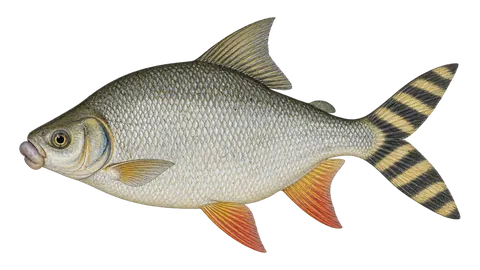
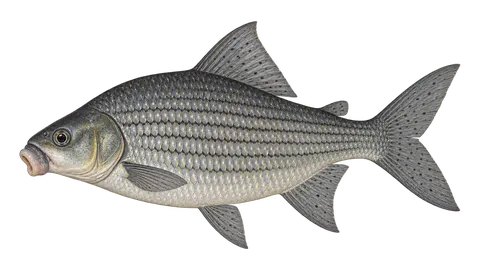
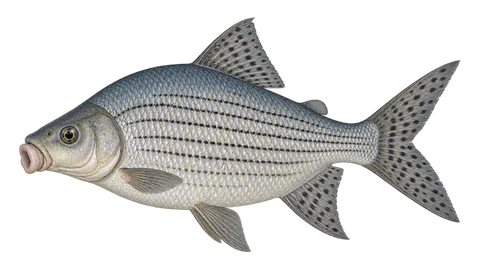
A relative of the curimbatá, the jaraqui scrapes mud, algae and organic matter from the bottom, logs and rocks. Lives in schools in blackwater and clearwater rivers and in várzea (floodplain) lakes of central and western Amazonia. Its migrations follow the water cycle: at the start of the flood, schools move down the blackwater tributaries, such as the Rio Negro, and spawn where they meet muddy water; then they enter the flooded forest to feed and, as the water falls, move again. It is one of the most landed fish in Manaus, caught with purse seines and cast nets. On the hook it almost never appears: it eats mud and doesn't chase bait.
fun facts
In Manaus they say whoever eats jaraquí never leaves the city.
A natural hybrid between the thick-scale and thin-scale jaraquí has been recorded.
how to recognize it
identification
Tall, compressed, silver body with a grey back. Fleshy, sucker-shaped mouth with small teeth, like the curimbatá's. Caudal fin with bold black and clear diagonal bands on both lobes. The thick-scale jaraquí has larger scales, in fewer numbers, than the thin-scale jaraquí, which is where its common name comes from. The curimatã does not have a striped tail.
how kissing prochilodus fishing looks
Loading the next 7 days…
Each card shows the day's index (0 to 100) and, below it, a strip with the index for each hour, from 0h to 23h. from poor to excellent.
Central and western Amazon: Rio Negro and other blackwater and clearwater tributaries, the Solimões-Amazonas channel, the Madeira River and várzea lakes. Heavily fished around Manaus.
Habitat: Blackwater and clearwater rivers, mouths of lakes and igarapés (streams), igapó and várzea in flood; river channel during migrations.
Schools are concentrated and easy to find during falling water and the dry season (July to November in central Amazonas), and at the start of the flood, when they move down to spawn. During the flood, when they spread through the flooded forest, they nearly vanish.
best time of day
Daytime. Scrapes the bottom and logs during the day. Migrating schools move at any hour.
weather, water and behavior
what affects the kissing prochilodus
sensitivity The little bars show how much each factor affects this species. Five full: it feels it a lot.
cold and cold fronts
Cold snaps (friagem) keep the school still for a few days.
atmospheric pressure
Little known effect.
moon
Little known effect.
rain
The first rains and the rising river trigger the downstream run to spawn.
water level
Falling water concentrates the school in channels and lake mouths; the flood spreads the fish through the forest.
noise
A large school sinks and changes direction when a motor is nearby.
3 to 4 m cane pole or light 5'6" to 6' rod, 6 to 12 lb
spinning / baitcasting reel
spinning reel 1000 to 2500 (optional)
line
monofilament 0.20 to 0.25 mm
leader
optional
hook
small, #8 to 4
natural baits
cassava flour dough
bread dough
accessories
bran chum
small float
tip from an angler
It's a net fish. On the hook, only with groundbait and soft dough, and even then it's a game of patience.
what the law says
rules for the kissing prochilodus
Summary of the regulations we found, with the source for each. Rules change; before keeping or transporting fish, check with the state environmental agency. Conservation: Not on the national list (Portaria GM/MMA 1.667/2026).
Amazonian closed season (AC)
catch, transport and sale prohibited (commercial fishing)15/11 to 15/03ACAmazon
In AC the jaraquí (Semaprochilodus spp.) is in Annex II of the ordinance, with fishing prohibited from Nov 15 to Mar 15. Under art. 2 of the ordinance, anglers fishing with a handline or pole, line and hook are exempt from this ban, unless a stricter state rule applies; during the period the angler's limit is 5 kg + 1 fish.
piracema closures in the basins where the species lives
Spawning closure (piracema) in Mato Grosso (all basins)
01/10 to 31/01MT
Allowed: All fishing modalities are prohibited in rivers, including catch and release (Law 9.096/2009, art. 19-A). Exceptions: subsistence fishing from shore (3 kg or 1 fish, no transport or sale) and scientific fishing. Law 13.159/2025 now allows licensed sport fishing in UHE/PCH hydropower reservoirs, natural lakes and border rivers, subject to a scientific study and a license from the environmental agency. We have not confirmed whether these licenses are already being issued.
Allowed: Recreational anglers with handline or rod, line and hook are outside the Annex II prohibitions, with a bag limit of 5 kg + 1 fish, unless a stricter state rule applies.
catch and release Releasing the fish alive, quickly and with a wet hand. During a closed season it isn't always allowed: what the regulation says applies.
Delicate mouth: if you hook one, remove the hook carefully and release it quickly.
in the kitchen
Tasty meat full of bones. Fried well done, with fine cuts along the back, or grilled over coals with flour and pepper.
calculator
how much it weighs without taking it out of the water
Length-weight relationship W = a·Lb (a = 0.01995, b = 3.0; FishBase). It's an average: a fat or lean fish can vary by 10% to 20%.
estimated weight
—
sources and references
The season weights (months), the time of day and the sensitivities (cold, pressure, moon, wind, rain, tide, strong light, murky water and noise) are the app's editorial estimates, based on the literature below and on the field experience of anglers and guides. They are not official data nor a measurement made for this species, and they may vary by region and year. Closed seasons and legal rules appear in the rules section, with the norm and a link.