Skip to content
catalog Prochilodontidae · detritivore

black prochilodus

Prochilodus nigricans

Freshwater

The curimbatá of the Amazon and Tocantins-Araguaia. A major migrant, the base of commercial fishing and food for peacock bass, pirarara and surubim.

Also called: curimatã, curimatá, curimba, papa-terra, grumatã, curimbatá-da-amazônia

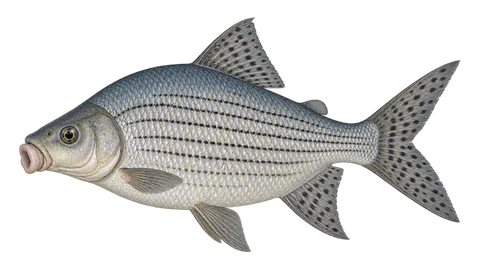
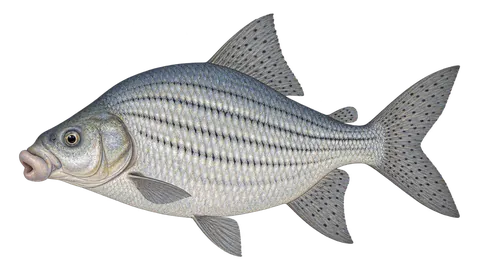
Scientific illustration of Black prochilodus
common size
25–40 cm
maximum
52 cm
common weight
0.4–1.5 kg
record/max.
3.0 kg
depth
0.5–8 m
ideal water
26–30 °C
overview

who is the black prochilodus

A mud and detritus eater, the curimatã is one of the most fished species in the Amazon basin and the Tocantins-Araguaia. It lives in schools that make long migrations: they run up the rivers to spawn at the start of the flood and then spread into flooded areas to feed. In the dry season the schools gather in channels and lake mouths, and that is where large predators follow them. On the hook, it is caught with dough and a small hook, over groundbait; once hooked, it makes strong runs. It is sold fresh and salted throughout the region and is increasingly raised in ponds.

fun facts

  • Curimatã schools are followed by large predators, which feed on them during migration.
  • By eating mud, it recycles organic matter and keeps the river productive.
how to recognize it

identification

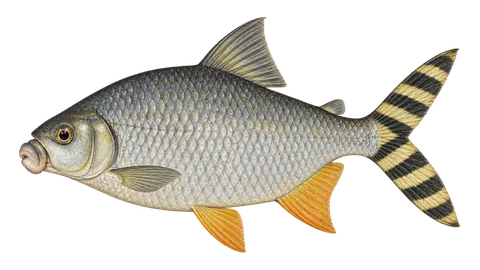
Sturdy, deep body, silver to grey, with dark-edged scales forming fine lines on the flank. Fleshy sucker mouth. Grey dorsal and caudal fins with faint dark spots, without the bold bands of the jaraquís. Very similar to the southern curimbatá (Prochilodus lineatus); the separation is mostly by the basin where it was caught.

how black prochilodus fishing looks

Loading the next 7 days…

Each card shows the day's index (0 to 100) and, below it, a strip with the index for each hour, from 0h to 23h. from poor to excellent.

distribution

where found

open on the large map

The whole Amazon basin and the Tocantins-Araguaia: white and clear-water rivers, várzea lakes and reservoirs such as Tucuruí.

Habitat: Muddy bottom of várzea lakes, slack water, channels and lake mouths; rapids and river channel during migration.

native to the basins

AmazonTocantins-Araguaia

states

Amazonas, Pará, Amapá, Acre, Rondônia, Roraima, Mato Grosso, Tocantins, Goiás, Maranhão

calendar and clock

when to fish

best season

time of yearbest: Jul–Nov
JanFebSeaAprMayJunJulAugSepOctNovDec

Best in falling water and the dry season (July to November across most of Amazonia), with the fish concentrated in the channels. In the piracema (spawning closure), from November to February, the fish run upriver to spawn and fishing is regulated.

best time of day

0h6h12h18h sunrise ~6amsunset ~6pm

Daytime, with peaks at dawn and dusk. Feeds during the day, stirring the bottom; schools move earlier and in the late afternoon.

weather, water and behavior

what affects the black prochilodus
sensitivity The little bars show how much each factor affects this species. Five full: it feels it a lot.

cold and cold fronts

Cold snaps (friagem) leave the school still on the bottom.

atmospheric pressure

Little effect.

moon

Little known effect.

rain

The first heavy rains and the rising river trigger the migration.

water level

Falling water concentrates the school in channels and lake mouths.

noise

Tolerant, but the school sinks when a motor is nearby.

wind

Little effect.

depth

Bottom, 1 to 6 m.

technique, gear and bait

how to fish

rod
6' to 7', medium action, 10 to 20 lb, or 4 m cane pole
spinning / baitcasting reel
spinning reel 2500 to 3000
line
monofilament 0.30 to 0.35 mm
leader
optional
hook
small, #2 to 1/0, short shank

natural baits

  • flour dough and cornmeal
  • bread dough
  • feed dough

accessories

  • spring feeder for dough
  • bran chum

tip from an angler

Soft dough in the feeder, with small hooks hidden in the dough. Set the hook gently: the mouth is weak.

what the law says

rules for the black prochilodus

Summary of the regulations we found, with the source for each. Rules change; before keeping or transporting fish, check with the state environmental agency.
Conservation: Not on the national list (Portaria GM/MMA 1.667/2026).

Amazonian closed season (PA, AP)

catch, transport and sale prohibited (commercial fishing)15/11 to 15/03PAAPAmazon

In PA and AP the curimatã (Prochilodus nigricans) is in Annex II of the ordinance, with fishing prohibited from Nov 15 to Mar 15. Under art. 2 of the ordinance, anglers fishing with a handline or pole, line and hook are exempt from this ban, unless a stricter state rule applies; during the period the angler's limit is 5 kg + 1 fish.

Source: Portaria IBAMA nº 48/2007, Annexes I and II

Marajó Island (PA): closed season from Jan 1 to Apr 30

catch prohibited (commercial fishing)01/01 to 30/04PAAmazon

In the rivers of Marajó Island, curimatã is on the fishing ban list from Jan 1 to Apr 30. Under art. 2 of the ordinance, anglers fishing with a handline or pole, line and hook are exempt from this ban, unless a stricter state rule applies; during the period the angler's limit is 5 kg + 1 fish.

Source: Portaria IBAMA nº 48/2007, Annexes I and II

MT: minimum 30 cm (35 cm in the Araguaia-Tocantins)

30 cmMTAmazonTocantins-Araguaia

The MT law sets 30 cm for the curimbatá Prochilodus nigricans in the Amazon and Araguaia-Tocantins basins (Annex II) and 35 cm in Annex IV, specific to the Araguaia-Tocantins: the larger size applies there. In MT, anglers may only kill for consumption on site (up to 2 kg or 1 fish, art. 19-C); the rule applies to that kill.

Source: Lei estadual MT nº 9.096/2009, Annex II, Amazon and Araguaia-Tocantins basins (as amended by Lei nº 9.895/2013); Annex IV

piracema closures in the basins where the species lives

Closed season in Goiás (state rule)

01/11 to 28/02GO

Allowed: Sport and guided fishing only in reservoirs, catch and release with barbless hooks (no keeping, transporting or eating). Subsistence: up to 5 kg per day, for household consumption only.

Source: IN Semad-GO nº 17/2026, arts. 8º to 11

Spawning closure (piracema) in Mato Grosso (all basins)

01/10 to 31/01MT

Allowed: All fishing modalities are prohibited in rivers, including catch and release (Law 9.096/2009, art. 19-A). Exceptions: subsistence fishing from shore (3 kg or 1 fish, no transport or sale) and scientific fishing. Law 13.159/2025 now allows licensed sport fishing in UHE/PCH hydropower reservoirs, natural lakes and border rivers, subject to a scientific study and a license from the environmental agency. We have not confirmed whether these licenses are already being issued.

Source: IN Interministerial MAPA/MMA nº 10/2017; Resolução Cepesca-MT nº 1/2026; Lei estadual MT nº 9.096/2009, arts. 19-A and 27 (Leis 12.434/2024 and 13.159/2025)

Spawning closure (piracema) in the Araguaia River basin

01/11 to 28/02GOTOPAMT

Allowed: Recreational fishing only in reservoirs, with handline, rod, or spinning or baitcasting reel. Fish may only be eaten on site, not transported. Competitions prohibited. Subsistence: 3 kg + 1 fish. State rules (GO and TO) may be stricter.

Source: IN Interministerial MPA/MMA nº 12/2011

Spawning closure (piracema) in the Tocantins and Gurupi river basins

01/11 to 28/02TOPAMAGO

Allowed: Recreational fishing only in reservoirs, with on-site consumption. Subsistence: 5 kg + 1 fish. State rules may be stricter.

Source: IN Interministerial MPA/MMA nº 13/2011

Closed season in the rivers of Marajó Island (PA)

01/01 to 30/04PA

Allowed: The same recreational-angler exceptions as in Portaria 48/2007 apply (handline or rod, 5 kg + 1 fish), unless a stricter state rule applies.

Source: Portaria IBAMA nº 48/2007

Closed season in the Amazon basin in Amapá

15/11 to 15/03AP

Allowed: Recreational anglers with handline or rod, line and hook are outside the Annex II prohibitions, with a bag limit of 5 kg + 1 fish, unless a stricter state rule applies.

Source: Portaria IBAMA nº 48/2007

Border rivers MT/RO and MT/PA

05/11 to 28/02MTROPA

Allowed: See the exceptions in Portaria 48/2007 and the state rules for each bank.

Source: Portaria IBAMA nº 48/2007

catch and release
catch and release Releasing the fish alive, quickly and with a wet hand. During a closed season it isn't always allowed: what the regulation says applies.

Delicate mouth: remove the hook carefully and release quickly, holding the fish horizontally.

in the kitchen

Fatty, tasty meat with many bones. Grilled over coals, in thin fried steaks, salted or smoked.

calculator

how much it weighs without taking it out of the water

Length-weight relationship W = a·Lb (a = 0.01862, b = 2.97; FishBase). It's an average: a fat or lean fish can vary by 10% to 20%.

estimated weight

—

sources and references

The season weights (months), the time of day and the sensitivities (cold, pressure, moon, wind, rain, tide, strong light, murky water and noise) are the app's editorial estimates, based on the literature below and on the field experience of anglers and guides. They are not official data nor a measurement made for this species, and they may vary by region and year. Closed seasons and legal rules appear in the rules section, with the norm and a link.

  1. scientific FishBase — Prochilodus nigricans (ficha da espécie)Names, distribution, biology, length-weight relationship and references. Page checked on October 13, 2026.
  2. official Portaria GM/MMA nº 1.667, de 27 de abril de 2026 — Lista Nacional Oficial de Espécies da Fauna Ameaçadas de Extinção (peixes e invertebrados aquáticos)Most recent national list. The species is not on it (search by scientific name in the text published in the DOU, checked on October 13, 2026).
  3. official ICMBio/SALVE — Ficha de Prochilodus nigricans (avaliação nacional do risco de extinção)ICMBio national assessment, published in 2025. DOI checked on Crossref.
  4. scientific IUCN Red List — Prochilodus nigricans (avaliação global: Pouco Preocupante, LC, 09/11/2020)Global assessment. Link given on the FishBase entry (Red List, version 2025-2).
  5. scientific Castro, R. M. C.; Vari, R. P. (2004). Detritivores of the South American fish family Prochilodontidae (Teleostei: Ostariophysi: Characiformes): a phylogenetic and revisionary study. Smithsonian Contributions to Zoology 622: 1–189.Revision of the family, with the distribution of Prochilodus nigricans. DOI checked in Crossref.
  6. scientific Bonilla-Castillo, C. A.; Córdoba, E. A.; Gómez, G.; Duponchelle, F. (2018). Population dynamics of Prochilodus nigricans (Characiformes: Prochilodontidae) in the Putumayo River. Neotropical Ichthyology 16(2): e170139.DOI checked in Crossref.
  7. scientific Mérona, B. de; Rankin-de-Mérona, J. (2004). Food resource partitioning in a fish community of the central Amazon floodplain. Neotropical Ichthyology 2(2): 75–84.Diet of the species of the central Amazon várzea, including the curimatã. DOI checked in Crossref.
  8. scientific Ferreira, E. J. G.; Zuanon, J. A. S.; Santos, G. M. (1998). Peixes comerciais do médio Amazonas: região de Santarém, Pará. Brasília: Ibama. 211 p.Printed work; the URL is the bibliographic record on FishBase, which cites this work for the species.
don't confuse

similar species