Skip to content
catalog Pimelodidae · forage fish

highwaterman catfish

Hypophthalmus edentatus

Freshwater

Mapará of the lower Tocantins and the Amazon: a silver, schooling, toothless catfish that filters plankton. Its fishing is a festival in Cametá (PA), and it hardly ever takes a hook.

Also called: mapará-de-cametá, mapará, mapurá

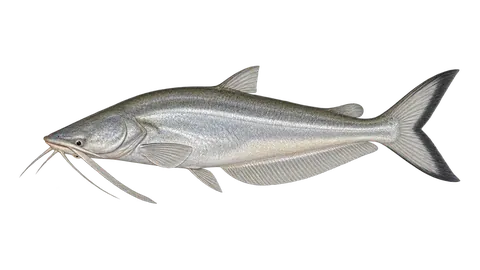
Scientific illustration of Highwaterman catfish
common size
30–45 cm
maximum
58 cm
common weight
0.2–0.8 kg
record/max.
1.3 kg
depth
0–37 m
ideal water
26–31 °C
overview

who is the highwaterman catfish

A pelagic, toothless, scaleless catfish that lives in schools near the surface over soft mud bottoms. FishBase places it in the family Pimelodidae, and many authors treat it in Hypophthalmidae. It filters crustacean plankton (cladocerans, copepods, ostracods) and detritus with long gill rakers, and follows the rise and fall of plankton through the day. Spawning is batch-wise, with 50,000 to 100,000 eggs per female; young stay in the lower river and estuaries, and adults move upstream. It is sold fresh or salted. In the lower Tocantins at Cametá (PA), the opening of the mapará fishing season in March is a municipal intangible cultural heritage. In the Itaipu reservoir in the upper Paraná, it became one of the most abundant species after the dam was built. Because it filters plankton, it hardly ever takes bait.

fun facts

  • In Cametá (PA), the opening of the mapará (Hypophthalmus edentatus) fishing season is the municipality's intangible cultural heritage (Lei municipal nº 349/2020, cited in the fishing agreement).
  • The young mapará under 29 cm is called mapará fifiti in the Cametá fishing agreement, and fishing for it is banned.
  • Its eyes sit so low on the head that the genus name, Hypophthalmus, means 'eye below'.
how to recognize it

identification

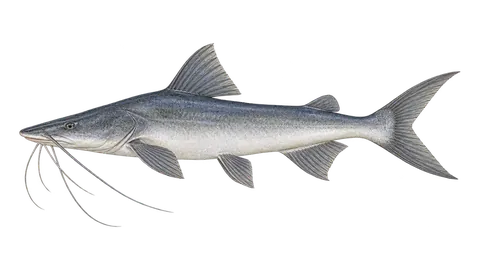
Elongated, compressed, scaleless body, pale gray back with a steel-blue sheen and a yellowish to whitish belly. Slightly flattened head, low eyes set on the sides, wide toothless mouth, long gray barbels and many long gill rakers. The mapará most often caught, Hypophthalmus marginatus (Mapará species page), looks very similar: species in the genus are separated by counts and proportions, not color, and in fishing and in rules they are all called mapará.

how highwaterman catfish fishing looks

Loading the next 7 days…

Each card shows the day's index (0 to 100) and, below it, a strip with the index for each hour, from 0h to 23h. from poor to excellent.

distribution

where found

open on the large map

Channels and lakes of whitewater rivers in the Amazon, the lower Tocantins (Cametá, in Pará) and the Araguaia-Tocantins basin; outside Brazil, the Orinoco and coastal rivers of the Guianas and Suriname. FishBase also cites it in the Paraná, and there is an abundant population in the Itaipu reservoir, where it arrived after 1982 (Júlio Júnior et al., 2009).

Habitat: Midwater and surface of rivers, lakes and reservoirs, over soft mud; young in lower reaches and estuaries, adults farther upstream.

native to the basins

AmazonTocantins-Araguaia

introduced in

Paraná

states

Amazonas, Pará, Amapá, Tocantins, Mato Grosso, Paraná

calendar and clock

when to fish

best season

time of yearbest: Jul–Oct
JanFebSeaAprMayJunJulAugSepOctNovDec

Most caught during falling water and the dry season. In the lower Tocantins, larvae have been recorded year-round and spawning in December and January in the past (Portal Amazônia, 2024). Closed seasons and minimum sizes are in the rules section.

best time of day

0h6h12h18h sunrise ~6amsunset ~6pm

Nighttime. It follows plankton: it rises to the surface at night and stays deeper by day, according to FishBase. Professional net fishing takes place at night.

weather, water and behavior

what affects the highwaterman catfish
sensitivity The little bars show how much each factor affects this species. Five full: it feels it a lot.

cold and cold fronts

Cold snaps reduce activity.

atmospheric pressure

Little known effect.

moon

Net fishers report higher catches on dark nights, when the school rises.

rain

Little effect.

water level

Falling water concentrates the school.

noise

Not very sensitive.

wind

Strong wind hampers surface net fishing.

depth

Surface at night; down to about 37 m by day, according to FishBase.

technique, gear and bait

how to fish

rod
not applicable: the mapará filters plankton and hardly ever takes a hook
spinning / baitcasting reel
not applicable
line
not applicable
leader
not applicable
hook
not applicable

tip from an angler

It is a net fish of artisanal fishing. For hook anglers it serves as an indicator: where there are mapará schools, predators such as pescada and peacock bass tend to hang around.

what the law says

rules for the highwaterman catfish

Summary of the regulations we found, with the source for each. Rules change; before keeping or transporting fish, check with the state environmental agency.
Conservation: Not on the Brazilian national list (Ministerial Ordinance GM/MMA No. 1.667/2026).

Amazonian closed season (AM, AC, PA, AP)

catch, transport and sale prohibited (professional fishing)15/11 to 15/03AMACPAAPAmazon

In AM, AC, PA and AP, mapará (Hypophthalmus spp.) is in Annex II of the ministerial ordinance, with fishing prohibited from November 15 to March 15. Under art. 2, II, anglers fishing with handline, pole, or line and hook are exempt from this ban, unless a stricter state rule applies; during the period, the recreational limit is 5 kg plus 1 specimen (art. 3).

Source: Portaria IBAMA nº 48/2007, Annexes I and II

PA (Cametá, lower Tocantins): minimum 29 cm

29 cm total lengthPATocantins-Araguaia

In the Cametá Fishing Agreement, in the area of the communities between Tamanduá-Costa and Pindobal, fishing for mapará (Hypophthalmus spp.) under 29 cm total length, the so-called mapará fifiti, is prohibited. The rule applies only to that stretch of the Tocantins River and for 3 years from publication (February 29, 2024); confirm whether it has been renewed.

Source: Portaria Semas-PA nº 288/2024 (Cametá Fishing Agreement), arts. 3º, III, and 5º, V and VI

PA (Cametá, lower Tocantins): closed season November 1 to February 28

commercial fishing prohibited; subsistence up to 5 kg plus 1 specimen01/11 to 28/02PATocantins-Araguaia

Under the Cametá Fishing Agreement, from November 1 to February 28, all commercial fishing activity is prohibited, including transport and sale of native Tocantins fish. Subsistence fishing is allowed up to 5 kg plus 1 specimen per day and per family, with handline, pole or rod. Recreational rod-and-hook fishing is allowed in the agreement area. The closed season ends February 28 and the mapará season opens in March.

Source: Portaria Semas-PA nº 288/2024 (Cametá Fishing Agreement), arts. 5º, VII, 6º, IV, and 7º

piracema closures in the basins where the species lives

Closed season in Goiás (state rule)

01/11 to 28/02GO

Allowed: Sport and guided fishing only in reservoirs, catch and release with barbless hooks (no keeping, transporting or eating). Subsistence: up to 5 kg per day, for household consumption only.

Source: IN Semad-GO nº 17/2026, arts. 8º to 11

Spawning closure (piracema) in Mato Grosso (all basins)

01/10 to 31/01MT

Allowed: All fishing modalities are prohibited in rivers, including catch and release (Law 9.096/2009, art. 19-A). Exceptions: subsistence fishing from shore (3 kg or 1 fish, no transport or sale) and scientific fishing. Law 13.159/2025 now allows licensed sport fishing in UHE/PCH hydropower reservoirs, natural lakes and border rivers, subject to a scientific study and a license from the environmental agency. We have not confirmed whether these licenses are already being issued.

Source: IN Interministerial MAPA/MMA nº 10/2017; Resolução Cepesca-MT nº 1/2026; Lei estadual MT nº 9.096/2009, arts. 19-A and 27 (Leis 12.434/2024 and 13.159/2025)

Spawning closure (piracema) in the Araguaia River basin

01/11 to 28/02GOTOPAMT

Allowed: Recreational fishing only in reservoirs, with handline, rod, or spinning or baitcasting reel. Fish may only be eaten on site, not transported. Competitions prohibited. Subsistence: 3 kg + 1 fish. State rules (GO and TO) may be stricter.

Source: IN Interministerial MPA/MMA nº 12/2011

Spawning closure (piracema) in the Tocantins and Gurupi river basins

01/11 to 28/02TOPAMAGO

Allowed: Recreational fishing only in reservoirs, with on-site consumption. Subsistence: 5 kg + 1 fish. State rules may be stricter.

Source: IN Interministerial MPA/MMA nº 13/2011

Closed season in the rivers of Marajó Island (PA)

01/01 to 30/04PA

Allowed: The same recreational-angler exceptions as in Portaria 48/2007 apply (handline or rod, 5 kg + 1 fish), unless a stricter state rule applies.

Source: Portaria IBAMA nº 48/2007

Closed season in the Amazon basin in Amapá

15/11 to 15/03AP

Allowed: Recreational anglers with handline or rod, line and hook are outside the Annex II prohibitions, with a bag limit of 5 kg + 1 fish, unless a stricter state rule applies.

Source: Portaria IBAMA nº 48/2007

Border rivers MT/RO and MT/PA

05/11 to 28/02MTROPA

Allowed: See the exceptions in Portaria 48/2007 and the state rules for each bank.

Source: Portaria IBAMA nº 48/2007

catch and release
catch and release Releasing the fish alive, quickly and with a wet hand. During a closed season it isn't always allowed: what the regulation says applies.

The rule does not apply to hook fishing. If it comes up in the net or on the hook and is below size (29 cm in Cametá and in MT), release it alive and without delay.

in the kitchen

Sold fresh or salted, according to FishBase. In the lower Tocantins it is the fish of the fishing-season opening festival, in March.

calculator

how much it weighs without taking it out of the water

Length-weight relationship W = a·Lb (a = 0.00617, b = 3.11; FishBase (relação peso-comprimento bayesiana, estimativa da própria espécie)). It's an average: a fat or lean fish can vary by 10% to 20%.

estimated weight

—

sources and references

The season weights (months), the time of day and the sensitivities (cold, pressure, moon, wind, rain, tide, strong light, murky water and noise) are the app's editorial estimates, based on the literature below and on the field experience of anglers and guides. They are not official data nor a measurement made for this species, and they may vary by region and year. Closed seasons and legal rules appear in the rules section, with the norm and a link.

  1. scientific FishBase: Hypophthalmus edentatus (ficha da espécie)Size, length-weight relationship, depth, habitat, distribution, biology and IUCN status. Page checked on October 13, 2026. FishBase cites a common length of 45 cm and a published maximum weight of 1.3 kg; the common size and weight range on this card is an editorial estimate, calculated from the length-weight relationship.
  2. scientific FishBase: nomes populares de Hypophthalmus edentatusNames by country and language.
  3. official Portaria GM/MMA nº 1.667, de 27 de abril de 2026: Lista Nacional Oficial de Espécies da Fauna Ameaçadas de Extinção (peixes e invertebrados aquáticos)The species is not on the list. Checked in the DOU of April 28, 2026.
  4. scientific IUCN Red List: Hypophthalmus edentatus (avaliação global: Pouco Preocupante, LC, 16/12/2020)Global assessment. Link given on the FishBase entry (Red List, version 2025-2).
  5. official Portaria IBAMA nº 48/2007: defeso na bacia do rio AmazonasAnnex II: mapará (Hypophthalmus spp.) with fishing banned in AC, AM, PA and AP during the closed season; arts. 2º and 3º on the recreational angler. Page checked on October 13, 2026.
  6. official Portaria Semas-PA nº 288, de 28/02/2024: homologa o Acordo de Pesca de Cametá (DOE nº 35.727, de 29/02/2024)Defines the mapará fifiti (under 29 cm), bans fishing for it and sets the closed season from Nov 1 to Feb 28; the Cametá municipal law nº 349/2020 is cited in relation to Hypophthalmus edentatus. Text checked on October 13, 2026.
  7. official Portaria Naturatins nº 47/2026, Anexo I (redação da Portaria nº 105/2026), Diário Oficial do Tocantins nº 7.089, de 29/06/2026Line of mapará (Hypophthalmus edentatus): 25 and 55 cm. Page checked on October 13, 2026.
  8. official Lei estadual MT nº 9.096/2009 e Lei nº 12.434/2024: medidas mínimas e cotas (Sema-MT)Araguaia basin table: mapará (Hypophthalmus edentatus), 29 cm; art. 19-C on recreational fishing. Document updated on June 6, 2025 and checked on October 13, 2026.
  9. scientific Ambrósio, A. M.; Gomes, L. C.; Agostinho, A. A. (2003). Age and growth of Hypophthalmus edentatus (Spix), (Siluriformes, Hypophthalmidae) in the Itaipu Reservoir, Paraná, Brazil. Revista Brasileira de Zoologia 20(2): 183-190.Shows the species' presence at Itaipu. DOI and title checked on Crossref.
  10. scientific Júlio Júnior, H. F.; Tós, C. D.; Agostinho, Â. A.; Pavanelli, C. S. (2009). A massive invasion of fish species after eliminating a natural barrier in the upper rio Paraná basin. Neotropical Ichthyology 7(4): 709-718.Cites Hypophthalmus edentatus as a species that colonized the upper Paraná and became one of the most abundant after the Itaipu damming; the authors note uncertainty about the name (H. oremaculatus). Text checked on October 13, 2026.
  11. press Portal Amazônia (14/08/2024): pesquisa da UFPA sobre a reprodução do mapará no baixo TocantinsCommon names, spawning recorded at Tucuruí in December and January, and larvae all year in the lower Tocantins. Article checked on October 13, 2026.
  12. technical Wikipédia (en): Hypophthalmus edentatusColor description (light gray back with a steel-blue sheen, yellowish and whitish belly, gray barbels). Open encyclopedia, used only for this description; page checked on October 13, 2026.
don't confuse

similar species