Skip to content
catalog Epinephelidae · predator

goliath grouper

Epinephelus itajara

SeaEstuarynational list: CR · critically endangered

The largest grouper in the Atlantic, over 2 m long. Critically Endangered: fishing banned since 2002.

Also called: mero, canapu (jovem, Nordeste), mero-gigante

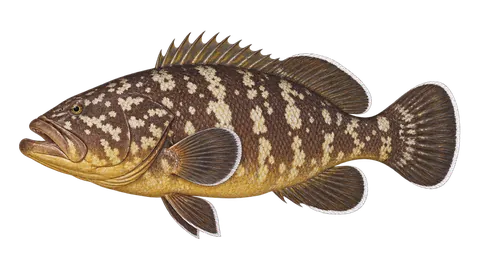
Scientific illustration of Goliath grouper
common size
100–200 cm
maximum
250 cm
common weight
30–200 kg
record/max.
455.0 kg
depth
1–100 m
ideal water
24–29 °C
overview

who is the goliath grouper

The goliath grouper is the largest reef fish in the Atlantic: over 2 m and 300 kg. It lives around wrecks, pilings, rocky shores and offshore reefs, and juveniles grow up in mangroves and estuaries, from Amapá to Santa Catarina. Slow, curious and very faithful to its territory, it is easy prey for longline, net and harpoon, which drove the population to collapse. It was Brazil's first marine fish to get a fishing moratorium, in 2002, and today it is Critically Endangered: fishing, transporting, storing or selling it is an offense and an environmental crime. It gathers to spawn in summer at wrecks and rocky outcrops. It is worth more alive: diving with groupers drives tourism at several points along the coast.

fun facts

  • It can exceed 400 kg and live nearly 40 years.
  • It makes a deep sound, like thunder, when threatened.
  • It was the first marine species to get a fishing moratorium in Brazil.
how to recognize it

identification

Goliath grouper: long, very thick body, broad flat head, tiny eyes and a huge mouth. Yellowish brown to olive, with small black spots on the head and fins and slanting dark blotches on the body, clearer in juveniles. Rounded fins; dorsal spines lower than the soft part. Difference from the dusky grouper (garoupa) and the black grouper (badejo): much larger size, wider head and small black spots.

how goliath grouper fishing looks

Loading the next 7 days…

Each card shows the day's index (0 to 100) and, below it, a strip with the index for each hour, from 0h to 23h. from poor to excellent.

distribution

where found

open on the large map

From Amapá to Santa Catarina. Juveniles in mangroves and estuaries (especially the coast of Pará, Maranhão, Paraíba, Pernambuco and Babitonga, SC); adults at wrecks, offshore reefs and pilings.

Habitat: Wrecks, pier and platform pilings, rocky shores and offshore reefs; juveniles in mangroves and estuaries.

coast

North CoastNortheast CoastSoutheast CoastSouth Coastcoastalshelf

states

Amapá, Pará, Maranhão, Piauí, Ceará, Rio Grande do Norte, Paraíba, Pernambuco, Alagoas, Sergipe, Bahia, Espírito Santo, Rio de Janeiro, São Paulo, Paraná, Santa Catarina

calendar and clock

when to fish

best season

time of yearbest: Nov–Feb
JanFebSeaAprMayJunJulAugSepOctNovDec

Spawning aggregations in summer, at wrecks and rocky areas. Biological note: catching it is banned all year round.

best time of day

0h6h12h18h sunrise ~6amsunset ~6pm

Dawn and dusk. Most active at dawn, at dusk and at night; during the day it stays still on the structure.

weather, water and behavior

what affects the goliath grouper
sensitivity The little bars show how much each factor affects this species. Five full: it feels it a lot.

cold and cold fronts

Very sensitive to cold: cold snaps have already killed groupers in shallow waters.

atmospheric pressure

Not very relevant.

moon

Spawning aggregations seem to be linked to the moon.

rain

Not very relevant.

water level

Juveniles in the estuary tolerate low-salinity water.

noise

Curious, it approaches divers, which makes it vulnerable.

wind

Not very relevant.

tide

Juveniles in mangroves follow the flood tide into the mangrove creeks and return to the pools on the ebb. Adults at wrecks stay in the shelter of the current.

depth

Juveniles from 1 to 5 m; adults from 5 to 50 m.

technique, gear and bait

how to fish

rod
Catch prohibited.
spinning / baitcasting reel
—
line
—
leader
—
hook
—

accessories

  • cutting pliers for a quick release

tip from an angler

If a goliath grouper is hooked by accident, don't lift it out of the water: remove the hook with pliers if you can reach it, or cut the line close to the mouth. Record it and notify the environmental agency if it is injured.

what the law says

rules for the goliath grouper

Summary of the regulations we found, with the source for each. Rules change; before keeping or transporting fish, check with the state environmental agency.
Conservation: Fishing for it is prohibited across Brazil.

History of the specific moratorium

moratorium since 2002confirm with the agency

Catching goliath grouper was banned in 2002 (Portaria Ibama 121/2002), with successive extensions (2007 and 2012), the last by Portaria Interministerial MPA/MMA nº 13/2015, valid until 2023. No new specific extension has been found: since then, protection has come from the national list of threatened species.

Source: Portaria Interministerial MPA/MMA nº 13/2015; Portaria Ibama nº 121/2002

Goliath grouper (mero): catching prohibited

North CoastNortheast CoastSoutheast CoastSouth Coast

Epinephelus itajara is Critically Endangered (CR). Catching, transport, storage and sale are prohibited, with no end date. Protection began with moratoria in 2002 (Portaria IBAMA 121/2002, renewed later). It now stems from the national threatened species list. Incidental catch: release alive, with care (goliath grouper suffers from decompression).

Source: Portaria GM/MMA nº 1.666/2026 (art. 3º) and nº 1.667/2026 (CR); previously, Portaria MMA 445/2014 and 148/2022
catch and release
catch and release Releasing the fish alive, quickly and with a wet hand. During a closed season it isn't always allowed: what the regulation says applies.

This is not catch and release: it is release of accidental catch. Keep the fish in the water, without hoisting it, and no photos out of the water.

in the kitchen

Catch and trade banned. Don't buy it.

calculator

how much it weighs without taking it out of the water

Length-weight relationship W = a·Lb (a = 0.0233493, b = 3.04; FishBase (estimativa bayesiana, comprimento total); coeficiente a ajustado ao porte máximo registrado). It's an average: a fat or lean fish can vary by 10% to 20%.

estimated weight

—

sources and references

The season weights (months), the time of day and the sensitivities (cold, pressure, moon, wind, rain, tide, strong light, murky water and noise) are the app's editorial estimates, based on the literature below and on the field experience of anglers and guides. They are not official data nor a measurement made for this species, and they may vary by region and year. Closed seasons and legal rules appear in the rules section, with the norm and a link.

  1. scientific FishBase — Epinephelus itajara (ficha da espécie)Names, distribution, biology, length-weight relationship and references. Page checked on October 13, 2026.
  2. official Portaria GM/MMA nº 1.667, de 27 de abril de 2026 — Lista Nacional Oficial de Espécies da Fauna Ameaçadas de Extinção (peixes e invertebrados aquáticos)The species is listed as CR (checked in the text published in Brazil's Official Gazette (DOU) of Apr 28, 2026, section 1, p. 96).
  3. official ICMBio/SALVE — Ficha de Epinephelus itajara (avaliação nacional do risco de extinção)National assessment by ICMBio, published in 2024. DOI verified on Crossref.
  4. scientific IUCN Red List — Epinephelus itajara (avaliação global: Vulnerável, VU, 20/11/2016)Global assessment. Link given on the FishBase entry (Red List, version 2025-2).
  5. scientific Heemstra, P. C.; Randall, J. E. (1993). FAO species catalogue. Vol. 16. Groupers of the world (family Serranidae, subfamily Epinephelinae). FAO Fisheries Synopsis 125(16). Roma: FAO.
  6. scientific Bueno, L. S.; Bertoncini, A. A.; Koenig, C. C.; Coleman, F. C.; Freitas, M. O.; Leite, J. R.; et al. (2016). Evidence for spawning aggregations of the endangered Atlantic goliath grouper Epinephelus itajara in southern Brazil. Journal of Fish Biology 89: 876–889.
  7. scientific Menezes, N. A.; Buckup, P. A.; Figueiredo, J. L.; Moura, R. L. (orgs.) (2003). Catálogo das espécies de peixes marinhos do Brasil. São Paulo: Museu de Zoologia da USP. 160 p.List of the marine species recorded in Brazil. Printed work; the URL is the bibliographic record in FishBase, which cites the catalogue for the species.
don't confuse

similar species