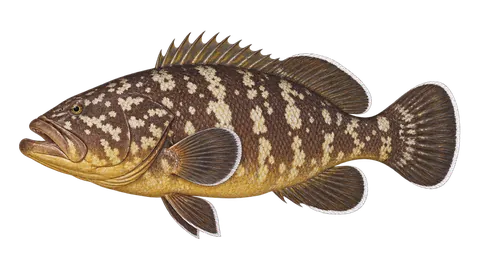
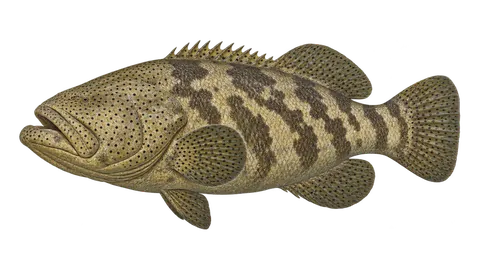
The badejo-quadrado, called sirigado in the Northeast, is one of the largest groupers in the Atlantic, over 1.4 m and 60 kg. It lives on reefs, patch reefs, wrecks and deep rocky shores, usually at 20 to 100 m; juveniles stay in shallow areas and coastal reefs. It hunts fish and squid with fast strikes and is more active and mobile than the grouper, even chasing trolling baits. It forms spawning aggregations in winter, when it becomes very exposed. That is why it is Endangered on the national list and has its own rule: a closed season in August and September and, for recreational anglers, catch and release only. A strong, fast fight toward the rock.
fun facts
It is also born female and turns male as it grows.
In the Northeast, the name sirigado is better known than "badejo" (grouper).
how to recognize it
identification
More elongated than the goliath grouper, with a pointed head. Grey-olive to brown body with rectangular dark blotches forming a "square" pattern, and tan dots on the head and underside. Straight tail with a dark edge and white thread. Difference from the goliath grouper: longer body, straight tail and solid dark blotches, not pale. The goliath grouper is much thicker, with a broad head and rounded tail.
how black grouper fishing looks
Loading the next 7 days…
Each card shows the day's index (0 to 100) and, below it, a strip with the index for each hour, from 0h to 23h. from poor to excellent.
From Maranhão to Santa Catarina, most common on the reefs and patch reefs of the Northeast, Abrolhos, Espírito Santo, Rio de Janeiro and the north coast of São Paulo.
Habitat: Reefs, patch reefs, wrecks and deep rocky shores; juveniles on shallow coastal reefs.
coast
North CoastNortheast CoastSoutheast CoastSouth Coastcoastalshelf
states
Maranhão, Piauí, Ceará, Rio Grande do Norte, Paraíba, Pernambuco, Alagoas, Sergipe, Bahia, Espírito Santo, Rio de Janeiro, São Paulo, Paraná, Santa Catarina
Winter spawning aggregations, protected by the closed season from August 1 to September 30. The best biological activity phase is in warm water, from late spring to autumn.
best time of day
Daytime, with peaks at dawn and dusk. Hunts by day, peaking at dawn and dusk.
weather, water and behavior
what affects the black grouper
sensitivity The little bars show how much each factor affects this species. Five full: it feels it a lot.
cold and cold fronts
Cold water shuts down activity on the patch reefs of the Southeast.
atmospheric pressure
Stable weather favors it; rough post-frontal sea gets in the way.
moon
Moderate effect; spawning aggregations tend to follow the lunar cycle.
rain
Not very relevant at sea.
water level
Rough sea prevents fishing on the offshore reefs.
noise
Wary of motors over the reef; make a long drift.
wind
Strong wind gets in the way of drifting and vertical jigging.
tide
Likes current: with the tide flooding or ebbing, it hunts at the edge of the offshore reef and in the front of the current. At slack tide, activity drops.
Summary of the regulations we found, with the source for each. Rules change; before keeping or transporting fish, check with the state environmental agency. Conservation: The species was reclassified from VU (2022) to EN (2026). Recovery plan: Portaria Interministerial 59-C/2018.
Amateur fishing for catch and release only
mandatory catch and release
Recreational and sport fishing of black grouper is allowed only as catch and release, in all Brazilian waters. Targeted fishing, transport, landing and trade outside the rules of the ordinance are prohibited. Spearfishing is not compatible with catch and release.
fishing prohibited August 1 to September 3001/08 to 30/09
Fishing for black grouper is banned from Aug 1 to Sep 30, throughout its range. Trade during the period is allowed only with stock declared to Ibama by Aug 10.
Authorized commercial fishing may only retain, transport and sell black grouper that are 60 cm or more in total length. It does not apply to recreational anglers, who must release all fish.
The black grouper is on the national list of threatened species (Endangered, EN). Its use is only allowed under the terms of the recovery plan; Portaria GM/MMA 1.666/2026 ordered the plans and rules to be reviewed, and they remain in force during the review. Check for changes before fishing.
Closed season for caranha, sirigado/badejo-quadrado (black grouper), garoupa-são-tomé and badejo-amarelo
01/08 to 30/09North CoastNortheast CoastSoutheast CoastSouth Coastconfirm with the agency
Closed season for threatened reef fish whose use is regulated by the recovery plan (Portaria MMA 292/2018 and PI 59-C/2018). Period confirmed in the 2026 official closed-season calendar of Sema-BA. We could not read PI 59-C (sizes and recreational-angler rules). Black grouper (badejo-quadrado) moved to EN in the 2026 list, and the plan is under review.
Black grouper (badejo-quadrado, EN) and caranha (VU): use only under the reef fish plan
North CoastNortheast CoastSoutheast CoastSouth Coastconfirm with the agency
Sirigado or badejo-quadrado (Mycteroperca bonaci, black grouper) moved from VU to EN on the 2026 list. Caranha (Lutjanus cyanopterus, cubera snapper) remains VU. Both have recognized use under Portaria MMA 292/2018, with rules in PI SEAP-PR/MMA 59-C/2018: closed season Aug 1 to Sep 30 and sizes we could not confirm. Because the black grouper moved up a category, the plan is under review (Portaria 1.666/2026, art. 11). If in doubt, release.
catch and release Releasing the fish alive, quickly and with a wet hand. During a closed season it isn't always allowed: what the regulation says applies.
Catch and release is mandatory for recreational anglers. Use a descender to return it to the bottom; don't puncture the swim bladder. Take a quick photo with the body supported horizontally.
in the kitchen
Recreational fishing is catch and release only.
calculator
how much it weighs without taking it out of the water
Length-weight relationship W = a·Lb (a = 0.0230633, b = 3.05; FishBase (estimativa bayesiana, comprimento total); coeficiente a ajustado ao porte máximo registrado). It's an average: a fat or lean fish can vary by 10% to 20%.
estimated weight
—
sources and references
The season weights (months), the time of day and the sensitivities (cold, pressure, moon, wind, rain, tide, strong light, murky water and noise) are the app's editorial estimates, based on the literature below and on the field experience of anglers and guides. They are not official data nor a measurement made for this species, and they may vary by region and year. Closed seasons and legal rules appear in the rules section, with the norm and a link.