The most sought-after rock fish of the South and Southeast. Vulnerable, with a closed season from November to February and a size window of 47 to 73 cm.
The grouper (garoupa-verdadeira) is the most sought-after rock fish of the South and Southeast. It lives on rocky shores, ledges and patch reefs, from a few metres to over 100 m, always close to dens. It is territorial, grows slowly, lives more than 50 years and changes sex: born female, the largest become males. That biology has left it vulnerable to fishing, and it is now on the national list as Vulnerable, with a recovery plan, a November to February closed season and a size window. It hunts by ambush, leaving its den to grab octopus, squid, fish and crabs, and goes straight back in. The fight is won in the first few metres.
fun facts
Born female, it becomes male at around 10 to 15 years.
Can live about 60 years.
Very territorial: the same grouper occupies the same den for years.
how to recognize it
identification
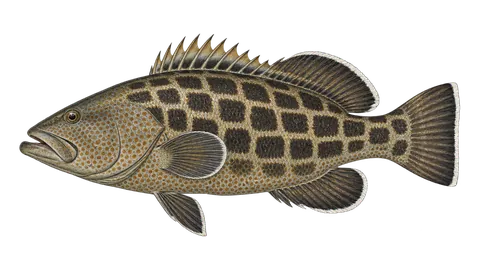
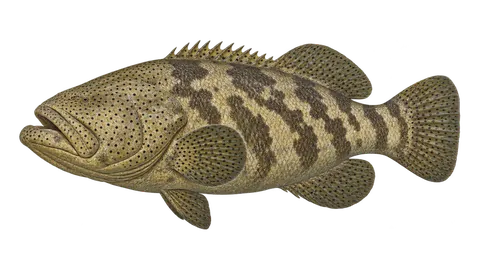
Robust body, large head, huge mouth with a projecting lower jaw. Dark brown to reddish, with irregular pale blotches over the body and head; soft dorsal, anal and tail fins with a thin white edge. Difference from the badejo-quadrado: the badejo is more elongated, has rectangular dark blotches and a straight tail. Difference from the goliath grouper (mero): the goliath exceeds 1.5 m, has a very broad head, tiny eyes and black spots.
how dusky grouper fishing looks
Loading the next 7 days…
Each card shows the day's index (0 to 100) and, below it, a strip with the index for each hour, from 0h to 23h. from poor to excellent.
It spawns in summer, protected by the closed season from November 1 to February 28. Outside it, March to May, with water still warm and clear, it tends to bite well on the rocky shores and patch reefs of the Southeast and South.
best time of day
Daytime, with peaks at dawn and dusk. Hunts by day from ambush, with peaks at dawn and dusk. At night it stays in its den.
weather, water and behavior
what affects the dusky grouper
sensitivity The little bars show how much each factor affects this species. Five full: it feels it a lot.
cold and cold fronts
A temperate-water fish; it tolerates cold better than the badejo, but very cold upwelling reduces activity.
atmospheric pressure
Stable pressure favors it; right after a cold front, with rough seas, fishing drops.
moon
Small effect; big-moon tides increase the current and the bait movement on the rocky shore.
rain
Not much relevant at sea; a storm on the rocky shore is dangerous.
water level
Surge muddies the water and stops rocky-shore fishing for days.
noise
Sensitive to motor noise over shallow rock; anchor away and approach with the current.
wind
Strong onshore wind makes the rocky shore dangerous and hampers drifting.
tide
Prefers moving water: with the tide flooding or ebbing, the current at the rock corner brings food and it leaves its den. At slack it eats less. On patch reefs, tidal current matters less than wind-driven current.
depth
On the rocky shore, 3 to 20 m; on patch reefs, 20 to 100 m.
rocky shore: 9 to 11 ft, 30 to 50 lb; boat: 5'6" to 6'6", 30 to 60 lb
spinning / baitcasting reel
300 to 400 baitcaster or 6000 to 8000 spinning reel, drag nearly locked
line
braid 40 to 65 lb
leader
fluorocarbon 60 to 100 lb, 1.5 m
hook
circle 5/0 to 8/0
lures
metal jig 60 to 150 g (slow pitch)
jig head 1 to 3 oz with large shad
natural baits
polvo
whole squid
live sardine
caranguejo
accessories
descender (fish descender)
measuring ruler
luvas
long-nose pliers
tip from an angler
On feeling the strike, lift the fish in the first few metres, with the drag nearly locked. If it gets into its den, leave the line slack for a few minutes: it often comes out on its own.
Summary of the regulations we found, with the source for each. Rules change; before keeping or transporting fish, check with the state environmental agency. Conservation: Recovery plan in force (Interministerial Ordinance 41/2018).
Closed season for dusky grouper (garoupa-verdadeira)
Nov 1 to Feb 2801/11 to 28/02
Targeted fishing, transport, landing and trade of the grouper (garoupa-verdadeira) from November 1 to February 28 are prohibited, for all methods and vessels. Trade in the period only with stock declared to Ibama by November 10.
Only grouper (garoupa-verdadeira) of 47 cm or more in total length may be caught and retained. IN MMA 53/2005 already set 47 cm for the Southeast and South.
Vulnerable species: recreational fishing not detailed in the rule
confirm with Ibama/MPAconfirm with the agency
The grouper (garoupa-verdadeira) is Vulnerable on the national list; use is valid only under the recovery plan. Ordinance 41/2018 regulates commercial fishing (vessels up to 20 AB, bottom longline and handline) and does not mention recreational fishing, which leads to divergent interpretations, including on underwater fishing. When in doubt, release and confirm with the competent agency. The plan is under review by Ordinance GM/MMA 1.666/2026.
Closed season for dusky grouper (garoupa-verdadeira)
01/11 to 28/02North CoastNortheast CoastSoutheast CoastSouth Coast
Targeted fishing, transport, landing and sale of dusky grouper (garoupa-verdadeira) are prohibited, for all methods and vessels. Outside the closed season, only fish of 47 to 73 cm (total length). The species is Vulnerable, and the plan is under review under Portaria GM/MMA 1.666/2026 (art. 11).
catch and release Releasing the fish alive, quickly and with a wet hand. During a closed season it isn't always allowed: what the regulation says applies.
Barotrauma is common from more than 15 to 20 m: release with a descender, without puncturing the swim bladder. Support the body; don't lift a large fish by the mouth alone.
in the kitchen
White, firm and highly valued meat. Respect the closed season and size window; if in legal doubt, release.
calculator
how much it weighs without taking it out of the water
Length-weight relationship W = a·Lb (a = 0.01023, b = 3.07; FishBase (estimativa bayesiana, comprimento total)). It's an average: a fat or lean fish can vary by 10% to 20%.
estimated weight
—
sources and references
The season weights (months), the time of day and the sensitivities (cold, pressure, moon, wind, rain, tide, strong light, murky water and noise) are the app's editorial estimates, based on the literature below and on the field experience of anglers and guides. They are not official data nor a measurement made for this species, and they may vary by region and year. Closed seasons and legal rules appear in the rules section, with the norm and a link.
scientificIUCN Red List — busca por Epinephelus marginatusAccording to FishBase (2025-2 version of the Red List), the species has not been assessed by the IUCN. Search for 'Epinephelus marginatus' on the site.