

- common size
- 100–200 cm
- maximum
- 250 cm
- common weight
- 30–200 kg
- record/max.
- 455.0 kg
- depth
- 1–100 m
- ideal water
- 24–29 °C

the right time
to be on the water
Choose the place and the species. The index, from 0 to 100, combines weather, sun, moon and tide with each fish's habits. Up to 28 days, with each day's confidence.
Loading the forecast…
—
Looking for alerts within 30 km…
Looking for what anglers have logged near here…
what you need to fish herelicense, certification and boat documents
fish likely at this spot
Tap a fish to see its forecast.
hour by hour
slide your finger or mouse over the chart to see each hoursee hour-by-hour table
why this index at —?
choose the day
the fishing month at a glance
what's the best window for the crew?
Choose how many fishing days. We compare each stretch by its average index, discount days with a warning or closed season, and show the 3 best.
trend for the coming weeks
Line: the middle value of 31 simulations of the American GEFS model. Band: where 8 out of 10 fall. Narrow, firm trend; wide, high uncertainty.
everything about the goliath grouper
how to recognize it
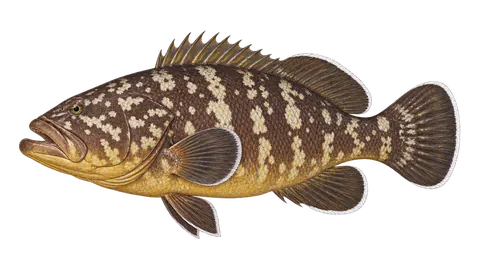
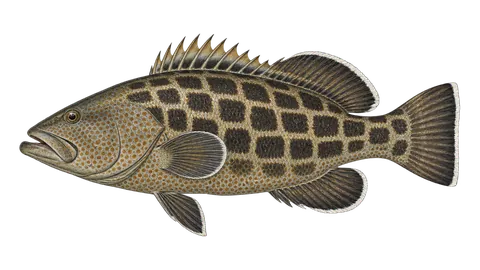
Goliath grouper: long, very thick body, broad flat head, tiny eyes and a huge mouth. Yellowish brown to olive, with small black spots on the head and fins and slanting dark blotches on the body, clearer in juveniles. Rounded fins; dorsal spines lower than the soft part. Difference from the dusky grouper (garoupa) and the black grouper (badejo): much larger size, wider head and small black spots.
Also called: mero, canapu (jovem, Nordeste), mero-gigante
don't confuse with:
where found
open on the large mapWhere to look: Wrecks, pier and platform pilings, rocky shores and offshore reefs; juveniles in mangroves and estuaries.
From Amapá to Santa Catarina. Juveniles in mangroves and estuaries (especially the coast of Pará, Maranhão, Paraíba, Pernambuco and Babitonga, SC); adults at wrecks, offshore reefs and pilings.
coast
states
Amapá, Pará, Maranhão, Piauí, Ceará, Rio Grande do Norte, Paraíba, Pernambuco, Alagoas, Sergipe, Bahia, Espírito Santo, Rio de Janeiro, São Paulo, Paraná, Santa Catarina
when to fish
best season
Spawning aggregations in summer, at wrecks and rocky areas. Biological note: catching it is banned all year round.
best time of day
Dawn and dusk. Most active at dawn, at dusk and at night; during the day it stays still on the structure.
what affects the goliath grouper
cold and cold fronts
Very sensitive to cold: cold snaps have already killed groupers in shallow waters.
atmospheric pressure
Not very relevant.
moon
Spawning aggregations seem to be linked to the moon.
rain
Not very relevant.
water level
Juveniles in the estuary tolerate low-salinity water.
noise
Curious, it approaches divers, which makes it vulnerable.
wind
Not very relevant.
tide
Juveniles in mangroves follow the flood tide into the mangrove creeks and return to the pools on the ebb. Adults at wrecks stay in the shelter of the current.
depth
Juveniles from 1 to 5 m; adults from 5 to 50 m.
how to fish
tip from an angler
If a goliath grouper is hooked by accident, don't lift it out of the water: remove the hook with pliers if you can reach it, or cut the line close to the mouth. Record it and notify the environmental agency if it is injured.
- rod
- Catch prohibited.
- spinning / baitcasting reel
- —
- line
- —
- leader
- —
- hook
- —
accessories
- cutting pliers for a quick release
catch and release
This is not catch and release: it is release of accidental catch. Keep the fish in the water, without hoisting it, and no photos out of the water.
kits and guides
rules for the goliath grouper
Rules change; before keeping or transporting fish, check with the state environmental agency.
Critically endangered species: fishing prohibited
catching, transport, holding and trade prohibited details
The goliath grouper is Critically Endangered (CR). Catching, transporting, storing, processing and selling it are banned throughout Brazil. A fish hooked by chance must be released alive on the spot.
Source: Portaria GM/MMA nº 1.667/2026 (list, CR) and Portaria GM/MMA nº 1.666/2026 (art. 3º)
History of the specific moratorium
moratorium since 2002confirm with the agency details
Catching goliath grouper was banned in 2002 (Portaria Ibama 121/2002), with successive extensions (2007 and 2012), the last by Portaria Interministerial MPA/MMA nº 13/2015, valid until 2023. No new specific extension has been found: since then, protection has come from the national list of threatened species.
Source: Portaria Interministerial MPA/MMA nº 13/2015; Portaria Ibama nº 121/2002
other rules that mention the goliath grouper (1)
Goliath grouper (mero): catching prohibited
North CoastNortheast CoastSoutheast CoastSouth Coast details
Epinephelus itajara is Critically Endangered (CR). Catching, transport, storage and sale are prohibited, with no end date. Protection began with moratoria in 2002 (Portaria IBAMA 121/2002, renewed later). It now stems from the national threatened species list. Incidental catch: release alive, with care (goliath grouper suffers from decompression).
Conservation: Fishing for it is prohibited across Brazil.
how much it weighs without taking it out of the water
estimated weight
—
how we calculate
Length-weight relationship W = a·Lb (a = 0.0233493, b = 3.04; FishBase (estimativa bayesiana, comprimento total); coeficiente a ajustado ao porte máximo registrado). It's an average: a fat or lean fish can vary by 10% to 20%.
more about the goliath grouper
The goliath grouper is the largest reef fish in the Atlantic: over 2 m and 300 kg. It lives around wrecks, pilings, rocky shores and offshore reefs, and juveniles grow up in mangroves and estuaries, from Amapá to Santa Catarina. Slow, curious and very faithful to its territory, it is easy prey for longline, net and harpoon, which drove the population to collapse. It was Brazil's first marine fish to get a fishing moratorium, in 2002, and today it is Critically Endangered: fishing, transporting, storing or selling it is an offense and an environmental crime. It gathers to spawn in summer at wrecks and rocky outcrops. It is worth more alive: diving with groupers drives tourism at several points along the coast.
Family: Epinephelidae · predator
fun facts
- It can exceed 400 kg and live nearly 40 years.
- It makes a deep sound, like thunder, when threatened.
- It was the first marine species to get a fishing moratorium in Brazil.
in the kitchen
Catch and trade banned. Don't buy it.
similar species
sources and references (7)
The season weights (months), the time of day and the sensitivities (cold, pressure, moon, wind, rain, tide, strong light, murky water and noise) are the app's editorial estimates, based on the literature below and on the field experience of anglers and guides. They are not official data nor a measurement made for this species, and they may vary by region and year. Closed seasons and legal rules appear in the rules section, with the norm and a link.
- scientific FishBase — Epinephelus itajara (ficha da espécie)Names, distribution, biology, length-weight relationship and references. Page checked on October 13, 2026.
- official Portaria GM/MMA nº 1.667, de 27 de abril de 2026 — Lista Nacional Oficial de Espécies da Fauna Ameaçadas de Extinção (peixes e invertebrados aquáticos)The species is listed as CR (checked in the text published in Brazil's Official Gazette (DOU) of Apr 28, 2026, section 1, p. 96).
- official ICMBio/SALVE — Ficha de Epinephelus itajara (avaliação nacional do risco de extinção)National assessment by ICMBio, published in 2024. DOI verified on Crossref.
- scientific IUCN Red List — Epinephelus itajara (avaliação global: Vulnerável, VU, 20/11/2016)Global assessment. Link given on the FishBase entry (Red List, version 2025-2).
- scientific Heemstra, P. C.; Randall, J. E. (1993). FAO species catalogue. Vol. 16. Groupers of the world (family Serranidae, subfamily Epinephelinae). FAO Fisheries Synopsis 125(16). Roma: FAO.
- scientific Bueno, L. S.; Bertoncini, A. A.; Koenig, C. C.; Coleman, F. C.; Freitas, M. O.; Leite, J. R.; et al. (2016). Evidence for spawning aggregations of the endangered Atlantic goliath grouper Epinephelus itajara in southern Brazil. Journal of Fish Biology 89: 876–889.
- scientific Menezes, N. A.; Buckup, P. A.; Figueiredo, J. L.; Moura, R. L. (orgs.) (2003). Catálogo das espécies de peixes marinhos do Brasil. São Paulo: Museu de Zoologia da USP. 160 p.List of the marine species recorded in Brazil. Printed work; the URL is the bibliographic record in FishBase, which cites the catalogue for the species.
how we calculatewhere each number comes from
The weather comes from three independent global models, cross-checked hour by hour: when they agree, confidence goes up; when they diverge, the band between them shows on the chart. Beyond 16 days, we use the GEFS ensemble of 31 simulations: if 20 of the 31 predict rain, the chance of rain is 65%. Sun and moon are calculated astronomically, with no uncertainty.
The index adds up, weighted for each species: time of day (species curve anchored to real sunrise and sunset), moon (transits, rise and set, phase), pressure (3 h trend and 24 h swing), water temperature (in rivers, estimated from air temperature; at sea, estimated by an ocean model), wind, rain, clouds, tide and the month in the species' cycle.
sources for this lookup
how accurate the forecast is
Accuracy measured in the reference project (4 regions, 93 days, forecast vs. observed): maximum temperature is off by 0.6 °C on average the next day and 1.7 °C at 7 days; rain of 5 mm or more is detected 76% of the time the next day and 57% at 7 days. Detection isn't everything: the false alarm rate isn't published here yet, and 93 days in 4 regions is still a small sample. We now also measure every day, at the app's destinations: