namorado sandperch
Pseudopercis numida
Noble bottom fish of the Southeast and South, with highly prized white flesh. Lives on submerged reefs and gravel bottoms of the shelf.
Also called: namorado

- common size
- 40–70 cm
- maximum
- 120 cm
- common weight
- 1–5 kg
- record/max.
- 20.2 kg
- depth
- 15–300 m
- ideal water
- 14–20 °C
who is the namorado sandperch
The namorado is a large pinguipedid, over 1 m and 20 kg, of the southwestern Atlantic: it ranges from Rio de Janeiro to Santa Catarina and has records as far as Golfo Nuevo in Argentina. It lives near the bottom, from shallow waters down to 300 m, most common between 100 and 300 m, on sand, gravel, and rock bottoms and on rocky reefs. It is one of the most valued fish in bottom line and longline fishing in the Southeast, with white, firm flesh, and it is much sought by recreational anglers on deep submerged reefs and wrecks, using squid and fish baits. Caught from great depth, it suffers barotrauma when brought to the surface.
fun facts
- It is endemic to the southwestern Atlantic.
- Records in Uruguay are probably of the relative Pseudopercis semifasciata.
identification
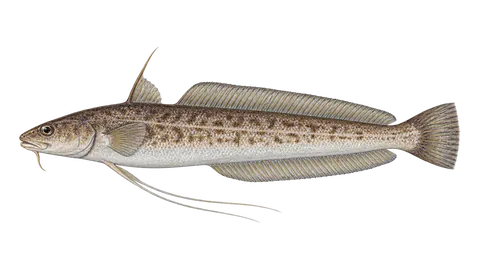
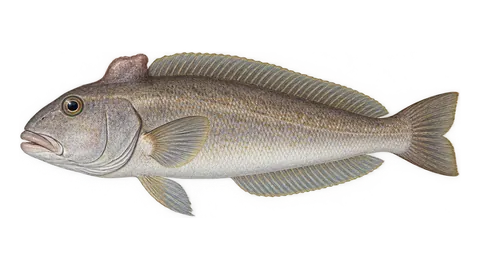
Elongated, almost cylindrical body, large head, wide mouth with a projecting lower jaw and thick lips. Grayish brown back and pale belly. One long dorsal fin, with seven short spines followed by 26 to 28 soft rays, and a long anal fin. Looks like the abrótea from a distance, but has no barbel and no filament-like pelvic fins.
Loading the next 7 days…
Each card shows the day's index (0 to 100) and, below it, a strip with the index for each hour, from 0h to 23h. from poor to excellent.
where found
From Rio de Janeiro to Santa Catarina, with records as far as Argentina; most common on the Southeast shelf.
Habitat: Sand, gravel, and rock bottoms and rocky reefs of the middle and outer shelf; deep submerged reefs and wrecks.
coast
states
Rio de Janeiro, São Paulo, Paraná, Santa Catarina, Rio Grande do Sul
when to fish
best season
Fished all year; calm-sea windows define the season.
best time of day
Any time. At depth light matters little; biting depends more on current and drift.
what affects the namorado sandperch
sensitivity The little bars show how much each factor affects this species. Five full: it feels it a lot.
cold and cold fronts
Lives in cold bottom water; surface cold has little effect on it.
atmospheric pressure
Not very sensitive, but a cold front brings rough seas.
moon
Small effect.
rain
No effect at depth.
water level
Does not depend on water level.
noise
Not very sensitive at 100 m depth.
wind
Strong wind prevents staying over the spot and keeping the line vertical.
tide
Strong current requires very heavy sinkers; look for weak current.
depth
80 to 250 m for most fishing.
how to fish
- rod
- 5'6" to 6'6", 30 to 60 lb
- spinning / baitcasting reel
- high-profile baitcaster or electric reel, or 10000 spinning reel
- line
- braid 40 to 65 lb
- leader
- monofilament 80 to 100 lb
- hook
- circle 6/0 to 9/0
lures
- 200 to 400 g slow pitch jigs
natural baits
- whole squid
- bonito or mackerel fillet
- sardinha
accessories
- 300 to 800 g sinker
- descompressor
- marker buoy
tip from an angler
Use a rig with large hooks and whole squid; when the namorado bites, reel in steadily, without giving slack.
rules for the namorado sandperch
Summary of the regulations we found, with the source for each. Rules change; before keeping or transporting fish, check with the state environmental agency.
Conservation: Not on the national list (Portaria GM/MMA 1.667/2026). We found no specific federal rule for this species.
We found no species-specific rule beyond the region's general rules.
catch and release
catch and release Releasing the fish alive, quickly and with a wet hand. During a closed season it isn't always allowed: what the regulation says applies.
If it comes from more than 100 m, it almost always suffers barotrauma; if you are going to release it, use a descending device to return it to the bottom.
in the kitchen
White, firm, highly prized flesh; excellent in grilled steaks, baked, and in moqueca.
how much it weighs without taking it out of the water
Length-weight relationship W = a·Lb (a = 0.00955, b = 3.01; FishBase (estimativa bayesiana, comprimento total)). It's an average: a fat or lean fish can vary by 10% to 20%.
estimated weight
—
sources and references
The season weights (months), the time of day and the sensitivities (cold, pressure, moon, wind, rain, tide, strong light, murky water and noise) are the app's editorial estimates, based on the literature below and on the field experience of anglers and guides. They are not official data nor a measurement made for this species, and they may vary by region and year. Closed seasons and legal rules appear in the rules section, with the norm and a link.
- scientific FishBase — Pseudopercis numida (ficha da espécie)Names, distribution, biology, length-weight relationship and references. Page checked on October 13, 2026.
- official Portaria GM/MMA nº 1.667, de 27 de abril de 2026 — Lista Nacional Oficial de Espécies da Fauna Ameaçadas de Extinção (peixes e invertebrados aquáticos)Most recent national list. The species is not on it (search by scientific name in the text published in the DOU, checked on October 13, 2026).
- official ICMBio/SALVE — Ficha de Pseudopercis numida (avaliação nacional do risco de extinção)National assessment by ICMBio, published in 2024. DOI verified on Crossref.
- scientific IUCN Red List — Pseudopercis numida (avaliação global: Pouco Preocupante, LC, 04/02/2009)Global assessment. Link given on the FishBase entry (Red List, version 2025-2).
- scientific Menezes, N. A.; Figueiredo, J. L. (1985). Manual de peixes marinhos do sudeste do Brasil. V. Teleostei (4). São Paulo: Museu de Zoologia da USP. 105 p.Printed work; the URL is the bibliographic record on FishBase, which cites this work for the species.
- scientific Haimovici, M.; Velasco, G. (2000). Length-weight relationships of marine fishes from southern Brazil. Naga, ICLARM Quarterly 23(1): 19–23.Length-weight relationships measured in southern Brazil. Printed work; the URL is the bibliographic record in FishBase, which cites this work for the species.
- scientific Menezes, N. A.; Buckup, P. A.; Figueiredo, J. L.; Moura, R. L. (orgs.) (2003). Catálogo das espécies de peixes marinhos do Brasil. São Paulo: Museu de Zoologia da USP. 160 p.List of marine species recorded in Brazil. Printed work; the URL is the bibliographic record in FishBase, which cites this work for the species.