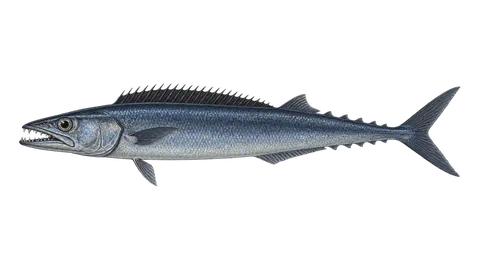
oilfish
Ruvettus pretiosus
A deep-water fish, brown, with very rough skin and flesh so oily that it acts as a laxative. FishBase marks it as poisonous to eat; eat little or avoid it.
Also called: peixe-prego, escolar, enchova-preta, enxova-preta, africana, oilfish

- common size
- 100–150 cm
- maximum
- 300 cm
- common weight
- 5.6–20 kg
- record/max.
- 63.5 kg
- depth
- 200–400 m
- ideal water
- 12–20 °C
who is the oilfish
The peixe-prego (oilfish) lives in tropical and temperate seas worldwide, on the continental shelf and in oceanic waters, usually between 200 and 400 m (the recorded range runs from 100 to 975 m). It tends to stay alone or in pairs near the bottom and moves away from the coast. It eats fish, crustaceans and squid and, when food is scarce on the bottom, rises at night to hunt near the surface. It reaches 300 cm and 63.5 kg, but a specialist consulted by FishBase says it does not exceed 2 m; the common length is 150 cm. Targeted fisheries are rare. It most often comes up as bycatch from tuna and swordfish longlines. The flesh is very oily, with indigestible waxes that have a laxative effect, and FishBase classifies the species as poisonous to eat.
fun facts
- In the South Pacific, fishers use a wooden hook, the 'palu', to catch the species.
- FishBase cites up to 300 cm, but a consulted specialist says the species does not exceed 2 m.
- It has been sold as peixe-manteiga (butterfish), robalo, bacalhau and other names.
identification
Elongated, compressed body, uniformly brown to dark brown. The skin is very rough: the scales are interspersed with spiny bony tubercles. It has a keel along the middle of the belly. The tips of the pectoral and pelvic fins are black and, in juveniles, the margins of the second dorsal and anal fins are white. The dorsal fin has 13 to 15 spines and the anal fin has none. The black escolar (Lepidocybium flavobrunneum) tends to be darker and has a strong lateral keel on the caudal peduncle.
Loading the next 7 days…
Each card shows the day's index (0 to 100) and, below it, a strip with the index for each hour, from 0h to 23h. from poor to excellent.
where found
Circumtropical and circumtemperate. In Brazil, it lives on the outer shelf and slope bottoms and in oceanic waters, usually from 200 to 400 m; we found no map of fishing spots in the country.
Habitat: Slope and outer shelf, usually 200 to 400 m (100 to 975 m), near the bottom; when food is scarce, it rises at night to hunt near the surface.
coast
when to fish
best season
No set season in deep, open waters. We found no closed season or specific rule in Brazil.
best time of day
Nighttime. It stays deep and, when food is scarce on the bottom, rises at night to hunt far from shore; the dark hours are the best time.
what affects the oilfish
sensitivity The little bars show how much each factor affects this species. Five full: it feels it a lot.
cold and cold fronts
It lives in deep, cold, stable water; a cold front only bothers it through rough seas.
atmospheric pressure
A cold front brings rough seas and makes it hard to hold position over the spot at night.
moon
The species rises at night to feed; moonlight may change the depth it stays at, but we found no measurement.
rain
No effect at depth.
water level
Not applicable at sea.
noise
Not very sensitive to noise at that depth.
wind
Strong wind and fast drift keep the bait from staying on the bottom.
tide
Strong current drags the line; with moderate current the bait stays on the bottom.
depth
Usually 200 to 400 m; rises at night.
how to fish
- rod
- 6' to 6'6", 50 to 80 lb, or electric gear for bottom fishing
- spinning / baitcasting reel
- electric reel or high-profile reel, for line over 300 m
- line
- braided line 80 to 130 lb
- leader
- heavy monofilament 100 to 150 lb or thin steel leader, 2 to 3 m
- hook
- circle 8/0 to 12/0
lures
- slow pitch jig 300 to 600 g
natural baits
- whole squid
- fish steak
accessories
- descender (descending device) for release
- luvas
- long-nose pliers
tip from an angler
The species has large teeth and rough skin: use gloves and a strong leader. If you will not eat it, release it with a descender.
rules for the oilfish
Summary of the regulations we found, with the source for each. Rules change; before keeping or transporting fish, check with the state environmental agency.
Conservation: Not on the Brazilian national list (Ministerial Ordinance GM/MMA No. 1.667/2026).
We found no species-specific rule beyond the region's general rules.
catch and release
catch and release Releasing the fish alive, quickly and with a wet hand. During a closed season it isn't always allowed: what the regulation says applies.
If it comes from more than 200 m, it arrives with barotrauma and rarely survives without help. If you release it, use a descender and gloves, because the skin is rough and the teeth are large.
in the kitchen
Caution: the flesh is very oily, with waxes that act as a laxative if eaten in quantity, and FishBase marks the species as poisonous to eat. According to Health Canada, which treats escolar and oilfish together, the effect is oily diarrhea, cramps and nausea a few hours later, and pregnant women, children, older people and people with bowel problems should avoid it. No safe dose has been defined; grilling to drain off the fat helps, but heat does not destroy the wax. It is sometimes sold under wrong names, such as peixe-manteiga (butterfish), robalo and bacalhau. We found no specific Brazilian rule.
how much it weighs without taking it out of the water
Length-weight relationship W = a·Lb (a = 0.00339, b = 3.11; FishBase (relação peso-comprimento bayesiana, estimativa da própria espécie)). It's an average: a fat or lean fish can vary by 10% to 20%.
estimated weight
—
sources and references
The season weights (months), the time of day and the sensitivities (cold, pressure, moon, wind, rain, tide, strong light, murky water and noise) are the app's editorial estimates, based on the literature below and on field experience from anglers and guides. They are not official data or measurements made for this species and may vary by region and year. Closed seasons and legal rules appear in the rules section, with the rule and link. The common size and weight ranges, water temperature and typical depth are also editorial estimates, anchored in FishBase data.
- scientific FishBase: Ruvettus pretiosus (ficha da espécie)Size, length-weight, depth, habitat, distribution, biology and IUCN status. Page checked on October 13, 2026. Common size and weight ranges, water temperature and typical depth: editorial estimates anchored in FishBase data. Entry name: 'peixe-prego' is one of the Brazilian Portuguese names FishBase lists (along with africana, enchova-preta, enxova-preta and escolar).
- scientific FishBase: nomes populares de Ruvettus pretiosusNames by country and language.
- official Portaria GM/MMA nº 1.667, de 27 de abril de 2026: Lista Nacional Oficial de Espécies da Fauna Ameaçadas de Extinção (peixes e invertebrados aquáticos)The species is not on the list. Checked in the DOU of April 28, 2026.
- official Health Canada: Escolar and Adverse Reactions (página de 08/04/2026)The escolar and the oilfish both have about 20% indigestible wax ester oil (gempylotoxin) in the muscle, which has a laxative effect. Symptoms begin within a few hours and clear up in 24 to 48 hours; pregnant women, children, the elderly and people with bowel problems should avoid it. No safe dose has been defined.
- technical Wikipedia: Oilfish (Ruvettus pretiosus)Secondary source, used for the nighttime rise to the surface, bycatch on longlines and mixing with other fish in restaurants. Data not checked against an official source.
- technical NOAA Fisheries: Return 'Em Right, soltura de peixes de recife pescados em fundo (barotrauma e dispositivos de descida)Guidance for releasing deep-water fish: barotrauma comes from rapid ascent, and specialists prefer descending devices to needle venting.