Skip to content
catalog Characidae · predator

saicanga

Galeocharax gulo

Freshwater

The humpbacked toothy fish of the upper Paraná and Tocantins-Araguaia reservoirs. Small, aggressive, and a good target for light artificial lures.

Also called: saicanga, peixe-cadela, dentudo, cacunda, peixe-cachorro

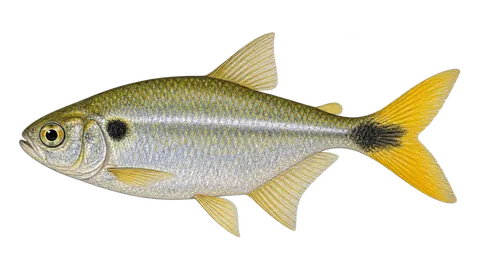
Scientific illustration of Saicanga
common size
15–25 cm
maximum
33 cm
common weight
0.1–0.2 kg
record/max.
0.4 kg
depth
0.5–6 m
ideal water
22–29 °C
overview

who is the saicanga

A predatory fish with an arched back and a large toothed mouth, which hunts small fish in reservoirs, eddies and rivers. Until 2017 the upper Paraná population was called Galeocharax knerii; the genus revision merged that form with G. gulo, which also occurs in the Tocantins-Araguaia, the Amazon (except the Negro and Xingu rivers) and the Orinoco. It does not occur in the São Francisco basin. It is common in reservoirs in São Paulo, Minas and Paraná, where it attacks small spoons, spinners and lambari. Small, but it fights well on ultralight tackle.

fun facts

  • Galeocharax comes from Greek and combines shark (galeos) with an ancient fish called charax.
  • The upper Paraná form, previously called G. knerii, was included in G. gulo in 2017.
how to recognize it

identification

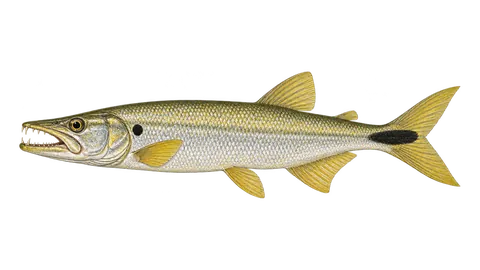
Tall body with an arched back just behind the head (humpbacked), silvery to yellowish, with a silver stripe along the flank. Dark spot behind the head, oval and elongated vertically. Transparent fins and a very long anal fin. Large toothed mouth. The peixe-cachorro is longer and has a horizontal tail spot.

how saicanga fishing looks

Loading the next 7 days…

Each card shows the day's index (0 to 100) and, below it, a strip with the index for each hour, from 0h to 23h. from poor to excellent.

distribution

where found

open on the large map

Upper Paraná, Tocantins-Araguaia and Amazon basin (except the Negro and Xingu rivers); outside Brazil, the Orinoco. Does not occur in the São Francisco.

Habitat: Reservoirs, eddies and river banks; mid-water near lambari schools.

native to the basins

ParanáTocantins-AraguaiaAmazon

states

São Paulo, Minas Gerais, Paraná, Goiás, Mato Grosso do Sul, Tocantins, Mato Grosso, Pará, Amazonas

calendar and clock

when to fish

best season

time of yearbest: Oct–Mar
JanFebSeaAprMayJunJulAugSepOctNovDec

Spring and summer; in southeastern winter it eats little.

best time of day

0h6h12h18h sunrise ~6amsunset ~6pm

Daytime, with peaks at dawn and dusk. Hunts by day, peaking at dawn and dusk.

weather, water and behavior

what affects the saicanga
sensitivity The little bars show how much each factor affects this species. Five full: it feels it a lot.

cold and cold fronts

Strong cold shuts down activity.

atmospheric pressure

A cold front shuts down biting.

moon

Little effect.

rain

Murky water hampers visual hunting.

water level

Little effect in reservoirs.

noise

Moderately sensitive.

wind

Light chop helps.

depth

Mid-water, 1 to 4 m.

technique, gear and bait

how to fish

rod
5' to 6', ultralight, 4 to 10 lb
spinning / baitcasting reel
spinning reel 1000 to 2000
line
braided line 8 to 12 lb or monofilament 0.20 mm
leader
fluorocarbon 20 lb
hook
treble hook #6 to 2

lures

  • colherzinha
  • spinner
  • micro jig
  • streamer

natural baits

  • live lambari

accessories

  • alicate

tip from an angler

Look for lambari schools in the reservoir: the saicanga is nearby. Fast retrieve with pauses.

what the law says

rules for the saicanga

Summary of the regulations we found, with the source for each. Rules change; before keeping or transporting fish, check with the state environmental agency.
Conservation: Not on the national list (Portaria GM/MMA 1.667/2026).

piracema closures in the basins where the species lives

Spawning closure (piracema) in the Paraná River basin

01/11 to 28/02SPPRMGGOMSDF

Allowed: Recreational fishing only for non-native species and hybrids (peacock bass, tilapia, black bass, carp, croaker, etc.; piauçu remains prohibited), with handline, simple pole, or rod with spinning or baitcasting reel, up to 10 kg + 1 fish. In rivers, from shore only; in reservoirs, from a boat or from shore. Prohibited: floodplain lakes, aquatic-animal bait, within 1,500 m of dams and waterfalls, and within 500 m of confluences. Tournaments only in reservoirs and only with non-native species.

Source: IN IBAMA nº 25/2009

Closed season in Goiás (state rule)

01/11 to 28/02GO

Allowed: Sport and guided fishing only in reservoirs, catch and release with barbless hooks (no keeping, transporting or eating). Subsistence: up to 5 kg per day, for household consumption only.

Source: IN Semad-GO nº 17/2026, arts. 8º to 11

Spawning closure (piracema) in Mato Grosso (all basins)

01/10 to 31/01MT

Allowed: All fishing modalities are prohibited in rivers, including catch and release (Law 9.096/2009, art. 19-A). Exceptions: subsistence fishing from shore (3 kg or 1 fish, no transport or sale) and scientific fishing. Law 13.159/2025 now allows licensed sport fishing in UHE/PCH hydropower reservoirs, natural lakes and border rivers, subject to a scientific study and a license from the environmental agency. We have not confirmed whether these licenses are already being issued.

Source: IN Interministerial MAPA/MMA nº 10/2017; Resolução Cepesca-MT nº 1/2026; Lei estadual MT nº 9.096/2009, arts. 19-A and 27 (Leis 12.434/2024 and 13.159/2025)

Spawning closure (piracema) in the Araguaia River basin

01/11 to 28/02GOTOPAMT

Allowed: Recreational fishing only in reservoirs, with handline, rod, or spinning or baitcasting reel. Fish may only be eaten on site, not transported. Competitions prohibited. Subsistence: 3 kg + 1 fish. State rules (GO and TO) may be stricter.

Source: IN Interministerial MPA/MMA nº 12/2011

Spawning closure (piracema) in the Tocantins and Gurupi river basins

01/11 to 28/02TOPAMAGO

Allowed: Recreational fishing only in reservoirs, with on-site consumption. Subsistence: 5 kg + 1 fish. State rules may be stricter.

Source: IN Interministerial MPA/MMA nº 13/2011

Closed season in the rivers of Marajó Island (PA)

01/01 to 30/04PA

Allowed: The same recreational-angler exceptions as in Portaria 48/2007 apply (handline or rod, 5 kg + 1 fish), unless a stricter state rule applies.

Source: Portaria IBAMA nº 48/2007

Closed season in the Amazon basin in Amapá

15/11 to 15/03AP

Allowed: Recreational anglers with handline or rod, line and hook are outside the Annex II prohibitions, with a bag limit of 5 kg + 1 fish, unless a stricter state rule applies.

Source: Portaria IBAMA nº 48/2007

Border rivers MT/RO and MT/PA

05/11 to 28/02MTROPA

Allowed: See the exceptions in Portaria 48/2007 and the state rules for each bank.

Source: Portaria IBAMA nº 48/2007

catch and release
catch and release Releasing the fish alive, quickly and with a wet hand. During a closed season it isn't always allowed: what the regulation says applies.

Remove the treble hook with pliers and release quickly; it loses scales easily.

in the kitchen

Small, bony fish; fried whole.

calculator

how much it weighs without taking it out of the water

Length-weight relationship W = a·Lb (a = 0.00912, b = 3.2; FishBase). It's an average: a fat or lean fish can vary by 10% to 20%.

estimated weight

—

sources and references

The season weights (months), the time of day and the sensitivities (cold, pressure, moon, wind, rain, tide, strong light, murky water and noise) are the app's editorial estimates, based on the literature below and on the field experience of anglers and guides. They are not official data nor a measurement made for this species, and they may vary by region and year. Closed seasons and legal rules appear in the rules section, with the norm and a link.

  1. scientific FishBase — Galeocharax gulo (ficha da espécie)Names, distribution, biology, length-weight relationship and references. Page checked on October 13, 2026.
  2. official Portaria GM/MMA nº 1.667, de 27 de abril de 2026 — Lista Nacional Oficial de Espécies da Fauna Ameaçadas de Extinção (peixes e invertebrados aquáticos)Most recent national list. The species is not on it (search by scientific name in the text published in the DOU, checked on October 13, 2026).
  3. official ICMBio/SALVE — Ficha de Galeocharax gulo (avaliação nacional do risco de extinção)ICMBio national assessment, published in 2025. DOI checked on Crossref.
  4. scientific IUCN Red List — Galeocharax gulo (avaliação global: Pouco Preocupante, LC, 04/03/2021)Global assessment. Link given on the FishBase entry (Red List, version 2025-2).
  5. scientific Giovannetti, V.; Toledo-Piza, M.; Menezes, N. A. (2017). Taxonomic revision of Galeocharax (Characiformes: Characidae: Characinae). Neotropical Ichthyology 15(1): e160040.Revision that includes G. knerii in G. gulo and describes the genus distribution. DOI and abstract checked in Crossref.
  6. scientific Ota, R. R.; Deprá, G. C.; Graça, W. J.; Pavanelli, C. S. (2018). Peixes da planície de inundação do alto rio Paraná e áreas adjacentes: revised, annotated and updated. Neotropical Ichthyology 16(2): e170094.Annotated list of species of the upper Paraná River, indicating native and non-native ones. Open access; species name checked in the text.
don't confuse

similar species