Skip to content
catalog Pimelodidae · predator

barred sorubim

Pseudoplatystoma fasciatum

Freshwater

Surubim catfish with dark bars on a pale background, from Amazonian rivers, the Orinoco and the Guianas; a nocturnal hunter of fish and crabs. It is an important sport and commercial fish, and the name P. fasciatum appears in the rules of several countries.

Also called: surubim, cachara, pintado, surubim-cachara, sorubim

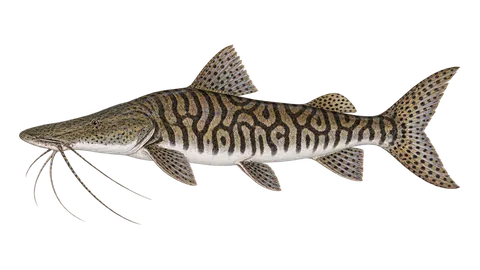
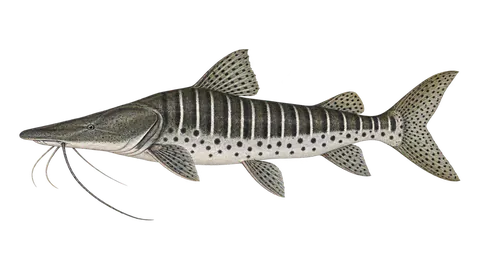
Scientific illustration of Barred sorubim
common size
60–90 cm
maximum
105 cm
common weight
2–8 kg
record/max.
70.0 kg
depth
3–20 m
ideal water
24–28 °C
overview

who is the barred sorubim

Pseudoplatystoma fasciatum is the oldest name for the striped surubims. The 2007 review by Buitrago-Suárez and Burr restricted the name to the Guianas and gave other names to the surubims of the Amazon, the Orinoco and the Paraná, but FishBase still uses it in a broad sense, and some authors treat it as a species of uncertain identity. Brazilian, Colombian and Peruvian rules keep using P. fasciatum, so this card brings them together. Adults live on the bed of large rivers and sometimes in flooded forest, and prefer more shaded streams than the caparari. They hunt at night for loricariids, cichlids, characins and crabs, always on the river bed. It is potamodromous: it goes up rivers to spawn. Females grow larger, maturing at 56 cm, and males at 45 cm. The flesh is yellowish, juicy and boneless.

fun facts

  • FishBase estimates 8 million eggs per kilo of female.
  • Females grow larger than males and mature at 56 cm, versus 45 cm for males.
  • The maximum weight of 70 kg published by FishBase does not match the 105 cm length, which gives about 13 kg by the length-weight relationship.
  • The name fasciatum is used in rules of Brazil, Colombia, Peru and Argentina for surubims that taxonomy now separates into more than one species.
how to recognize it

identification

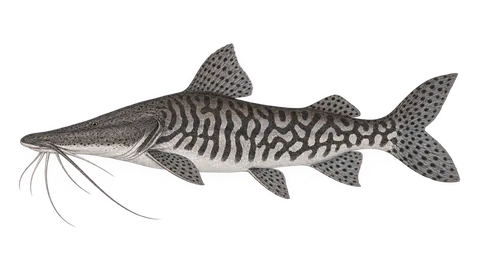
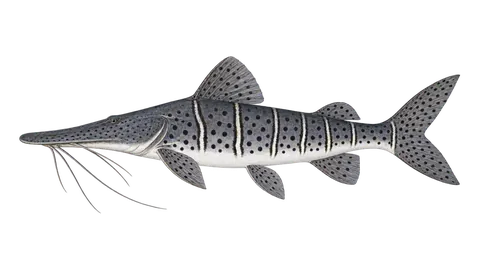
Long, broad, flattened head, elongated body gray to olive on the back with narrow dark vertical bars alternating with pale bands, and a white belly. The striped surubims of the Amazon and the Orinoco look very similar to each other. The caparari (P. tigrinum) has curved stripes forming loops, and the surubim pintado (P. corruscans) has spots instead of bars. In the field, the fishing area is the best guide; in the Paraná and the Pantanal, the striped surubim is the cachara.

how barred sorubim fishing looks

Loading the next 7 days…

Each card shows the day's index (0 to 100) and, below it, a strip with the index for each hour, from 0h to 23h. from poor to excellent.

distribution

where found

open on the large map

Whitewater and clearwater rivers of the Amazon basin; FishBase also cites the Corantijn, Essequibo, Orinoco and Paraná rivers. Under the 2007 review, the name fasciatum strictly applies to the Guianas; Brazilian rules use it for the Amazonian surubim, and those of the Paraná and the Pantanal use it for the cachara.

Habitat: Bed of large rivers, pools and channels of whitewater or clearwater, sometimes flooded forest; prefers shaded stretches. Typical water is pH 6.0 to 8.0 and 24 to 28 °C.

native to the basins

Amazon
calendar and clock

when to fish

best season

time of yearbest: Jul–Oct
JanFebSeaAprMayJunJulAugSepOctNovDec

Falling water and dry season (July to October in central Amazonia): fish concentrated in channels and pools, the best time. With rising water it goes up the rivers to spawn; that is why there is a closed season from Nov 15 to Mar 15 in Amazonas and Rondônia.

best time of day

0h6h12h18h sunrise ~6amsunset ~6pm

Nighttime. Hunts at night, on the river bed. By day it stays on the bottom of pools and channels, and fishing is best from late afternoon to dawn.

weather, water and behavior

what affects the barred sorubim
sensitivity The little bars show how much each factor affects this species. Five full: it feels it a lot.

cold and cold fronts

Cold snaps (friagem) shut down activity for a few days.

atmospheric pressure

Stable weather favors it; a sharp drop before a storm usually gives a short peak.

moon

Bright full-moon nights make the fish more wary; new and waxing moons give more bites on bottom bait.

rain

Rain in the headwaters that raises the river and muddies the water can activate the fish; a thunderstorm with lightning means getting out of the water.

water level

A falling river is the best scenario, with fish in the channel. At rising water it migrates and fishing becomes irregular.

noise

Sensitive to hull knocks and bright light: fish in the dark, with a red lantern.

wind

Little effect on the bottom.

depth

Bottom of pools and channels, 3 to 15 m; at night it rises to shallower banks.

technique, gear and bait

how to fish

rod
6'6" to 7', heavy action, 30 to 50 lb
spinning / baitcasting reel
low-profile baitcasting reel 400 to 500 or spinning reel 8000, with strong drag
line
braided line 50 to 80 lb
leader
monofilament or fluorocarbon 0.80 to 1.00 mm, 1 m
hook
circle hook 6/0 to 10/0, which hooks in the corner of the mouth and makes release easier

lures

  • shad or paddle tail, 10 to 15 cm
  • jig, 1/2 to 1 oz

natural baits

  • live lambari
  • tuvira or sarapó
  • small curimatã
  • piece of fresh fish

accessories

  • thick gloves
  • long-nose pliers
  • boga-grip
  • red light lantern

tip from an angler

Live or fresh bait on the bottom, at a lake mouth or cutbank, at night. Let the fish swallow the bait before setting the hook firmly: the circle hook hooks on its own.

what the law says

rules for the barred sorubim

Summary of the regulations we found, with the source for each. Rules change; before keeping or transporting fish, check with the state environmental agency.
Conservation: Not on the Brazilian national list (Ministerial Ordinance GM/MMA No. 1.667/2026).

Amazon basin: minimum size 80 cm

80 cm total lengthAmazon

Portaria Ibama nº 8/1996, art. 5º, bans catching, transporting and selling surubim (Pseudoplatystoma fasciatum) under 80 cm total length in the Amazon basin, except the Araguaia-Tocantins. A tolerance of up to 10% of smaller fish in the total catch per species applies. Total length runs from the tip of the snout to the tip of the caudal fin. The rule cites the species by the name P. fasciatum, still used today for the Amazonian surubim.

Source: Portaria Ibama nº 8/1996, art. 5º and §§ 1º and 2º

Amazonas: surubim closed season Nov 15 to Mar 15

catch, landing, storage, transport and sale banned15/11 to 15/03AMAmazon

Cemaam Resolution nº 18/2014 bans, from Nov 15 to Mar 15, the catch, landing, storage, transport and sale of surubim (P. fasciatum), caparari and jaraqui in Amazonas. Riverside communities may fish and transport up to 5 kg a day for subsistence. The rule does not cover recreational fishing. Ipaam, which enforces it, publishes the closed season each year and also cites Cemaam Resolution nº 21/2015 as a basis, with the same period and species; when in doubt, release the fish.

Source: Resolução Cemaam (AM) nº 18, of Sep 16, 2014, arts. 1º and 2º (and nº 21/2015, cited by Ipaam)

Rondônia (Madeira River): surubim closed season Nov 15 to Mar 15

catch banned; handline or rod are exempt, with a limit of 5 kg + 1 fish15/11 to 15/03ROAmazon

Annex II of Portaria Ibama nº 48/2007 bans, in the Madeira River basin in Rondônia, catching surubim (P. fasciatum), caparari, pescada, pirapitinga and jatuarana from Nov 15 to Mar 15. Art. 2º, II, exempts artisanal and recreational anglers who use handline or rod and line, where no stricter state rule applies, and art. 3º limits the recreational angler to 5 kg + 1 fish in the period. Tournaments are banned during the closed season.

Source: Portaria Ibama nº 48/2007, Annexes I and II and arts. 2º to 4º

Mato Grosso: surubim and cachara under Transporte Zero

catch and release; transport, storage and sale banned until Dec 31, 2028MT

Art. 19-B of Lei 9.096/2009 (wording from Lei 12.434/2024) bans for five years, from Jan 1, 2024, transporting, storing and selling cachara (Pseudoplatystoma fasciatum) and pintado/surubim (P. corruscans, P. fasciatum and Pseudoplatystoma sp.) caught in MT rivers. The recreational angler only practices catch and release; keeping on site (up to 2 kg or 1 fish, within 500 m of the river) applies only to species outside the list (art. 19-C, §4º).

Source: Lei estadual MT nº 9.096/2009, arts. 19-B and 19-C (added by Lei nº 12.434/2024) - Sema-MT

Mato Grosso (Amazon and Araguaia-Tocantins): minimum 80 cm

80 cmMTAmazonTocantins-Araguaia

Annex II of MT's fishing law sets 80 cm for surubim pintado (Pseudoplatystoma sp.) in the Amazon and Araguaia-Tocantins basins. With Transporte Zero in force, the fish goes back into the water, and the size serves as a reference for enforcement.

Source: Lei estadual MT nº 9.096/2009, art. 28 and Annex II - Sema-MT

Colombia: bagre rayado at least 80 cm

80 cm standard length with head (60 cm without head)confirm with the agency

The AUNAP table of current minimum sizes (updated in August 2018) lists the 'bagre rayado del Orinoco' (Pseudoplatystoma metaense and P. orinocoense, the latter treated as P. fasciatum) at 80 cm standard length with head, or 60 cm without head. The entry appears in the section for the Caquetá and Amazon basins (Acuerdo INDERENA 075/1989). The AUNAP table may have changed since; confirm with the authority.

Source: AUNAP 'Normatividad tallas mínimas vigentes' table (Colombia), updated Aug 8, 2018

Colombia: Orinoquia closed season, from Easter to May 31

from the first Monday after Holy Week until May 31: no storing, transporting or selling consumable fish outside the municipality

AUNAP Resolution nº 2663/2022 creates, in the departments of Meta, Vichada, Casanare, Arauca, Guaviare and Guainía, a closed season that starts on the first Monday after Holy Week and runs until May 31 each year. During this period it is banned to store, transport and sell consumable fish taken from the natural environment outside the municipality or department; sales may only take place within the municipality itself, directly by the subsistence fisher. The rule covers storage, transport and trade; confirm with AUNAP the rules for sport fishing in this period.

Source: Resolución AUNAP nº 2663, of Nov 9, 2022, arts. 1º and 2º

Peru: doncella with minimum catch size (86 cm fork length)

86 cm fork length (about 82 cm standard length)confirm with the agency

The considerandos of the Peruvian Amazon Fisheries Management Regulation (DS 015-2009-PRODUCE) recall that the earlier rule (RM 147-2001-PE) set minimum catch sizes for the doncella, cited as Pseudoplatystoma fasciatum, among other species. Individual sport fishing does not require a fishing permit. A 2022 scientific study reports that the Peruvian Amazon regulation sets 86 cm fork length (about 82 cm standard length), citing RM 147-2001-PE and DS 015-2009. The figure was not checked against the text of the rules.

Source: DS nº 015-2009-PRODUCE (Reglamento de Ordenamiento Pesquero de la Amazonía Peruana) and RM nº 147-2001-PE, per Armas et al. (2022)

Santa Fe (AR): the law's surubí atigrado is the Paraná 'P. fasciatum', at 78 cm

78 cm total length (commercial fishing table)confirm with the agency

Santa Fe Provincial Law 12.212, art. 10, lists the 'surubí atigrado (Pseudoplatystoma fasciatum)' at 78 cm in the commercial fishing table for the Paraná alluvial valley. The surubí atigrado of the Paraná and Plata now corresponds to the cachara (P. reticulatum), not to the species on this card; the figure is included here only because the rule uses the name. For sport fishing in environments and species not listed, measures are set by the enforcing authority.

Source: Ley provincial de Santa Fe nº 12.212, art. 10 (copy published by the press)

piracema closures in the basins where the species lives

Spawning closure (piracema) in Mato Grosso (all basins)

01/10 to 31/01MT

Allowed: All fishing modalities are prohibited in rivers, including catch and release (Law 9.096/2009, art. 19-A). Exceptions: subsistence fishing from shore (3 kg or 1 fish, no transport or sale) and scientific fishing. Law 13.159/2025 now allows licensed sport fishing in UHE/PCH hydropower reservoirs, natural lakes and border rivers, subject to a scientific study and a license from the environmental agency. We have not confirmed whether these licenses are already being issued.

Source: IN Interministerial MAPA/MMA nº 10/2017; Resolução Cepesca-MT nº 1/2026; Lei estadual MT nº 9.096/2009, arts. 19-A and 27 (Leis 12.434/2024 and 13.159/2025)

Closed season in the rivers of Marajó Island (PA)

01/01 to 30/04PA

Allowed: The same recreational-angler exceptions as in Portaria 48/2007 apply (handline or rod, 5 kg + 1 fish), unless a stricter state rule applies.

Source: Portaria IBAMA nº 48/2007

Closed season in the Amazon basin in Amapá

15/11 to 15/03AP

Allowed: Recreational anglers with handline or rod, line and hook are outside the Annex II prohibitions, with a bag limit of 5 kg + 1 fish, unless a stricter state rule applies.

Source: Portaria IBAMA nº 48/2007

Border rivers MT/RO and MT/PA

05/11 to 28/02MTROPA

Allowed: See the exceptions in Portaria 48/2007 and the state rules for each bank.

Source: Portaria IBAMA nº 48/2007

catch and release
catch and release Releasing the fish alive, quickly and with a wet hand. During a closed season it isn't always allowed: what the regulation says applies.

Hold the surubim by the mouth with thick gloves and support the body with your other hand; do not hang it vertically. Watch the spines of the pectoral and dorsal fins. Remove the hook with long pliers, release it quickly and return it facing the current. In Mato Grosso, where only catch and release applies, and during closed seasons, take even more care when releasing.

in the kitchen

FishBase describes the yellowish flesh as juicy and boneless. Fried steaks, moqueca, caldeirada and grilled over embers; it is a highly valued market fish.

calculator

how much it weighs without taking it out of the water

Length-weight relationship W = a·Lb (a = 0.00794, b = 3.07; FishBase (relação peso-comprimento bayesiana, estimativa da própria espécie)). It's an average: a fat or lean fish can vary by 10% to 20%.

estimated weight

—

sources and references

The season weights (months), the time of day and the sensitivities (cold, pressure, moon, wind, rain, tide, strong light, murky water and noise) are the app's editorial estimates, based on the literature below and on the field experience of anglers and guides. They are not official data nor a measurement made for this species, and they may vary by region and year. Closed seasons and legal rules appear in the rules section, with the norm and a link.

  1. scientific FishBase: Pseudoplatystoma fasciatum (ficha da espécie)Size, length-weight relationship, depth, habitat, distribution, biology and IUCN status. Page checked on October 13, 2026. The maximum weight of 70 kg is the published figure, but it does not match the 105 cm length by the length-weight relationship (about 13 kg); we kept both, as in FishBase. The common size and weight and the depth range are editorial estimates for sport fish. FishBase treats P. fasciatum in a broad sense, with distribution in the Amazon, the Corantijn, the Essequibo, the Orinoco and the Paraná; this card lists only the Amazon basin and refers the Paraná to the cachara.
  2. scientific FishBase: nomes populares de Pseudoplatystoma fasciatumNames by country and language.
  3. official Portaria GM/MMA nº 1.667, de 27 de abril de 2026: Lista Nacional Oficial de Espécies da Fauna Ameaçadas de Extinção (peixes e invertebrados aquáticos)The species is not on the list. Checked in the DOU of April 28, 2026.
  4. scientific Buitrago-Suárez, U. A.; Burr, B. M. (2007). Taxonomy of the catfish genus Pseudoplatystoma Bleeker (Siluriformes: Pimelodidae) with recognition of eight species. Zootaxa 1512: 1-38.The abstract places P. fasciatum in the Guianas and recognizes other species for the Amazon, the Orinoco and the Paraná. FishBase still uses the name in a broad sense. Checked on October 13, 2026.
  5. official Portaria Ibama nº 8, de 2 de fevereiro de 1996 (normas de pesca na bacia do rio Amazonas)Art. 5º: minimum size of 80 cm for surubim (Pseudoplatystoma fasciatum), with a 10% tolerance. Scanned text checked on October 13, 2026.
  6. official Portaria Ibama nº 48, de 5 de novembro de 2007 (defeso na bacia amazônica)Annex II: surubim (P. fasciatum) appears only in the Madeira River basin, in Rondônia; it is not on the lists for Acre, Amazonas, Amapá and Pará. Text checked on October 13, 2026.
  7. official Resolução Cemaam (AM) nº 18, de 16 de setembro de 2014 (defeso do jaraqui, do caparari e do surubim)Closed season Nov 15 to Mar 15 and an exception of 5 kg a day for riverside subsistence. Text checked on October 13, 2026.
  8. press Portal Amazônia: Ipaam alerta para início do período defeso do caparari e surubimIpaam notice of Nov 13, 2017 on the closed season for caparari and surubim (Nov 15, 2017 to Mar 15, 2018), citing Cemaam Resolution nº 21, of Oct 27, 2015, as a basis, and dealing with stock declarations. It sets no minimum size and no exception for recreational fishing. Checked on October 13, 2026.
  9. official Lei estadual nº 9.096/2009 (consolidada) - Política da Pesca de Mato GrossoArts. 19-B and 19-C (Transporte Zero, with cachara and pintado/surubim cited as P. fasciatum) and Annex II (80 cm for pintado in the Amazon and Araguaia-Tocantins basins). Consolidated text checked on October 13, 2026.
  10. official AUNAP (Colômbia): normatividad de tallas mínimas vigentes (atualizada em 08/08/2018)Minimum size for the 'bagre rayado' (P. metaense and P. orinocoense, the latter cited as P. fasciatum). Document checked on October 13, 2026; the table predates Resolution 2663/2022 and may have changed.
  11. official AUNAP: Resolução nº 2663, de 9 de novembro de 2022 (veda da Orinoquia colombiana)Annual closed season for consumable and ornamental fish in six departments of the Orinoquia; the rule repealed Acuerdo INPA 008/1997, which appears in the old closed-season table. Text checked on October 13, 2026.
  12. official Decreto Supremo nº 015-2009-PRODUCE (Reglamento de Ordenamiento Pesquero de la Amazonía Peruana)The considerandos cite the doncella (Pseudoplatystoma fasciatum) among the species with a minimum catch size under the earlier rule; the decree text does not give the measure. Document checked on October 13, 2026.
  13. scientific Armas, M.; Ortega, H.; Garcia-Vasquez, A.; et al. (2022). Age validation and contrasted growth performances of Pseudoplatystoma punctifer in two river systems of the Western Amazon. Neotropical Ichthyology 20(1): e210099.Gives the minimum catch size of 86 cm fork length (about 82 cm standard length) in the Peruvian Amazon regulation, citing RM 147-2001-PE and DS 015-2009-PRODUCE. Checked on October 13, 2026.
  14. press Ley provincial de Santa Fe nº 12.212 (pesca)Art. 10: table of minimum sizes that cites the surubí atigrado as Pseudoplatystoma fasciatum (78 cm). Copy of the text published by a newspaper. Checked on October 13, 2026.
don't confuse

similar species