

roughear scad
Decapterus tabl
Small schooling fish of the shelf, with a red tail, often used as bait.
- maximum
- 50 cm
- record/max.
- 0.6 kg
- depth
- 150–220 m
how to recognize it
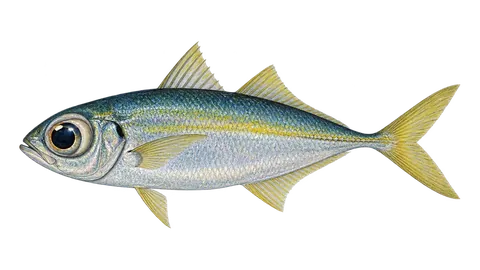
Fusiform body, metallic blue to greenish on the back and silvery below. It has a small black spot on the edge of the gill cover, a bright red tail, and the tips of the soft dorsal fins tinged red. The last rays of the dorsal and anal fins are set apart from the rest, forming small finlets. To tell it from the garaçuma (Trachurus lathami), look at the red tail and these finlets.
Also called: xaréu-rabo-vermelho, caballeta rabicolorá, roughear scad
don't confuse with:
We don't have tips on season, bait or technique for this species yet.
where found
open on the large mapWhere to look: Continental shelf, in midwater or near the bottom, usually between 150 and 220 m.
It occurs from the North American Atlantic to Venezuela, and also in Brazil and Argentina, in shelf waters.
coast
rules for the roughear scad
Rules change; before keeping or transporting fish, check with the state environmental agency.
We found no species-specific rule beyond the region's general rules.
Conservation: Not on the Brazilian national list (Ministerial Ordinance GM/MMA No. 1.667/2026).
how much it weighs without taking it out of the water
estimated weight
—
how we calculate
Length-weight relationship W = a·Lb (a = 0.0123, b = 3.01; FishBase (relação peso-comprimento bayesiana, estimativa da própria espécie)). It's an average: a fat or lean fish can vary by 10% to 20%.
more about the roughear scad
The red-tail jack belongs to the family Carangidae and reaches 50 cm. It lives on the shelf, usually between 150 and 220 m, in midwater or near the bottom, and also rises to the surface. It feeds mainly on copepods and other small plankton invertebrates. It is sold fresh and is often used as bait. It occurs from the North American Atlantic to Venezuela, and also in Brazil and Argentina. It has been recorded down to 550 m, but is most common between 150 and 220 m.
Family: Carangidae · forage fish
fun facts
- The maximum recorded depth is 550 m.
in the kitchen
Sold fresh; also used as bait.
similar species

sources and references (3)
Essential profile: size, length-weight, depth, countries and conservation come from FishBase and the cited regulations, and the texts were written from those sources. Season, time of day, sensitivities, technique and baits and lures are not included yet, because we did not find a good source for this species.
- scientific FishBase: Decapterus tabl (ficha da espécie)Size, length-weight, depth, habitat, distribution, biology, and IUCN status. Page checked on Oct 13, 2026.
- scientific FishBase: nomes populares de Decapterus tablNames by country and language.
- official Portaria GM/MMA nº 1.667, de 27 de abril de 2026: Lista Nacional Oficial de Espécies da Fauna Ameaçadas de Extinção (peixes e invertebrados aquáticos)The species is not on the list. Checked in the DOU of April 28, 2026.