

bigeye scad
Selar crumenophthalmus
A small fish with huge eyes that moves in compact schools near islands and rocky coasts. It is one of the most used live baits for seriolas, mackerel, tunas and dorado.
- common size
- 15–25 cm
- maximum
- 30 cm
- common weight
- 0.1–0.2 kg
- record/max.
- 0.4 kg
- depth
- 0–170 m
- ideal water
- 24–28 °C
how to recognize it
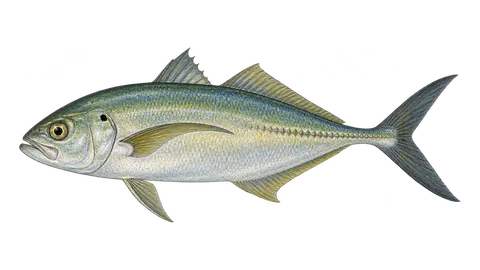
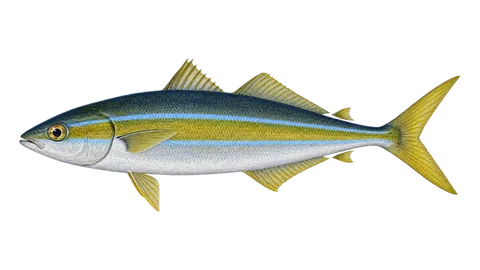
Elongated, compressed body, metallic blue-green back and silvery flank, sometimes with a weak yellow band. The eye is very large, covered by a thick fatty eyelid. Lateral-line scutes only on the straight part near the tail. The blue runner (xerelete) and the jack have a deeper body and a smaller eye; the rainbow runner has blue stripes and loose pinnules behind the dorsal and anal fins.
Also called: xixarro, chicharro, chicharro-olho-grande, garapau, bigeye scad
don't confuse with:
where found
open on the large mapWhere to look: Clear water around islands, rocky coasts and shoals; at night it rises and spreads through the water column.
In Brazil, from the Northeast to São Paulo, most common in clear water: oceanic islands, rocky coasts, reefs and bays.
coast
states
Piauí, Ceará, Rio Grande do Norte, Paraíba, Pernambuco, Alagoas, Sergipe, Bahia, Espírito Santo, Rio de Janeiro, São Paulo
when to fish
next 7 days
Loading the next 7 days…
best season
Available year-round; what matters is finding the school.
best time of day
Night and twilight. Feeds more at night and at dusk; by day it forms a tight school near the bottom or the rock.
what affects the bigeye scad
cold and cold fronts
Cold upwelling water spreads and drives schools away.
atmospheric pressure
Little direct effect.
moon
On dark nights the boat light gathers the school more; under a full moon it scatters.
rain
Little effect.
water level
Not applicable at sea.
noise
A large school tolerates an anchored boat but disappears if the engine runs above it.
wind
Strong wind makes it hard to anchor on the school's spot.
tide
With the current, the school moves along the rock; look for the sheltered side.
depth
By day, near the bottom or by the rock; at night, in midwater and at the surface.
how to fish
lures
- sabiki with feathers or fish skin
natural baits
- fish strip
- small shrimp
tip from an angler
To use it as bait, take the scad off the sabiki with a wet hand and put it straight into the livewell; hook it through the back or the nostrils.
- rod
- light rod 6' to 7' or cane pole
- spinning / baitcasting reel
- spinning reel 1000 to 2500
- line
- monofilament 0.25 to 0.30 mm
- leader
- sabiki (rain of hooks) rigged on 0.30 to 0.40 mm line
- hook
- hook size 10 to 12, or the sabiki's own
accessories
- livewell with air pump or running water
- sinker 20 to 50 g
- night-fishing light, where permitted
catch and release
Small and fragile: if you are not using it as bait, release it quickly, without squeezing it or scraping off its scales.
rules for the bigeye scad
Rules change; before keeping or transporting fish, check with the state environmental agency.
We found no species-specific rule beyond the region's general rules.
Conservation: Not on the national list (Portaria GM/MMA 1.667/2026). We found no specific federal rule for this species.
how much it weighs without taking it out of the water
estimated weight
—
how we calculate
Length-weight relationship W = a·Lb (a = 0.01318, b = 2.99; FishBase (estimativa bayesiana, comprimento total)). It's an average: a fat or lean fish can vary by 10% to 20%.
more about the bigeye scad
The scad (xixarro) is a small carangid of tropical seas worldwide. In the western Atlantic it ranges from Nova Scotia and Bermuda to São Paulo. It prefers clear water around islands and rocky coasts, but also enters the coastal strip and sometimes murky water. It forms compact schools, which may contain hundreds of thousands of fish, and it is more active at night, when it spreads out to feed on small shrimp, larvae and plankton. It grows fast and lives short. For anglers, it is mostly valuable as live bait: it holds up well on the hook and in the livewell and attracts yellowtail amberjacks, longfin yellowtails, mackerel, tunas and dorado. It bites on a sabiki and on a small hook with a fish strip, by day near the bottom and at night under the boat light.
Family: Carangidae · forage fish
fun facts
- Travels in compact groups that can number hundreds of thousands of fish.
- Short-lived: the maximum recorded age is about 3 years.
in the kitchen
Dark, fatty flesh, good fried, grilled or salted. Specimens from reef areas have been linked to ciguatera.
similar species
sources and references (5)
The season weights (months), the time of day and the sensitivities (cold, pressure, moon, wind, rain, tide, strong light, murky water and noise) are the app's editorial estimates, based on the literature below and on the field experience of anglers and guides. They are not official data nor a measurement made for this species, and they may vary by region and year. Closed seasons and legal rules appear in the rules section, with the norm and a link.
- scientific FishBase — Selar crumenophthalmus (ficha da espécie)Names, distribution, biology, length-weight relationship, country list and references. Page checked on October 13, 2026. The record cites an isolated 70 cm specimen in Indonesia; other maximum size records are around 30 cm, the value used here. The maximum weight was estimated from the length-weight relationship.
- official Portaria GM/MMA nº 1.667, de 27 de abril de 2026 — Lista Nacional Oficial de Espécies da Fauna Ameaçadas de Extinção (peixes e invertebrados aquáticos)Most recent national list. The species is not on it (search by scientific name in the text published in the DOU, checked on October 13, 2026).
- official ICMBio/SALVE — Ficha de Selar crumenophthalmus (avaliação nacional do risco de extinção)National assessment by ICMBio, published in 2023. DOI verified on Crossref.
- scientific IUCN Red List — Selar crumenophthalmus (avaliação global: Pouco Preocupante, LC, 07/11/2013)Global assessment. Link given on the FishBase entry (Red List, version 2025-2).
- scientific Carpenter, K. E. (org.) (2002). The living marine resources of the Western Central Atlantic. Vol. 3: Bony fishes part 2 (Opistognathidae to Molidae). FAO Species Identification Guide for Fishery Purposes. Roma: FAO.Chapter Carangidae (Smith-Vaniz, W. F.).