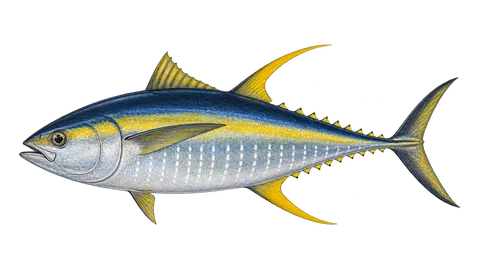
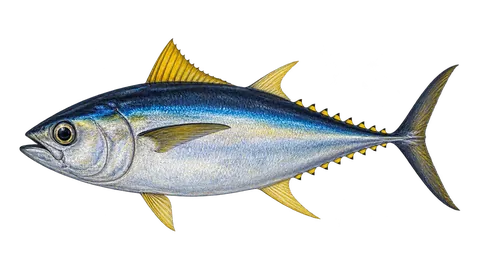
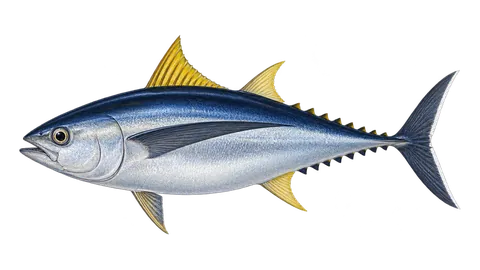
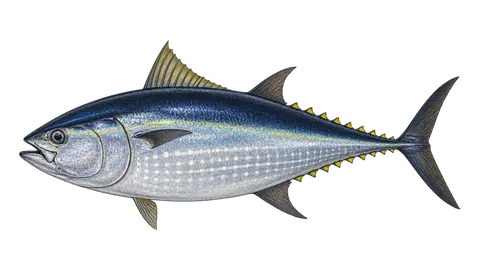
The largest of the tunas, with a torpedo-shaped body and a reddish second dorsal fin, it crosses the Atlantic in schools. In Brazil it is Endangered on the national list: catching and possession are banned; if you hook one, release it.
Also called: atum-rabilho-do-atlântico, atum-azul, albacora-azul, atum-rabilho, Atlantic bluefin tuna
Choose the place and the species. The index, from 0 to 100, combines weather, sun, moon and tide with each fish's habits. Up to 28 days, with each day's confidence.
location
Sample location: choose yours to see the forecast for where you fish.
period
Reading the weather across 3 global models and 31 simulations…
0—
index Score from 0 to 100 for the fishing conditions of each hour. It reads weather, sun, moon, tide and the species' habits. It doesn't promise fish: it tells you when the water is on your side. 0–24 poor · 25–44 fair · 45–64 good · 65–84 very good · 85–100 excellent.
today
—
confidence —
confidence How much you can trust the weather forecast for the day. It drops with distance and when the models disagree. It is not the chance of catching fish.
models and trend Up to 16 days, three global weather models (the European ECMWF, the American GFS and a high-resolution blend) read hour by hour; when they disagree, the light band on the chart widens. Beyond that it's a trend: 31 runs of the American GEFS model. Confirm when it's 1 week out.
window Consecutive hours with the index near the day's peak and no danger alert. It is the time to have the bait in the water.
hour by hour
slide your finger or mouse over the chart to see each hour
see hour-by-hour table
why this index at —?
next 7 days
choose the day
chart: bar height = day's index · line = variation between models · striped = trend · fainter = less confidence
Each card shows the day's index (0 to 100) and, below it, a strip with the index for each hour, from 0h to 23h. from poor to excellent.
4-week calendar
the fishing month at a glance
plan a trip
what's the best window for the crew?
Choose how many fishing days. We compare each stretch by its average index, discount days with a warning or closed season, and show the 3 best.
trend for the coming weeks
Line: the middle value of 31 simulations of the American GEFS model. Band: where 8 out of 10 fall. Narrow, firm trend; wide, high uncertainty.
the species
everything about the atlantic bluefin tuna
overview
who is the atlantic bluefin tuna
The Atlantic bluefin tuna is the largest tuna: it reaches 458 cm, 684 kg and about 32 years. It is an oceanic migrant that comes closer to shore at certain times and forms size-sorted schools, sometimes with albacore and bonito. It hunts small schooling fish, squid and red crabs by sight. It matures at about 100 cm and spawns in water between 22.6 and 27.5 °C, in the Gulf of Mexico and the Mediterranean; adults return to the same spawning sites. It occurs in the western Atlantic from Labrador to the Gulf of Mexico, the Caribbean, Venezuela and Brazil, and in the eastern Atlantic from Norway to the Canary Islands. FishBase says it became rare from overfishing. In Brazil it is classified as Endangered (EN) and has full protection.
fun facts
Fish tagged in the western Atlantic return to specific spawning sites, in the Gulf of Mexico or the Mediterranean.
FishBase records up to 684 kg published and an age of 32 years, and cites a lifespan of up to 40 years in the western Atlantic.
The egg measures 1.0 mm and the larva hatches at 2.8 mm; the adult takes about 10 years to reach two-thirds of its maximum length.
how to recognize it
identification
A very large, robust tuna, deepest near the middle of the first dorsal fin base. The second dorsal fin is taller than the first: the first is yellow or bluish and the second reddish-brown. Pectoral fins short, under 80% of head length. Flanks and belly silver, with colorless cross lines alternating with rows of colorless spots. Anal fin and finlets dark yellow with black edges, and a black central keel on the tail in adults. The other Atlantic tunas are much smaller and have their own markings.
Western Atlantic: from Labrador and Newfoundland to the Gulf of Mexico and the Caribbean, to Venezuela and Brazil. Eastern Atlantic: from the Lofoten Islands (Norway) to the Canaries, including the Mediterranean and part of the Black Sea; there is a subpopulation in South Africa. In Latin America it is rare: it appears in the Gulf of Mexico, the Caribbean, Venezuela and Brazil, and FishBase also includes Argentina and Uruguay. In Brazilian waters it lies at the southern limit of the western Atlantic population.
Habitat: Open sea and outer shelf, from the surface to about 100 m (down to nearly 1,000 m); comes closer to shore at certain times of the year.
coast
North CoastNortheast CoastSoutheast CoastSouth Coastoceanicshelf
calendar and clock
when to fish
best season
time of yearbest: May–Jun
JanFebSeaAprMayJunJulAugSepOctNovDec
In the Gulf of Mexico spawning happens in water between 22.6 and 27.5 °C, usually in spring. Outside the Gulf and the Mediterranean, the sources consulted do not detail when the fish appears on the Latin American coast.
best time of day
Daytime, with peaks at dawn and dusk. Visual predator: hunts by day, most active in low light at the start and end of the day.
weather, water and behavior
what affects the atlantic bluefin tuna
sensitivity The little bars show how much each factor affects this species. Five full: it feels it a lot.
cold and cold fronts
It tolerates 3 to 30 °C, which explains its long migrations between cold and warm waters.
atmospheric pressure
Little documented effect.
moon
Small effect in the sources consulted.
rain
Little effect in open sea.
water level
Does not apply at sea. What counts is the presence of bait and temperature fronts.
noise
A wary visual predator, spooked by engine noise and boat shadow in clear water.
wind
Strong wind and rough seas make it hard to see the feeding and to hold course.
heavy big-tuna gear; the species is not a permitted target in Brazil
spinning / baitcasting reel
offshore baitcasting reel
line
braid or monofilament of 80 lb or more
leader
heavy monofilament or fluorocarbon
hook
barbless circle hook
accessories
cutting pliers
long-nose pliers
tip from an angler
A species protected in Brazil, which should not be targeted. If you hook one, release it with minimal handling, without lifting it out of the water; if the hook is deep, cut the line close to it.
what the law says
rules for the atlantic bluefin tuna
Summary of the regulations we found, with the source for each. Rules change; before keeping or transporting fish, check with the state environmental agency. Conservation: On the national list of threatened species as EN. IUCN global assessment: LC.
Threatened species in Brazil: catch banned
full protection
The national list (Portaria GM/MMA nº 1.667/2026) classifies the species as EN. Under Portaria GM/MMA nº 1.666/2026 (art. 3), species listed as VU, EN and CR have full protection: capture, transport, storage, processing and sale are banned. If you hook one by accident, release it right away, with minimal handling.
Mexico: up to 5 per species and 10 saltwater fish per day
5 specimens of the species per angler per day, within the limit of 10 saltwater fish
In sport and recreational fishing in Mexican federal waters, each angler may keep up to 10 marine fish per day, no more than 5 of the same species. The Atlantic bluefin tuna is not among the species with their own limits (billfish, sharks, giant seatrout, tarpon, dorado, roosterfish and baya). Fish over the bag limit must go back alive, and sport-caught fish may not be sold. Fishing from a boat requires a permit, and sport fishing is banned in closed zones and seasons.
Puerto Rico and U.S. Virgin Islands: bluefin tuna limit in recreational fishing in 2026
2 per private boat per day or trip, from 27 to under 73 inches (CFL), only 1 over 4701/06 to 31/12confirm with the agency
The US federal Atlantic rule (50 CFR 635) applies to boats with HMS Angling or Charter/Headboat permits and, according to the May 2026 notice, in all areas except the Gulf (where directed fishing is banned). From June 1 to December 31, 2026, a private boat may keep 2 bluefin tuna per day or trip, between 27 and under 73 inches (68.5 to 185 cm) of curved fork length, and only 1 of them may be 47 inches (119 cm) or larger. The standard limit is 1 fish, and the adjustment may change during the season. The notice does not mention Puerto Rico or the U.S. Virgin Islands: check with NOAA.
catch and release Releasing the fish alive, quickly and with a wet hand. During a closed season it isn't always allowed: what the regulation says applies.
A species protected in Brazil: release it right away. Keep the fish in the water, shorten the fight, use a barbless circle hook, and do not lift it by the head or rest it out of the water.
in the kitchen
In other countries it is one of the most valued species in the market, and FishBase says mass fishing made it rare. In Brazil, catching, possessing and selling are banned.
calculator
how much it weighs without taking it out of the water
Length-weight relationship W = a·Lb (a = 0.01202, b = 3.03; FishBase (relação peso-comprimento bayesiana, estimativa da própria espécie)). It's an average: a fat or lean fish can vary by 10% to 20%.
estimated weight
—
sources and references
The season weights (months), the time of day and the sensitivities (cold, pressure, moon, wind, rain, tide, strong light, murky water and noise) are the app's editorial estimates, based on the literature below and on field experience from anglers and guides. They are not official data or measurements made for this species and may vary by region and year. Closed seasons and legal rules appear in the rules section, with the rule and link. The fishing depth range, the common size and the ideal water temperature range, when FishBase does not give a value, are editorial estimates based on the species' biology.
scientificFishBase: nomes populares de Thunnus thynnusNames by country and language. The name atum-rabilho-do-atlântico was adopted in this profile, drawn from European Portuguese and English, to separate the species from the Pacific bluefin tuna (Thunnus orientalis).
The weather comes from three independent global models, cross-checked hour by hour: when they agree, confidence goes up; when they diverge, the band between them shows on the chart. Beyond 16 days, we use the GEFS ensemble of 31 simulations: if 20 of the 31 predict rain, the chance of rain is 65%. Sun and moon are calculated astronomically, with no uncertainty.
The index adds up, weighted for each species: time of day (species curve anchored to real sunrise and sunset), moon (transits, rise and set, phase), pressure (3 h trend and 24 h swing), water temperature (in rivers, estimated from air temperature; at sea, estimated by an ocean model), wind, rain, clouds, tide and the month in the species' cycle.
Accuracy measured in the reference project (4 regions, 93 days, forecast vs. observed): maximum temperature is off by 0.6 °C on average the next day and 1.7 °C at 7 days; rain of 5 mm or more is detected 76% of the time the next day and 57% at 7 days. Detection isn't everything: the false alarm rate isn't published here yet, and 93 days in 4 regions is still a small sample. We now also measure every day, at the app's destinations:
where are you going fishing?
Your location is saved only on this device and feeds the forecast, the map and the "today" on the home page.