Skip to content
catalog Scombridae · predator

pacific bluefin tuna

Thunnus orientalis

SeaIUCN global: NT · near threatened

The giant of the tunas of the North Pacific, which crosses the ocean and spends years off Baja California. Near threatened, it is fished with live sardines, surface lures and jigs.

Also called: atum-rabilho-do-pacífico, atum-azul-do-pacífico, Pacific bluefin tuna

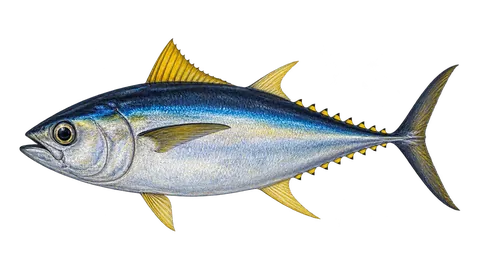
Scientific illustration of Pacific bluefin tuna
common size
70–150 cm
maximum
300 cm
common weight
5–55 kg
record/max.
450.0 kg
depth
0–250 m
ideal water
16–22 °C
overview

who is the pacific bluefin tuna

Pacific bluefin tuna, from the Gulf of Alaska to Baja California and from the Sea of Okhotsk to the Philippines. It spawns in the western Pacific, near Japan, and many young fish cross the ocean to the California Current, where they spend a few years before returning. It forms schools by size and moves up the Baja California coast between June and September, coming close to shore at certain times. It eats schooling fish, squid and pelagic crabs. In Mexico it is commercially caught with purse seines and fattened on farms in Ensenada; in sport fishing, boats from Ensenada and other ports seek the schools on banks and islands, using live sardines, stickbaits and jigs. The IUCN classifies it as near threatened, and catch is controlled by international quotas.

fun facts

  • Many bluefin are born near Japan and cross the Pacific while still young to the Baja California coast, where they spend a few years.
  • Ensenada, in Baja California, is home to fattening farms that catch young bluefin at sea and feed them in cages.
how to recognize it

identification

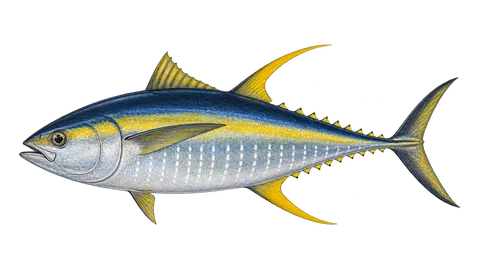
Very robust, torpedo-shaped body, dark blue back and silvery belly with light lines and dots. The pectoral fins are short and do not reach the base of the second dorsal, unlike the yellowfin and albacore, which have long pectorals. Yellow finlets with dark edges and dark tail keels. Yellowfin has a yellow second dorsal and anal fin, long in adults.

how pacific bluefin tuna fishing looks

Loading the next 7 days…

Each card shows the day's index (0 to 100) and, below it, a strip with the index for each hour, from 0h to 23h. from poor to excellent.

distribution

where found

open on the large map

Not found in Brazil. North Pacific; in Latin America, mainly along the Pacific coast of Baja California (Mexico), at islands and offshore banks. There are rare records farther south, including Ecuador.

Habitat: Open sea and shelf edges, near banks, islands and temperature fronts; sometimes comes close to shore.

calendar and clock

when to fish

best season

time of yearbest: Jun–Oct
JanFebSeaAprMayJunJulAugSepOctNovDec

On the Pacific coast of Baja California, schools appear from late spring to autumn, with a peak usually between June and October.

best time of day

0h6h12h18h sunrise ~6amsunset ~6pm

Daytime, with peaks at dawn and dusk. Hunts by day, with peaks at dawn and dusk; at night there is fishing with live bait and jigs under the boat lights.

weather, water and behavior

what affects the pacific bluefin tuna
sensitivity The little bars show how much each factor affects this species. Five full: it feels it a lot.

cold and cold fronts

It tolerates colder water than tropical tunas; temperature fronts concentrate bait and schools.

atmospheric pressure

Little direct effect; calm sea makes it easier to find the schools.

moon

During a full moon, fish feed more at night and are more selective by day.

rain

Little effect.

water level

Not applicable at sea.

noise

A school at the surface sinks when the boat is on top of it; approach from the front of the school, slowly.

wind

Rough seas make it hard to find and follow the schools.

tide

Little effect in open sea; near banks, current concentrates the bait.

depth

From the surface to more than 100 m; the schools rise when they hunt sardines.

technique, gear and bait

how to fish

rod
stand-up 5'6" to 7', 50 to 130 lb; long casting rod for stickbaits
spinning / baitcasting reel
two-speed lever-drag baitcasting reel (size 30 to 80) or spinning reel 14000 to 30000
line
braided line 80 to 130 lb
leader
fluorocarbon 60 to 130 lb, 2 to 3 m
hook
circle hook 4/0 to 8/0 for live bait

lures

  • stickbait and popper 18 to 25 cm
  • vertical jig 150 to 300 g
  • trolling plugs

natural baits

  • live sardine and mackerel
  • lula

accessories

  • fighting belt and harness
  • luvas
  • bicheiro

tip from an angler

With live bait, use the thinnest leader the fish's size allows and a small hook: bluefin see well and refuse thick line on clear-water days.

what the law says

rules for the pacific bluefin tuna

Summary of the regulations we found, with the source for each. Rules change; before keeping or transporting fish, check with the state environmental agency.
Conservation: Stock recovering under quotas set by the Inter-American Tropical Tuna Commission (CIAT); Mexico sets the commercial catch volume every two years.

Mexico: bluefin tuna quota for sport fishing

up to 5 per angler per day under the general rule; earlier agreements set 2confirm with the agency

Under the general rule for sport fishing in Mexican seawaters, each angler may keep up to 10 saltwater fish per day, no more than 5 of the same species. The bluefin quota agreements of 2017 and 2019-2020 limited sport fishing from Mexican boats to 2 bluefin per angler per day; the 2025-2026 biennial agreement covers only the commercial fleet. Check with Conapesca or your operator which limit applies this season, and release alive any fish over the limit.

Source: Amendment to NOM-017-PESC-1994 (DOF Nov 25, 2013), item 4.9.1; Agreement on bluefin tuna catch volume (DOF Mar 20, 2019), art. 4º; Agreement for the 2025-2026 biennium (Sader/Conapesca)

catch and release
catch and release Releasing the fish alive, quickly and with a wet hand. During a closed season it isn't always allowed: what the regulation says applies.

Tuna does not survive well out of water: if you release it, do it without lifting it from the sea, with the boat moving slowly so water passes over the gills. Use a circle hook to set in the corner of the mouth.

in the kitchen

Red, fatty flesh, among the most prized in the world for sashimi; bleed and chill the fish right after the catch.

calculator

how much it weighs without taking it out of the water

Length-weight relationship W = a·Lb (a = 0.01349, b = 3.03; FishBase (estimativa bayesiana para o gênero e o formato do corpo)). It's an average: a fat or lean fish can vary by 10% to 20%.

estimated weight

—

sources and references

The season weights (months), the time of day and the sensitivities (cold, pressure, moon, wind, rain, tide, strong light, murky water and noise) are the app's editorial estimates, based on the literature below and on the field experience of anglers and guides. They are not official data nor a measurement made for this species, and they may vary by region and year. Closed seasons and legal rules appear in the rules section, with the norm and a link.

  1. scientific FishBase — Thunnus orientalis (ficha da espécie)Names, distribution, biology, length-weight relationship, list of countries and references. Page checked 13/10/2026. The FishBase country list includes Ecuador; in Latin America, fishing is concentrated in Mexico.
  2. scientific IUCN Red List — Thunnus orientalis (avaliação global: Quase Ameaçada, NT, 15/01/2021)Global assessment. Link given on the FishBase entry (Red List, version 2025-2).
  3. scientific Collette, B. B.; Nauen, C. E. (1983). FAO Species Catalogue. Vol. 2. Scombrids of the world. FAO Fisheries Synopsis 125(2). Roma: FAO.FishBase reference for the migration along Baja California between June and September.
  4. official DOF — Modificação da NOM-017-PESC-1994, para regular a pesca deportivo-recreativa em águas de jurisdição federal do México (publicada em 25/11/2013)Daily limits at sea (item 4.9.1) and in fresh water (4.9.2), one rod in inland waters (4.6 b), ban on live fish as bait in inland waters (4.7 c) and on fishing in closed areas and seasons (4.10).
  5. official DOF — Acordo que estabelece o volume de captura permissível de atum aleta azul (Thunnus orientalis) no Pacífico (20/03/2019)Art. 4º: 2 specimens per angler per day in sport fishing from Mexican boats. It applied in 2019 and 2020; the 2017 agreement (DOF 03/05/2017) had the same limit.
  6. official Sader/Conapesca — Acordo que estabelece o volume de captura permissível de atum aleta azul para o biênio 2025-2026 (assinado em 09/12/2024)Maximum volume of 11,127.81 t over the biennium for the commercial fleet; the text does not address sport fishing.
don't confuse

similar species