yellowfin tuna
Thunnus albacares
The tuna most sought after by Brazilian sport fishing. Long, heavy fights on trolling, jigging, and popping.
Also called: albacora-laje, albacora-de-laje, atum-de-barbatana-amarela, yellowfin

- common size
- 80–150 cm
- maximum
- 239 cm
- common weight
- 10–60 kg
- record/max.
- 200.0 kg
- depth
- 0–250 m
- ideal water
- 22–28 °C
who is the yellowfin tuna
The yellowfin tuna is an open-sea tuna that can exceed 150 kg, but in Brazilian sport fishing, fish of 15 to 60 kg are the most common. It travels in schools, often with skipjack tuna and dolphins, and rises to the surface to hunt sardines, flying fish, and squid. In the Southeast, the oil platforms of the Campos and Santos basins have become a classic jigging and popping ground; in the Northeast, Natal, Fernando de Noronha, and the São Pedro e São Paulo archipelago hold large fish. The fight is one of endurance: the tuna dives for the bottom and circles below the boat. It is also an important target of commercial longline and line fishing.
fun facts
- Schools often travel with dolphins, which helps locate the fish.
- The sickle-shaped yellow fins grow with age and mark the large specimens.
- It keeps its body warmer than the water thanks to a network of vessels that retains muscle heat.
identification
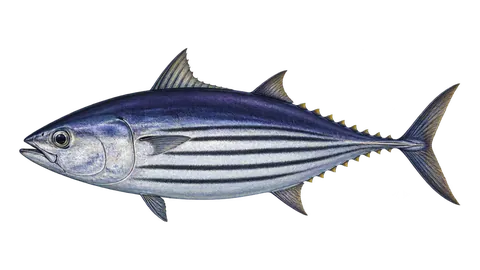
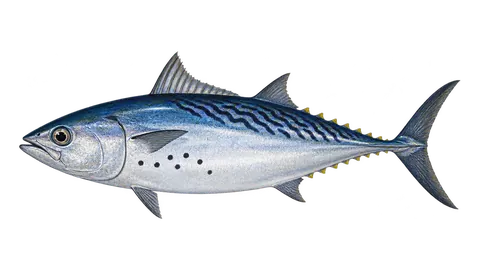
Torpedo-shaped body, metallic dark-blue back and golden stripe along the flank. Second dorsal, anal fin, and finlets bright yellow; in large adults, the second dorsal and anal fins are long and sickle-shaped. Silver belly with vertical rows of pale dots. Skipjack tuna has dark horizontal stripes on the belly. Spotted bonito has wavy patterns on the back and black spots below the pectoral. Bigeye tuna has a larger eye and a deeper body.
Loading the next 7 days…
Each card shows the day's index (0 to 100) and, below it, a strip with the index for each hour, from 0h to 23h. from poor to excellent.
where found
Open sea along the whole coast, most abundant at the shelf edge and on the slope, from the Northeast to the South. Known grounds: oil platforms of the Campos Basin (departures from Macaé-RJ) and the Santos Basin; shelf edge off Vitória-ES; Cabo Frio-RJ; Natal-RN; Fernando de Noronha-PE, outside the Parque Nacional Marinho; São Pedro e São Paulo archipelago, restricted access.
Habitat: Warm layer from 0 to 250 m over the slope, seamounts, oil platforms, and current edges. Associated with floating objects, dolphins, and skipjack schools.
coast
states
Amapá, Pará, Maranhão, Piauí, Ceará, Rio Grande do Norte, Paraíba, Pernambuco, Alagoas, Sergipe, Bahia, Espírito Santo, Rio de Janeiro, São Paulo, Paraná, Santa Catarina, Rio Grande do Sul
when to fish
best season
Can be fished all year. In the Southeast the best period runs from October to May, when warm water reaches the shelf. In the Northeast fishing is good all year, with local variations.
best time of day
Daytime, with peaks at dawn and dusk. Feeds hard at dawn and in late afternoon, when it comes up to the surface. At midday it goes down, and jigging yields more. At the platforms, lights concentrate bait and tuna at night.
what affects the yellowfin tuna
sensitivity The little bars show how much each factor affects this species. Five full: it feels it a lot.
cold and cold fronts
It tolerates somewhat colder water at depth, but at the surface it disappears below 20 °C.
atmospheric pressure
A cold front hurts more through the sea than through the fish; return when the sea settles.
moon
At full moon tuna feed more at night around the platforms and become more selective by day.
rain
Light rain doesn't bother and sometimes brings the school up. Thunderstorm with lightning: head back.
water level
Not applicable at sea. The equivalent is the color and clarity of the water: look for blue, clean water and current lines.
noise
A school at the surface sinks with a loud motor and the boat passing over it. Approach from the front of the school and slow down.
wind
Moderate light swell is good for popping. Wind above 20 knots makes going out unfeasible.
tide
Little effect; at the platforms the current determines which side the fish sit on.
depth
From the surface down to 250 m. At midday look for the layer with bait on the sonar, usually between 30 and 100 m.
how to fish
- rod
- popping 7'6" to 8'0" PE 6 to 8; jigging PE 3 to 5 (up to 300 g); trolling 30 to 50 lb
- spinning / baitcasting reel
- 14000 to 20000 spinning reel for popping; 8000 to 14000 spinning reel or jigging baitcaster for jigging; 30 to 50 lb trolling baitcaster
- line
- braided PE 5 to 8 (65 to 100 lb) for popping; PE 3 to 5 for jigging
- leader
- fluorocarbon or monofilament 80 to 130 lb, 2 to 3 m
- hook
- 7/0 to 9/0 assist hooks on jigs; treble or reinforced single hooks on poppers; 7/0 to 10/0 circle hook on natural bait
lures
- 18 to 25 cm poppers and stickbaits (120 to 200 g)
- 150 to 300 g jigs
- lipped trolling plugs
- silicone squid and skirts
natural baits
- live or cut sardine for chum
- lula
- cut bonito (chunking)
accessories
- fighting belt
- luvas
- bicheiro
- split-ring pliers and cutting pliers
tip from an angler
At platforms, respect the 500 m safety zone and fish drifting outside it, watching for birds and fish at the surface. Work the jig fast in the layer the sonar shows.
offshore jigging
Vertical fishing with metal jigs over reefs, wrecks and the shelf edge, from 30 to 150 m deep.
ready-made kitocean trolling (blue marlin, mahi-mahi and tuna)
Boat fishing at the shelf edge and in open sea, trolling artificial or natural baits at speed, after marlin, mahi-mahi and tuna.
guidefish preservation and cleaning
Quick killing, bleeding, the right amount of ice, a well-used cooler, filleting and transport within the law. Fish handled well on the boat is worth twice as much at the table.
rules for the yellowfin tuna
Summary of the regulations we found, with the source for each. Rules change; before keeping or transporting fish, check with the state environmental agency.
Conservation: Atlantic stock managed by ICCAT, with a total catch limit. We have not found a federal minimum size for recreational fishing.
We found no species-specific rule beyond the region's general rules.
catch and release
catch and release Releasing the fish alive, quickly and with a wet hand. During a closed season it isn't always allowed: what the regulation says applies.
Tuna loses a lot of stamina in the fight. If you are going to release it, keep the fight short, don't lift it out of the water, and release it with the boat moving, head first, so water flows over the gills.
in the kitchen
Excellent red meat. Bleed it right away, gut it, and chill it in ice water. Sashimi, tataki, or grilled rare.
how much it weighs without taking it out of the water
Length-weight relationship W = a·Lb (a = 0.01413, b = 3.03; FishBase (estimativa bayesiana, comprimento total)). It's an average: a fat or lean fish can vary by 10% to 20%.
estimated weight
—
sources and references
The season weights (months), the time of day and the sensitivities (cold, pressure, moon, wind, rain, tide, strong light, murky water and noise) are the app's editorial estimates, based on the literature below and on the field experience of anglers and guides. They are not official data nor a measurement made for this species, and they may vary by region and year. Closed seasons and legal rules appear in the rules section, with the norm and a link.
- scientific FishBase — Thunnus albacares (ficha da espécie)Names, distribution, biology, length-weight relationship and references. Page checked on October 13, 2026.
- official Portaria GM/MMA nº 1.667, de 27 de abril de 2026 — Lista Nacional Oficial de Espécies da Fauna Ameaçadas de Extinção (peixes e invertebrados aquáticos)Most recent national list. The species is not on it (search by scientific name in the text published in the DOU, checked on October 13, 2026).
- official ICMBio/SALVE — Ficha de Thunnus albacares (avaliação nacional do risco de extinção)ICMBio national assessment, published in 2026. DOI checked on Crossref.
- scientific IUCN Red List — Thunnus albacares (avaliação global: Pouco Preocupante, LC, 15/01/2021)Global assessment. Link given on the FishBase entry (Red List, version 2025-2).
- scientific Collette, B. B.; Nauen, C. E. (1983). FAO species catalogue. Vol. 2. Scombrids of the world. FAO Fisheries Synopsis 125(2). Roma: FAO.
- technical ICCAT Manual, cap. 2.1.1 — Yellowfin tuna (Thunnus albacares). International Commission for the Conservation of Atlantic Tunas.Biology and fishery of the species in the Atlantic.
- scientific Carpenter, K. E. (org.) (2002). The living marine resources of the Western Central Atlantic. Vol. 3: Bony fishes part 2 (Opistognathidae to Molidae). FAO Species Identification Guide for Fishery Purposes. Roma: FAO.Scombridae chapter (Collette, B. B.).