Skip to content
fishing forecast

bearded brotula

Brotula barbata · Ophidiidae · predator

Sea

Long bottom fish with six barbels on the snout and six on the chin, living on the shelf and slope of the warm Atlantic. It turns up in bottom boat fishing between 50 and 300 m.

Also called: brótula-barbada, brótula, bearded brotula

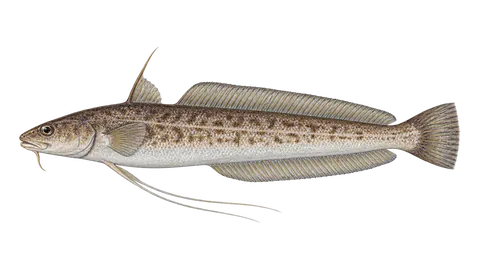
Scientific illustration of Bearded brotula
common size
40–60 cm
maximum
94 cm
common weight
0.5–1.7 kg
record/max.
8.5 kg
depth
50–300 m
ideal water
16–24 °C
location

Sample location: choose yours to see the forecast for where you fish.

period

Reading the weather across 3 global models and 31 simulations…

the species

everything about the bearded brotula

overview

who is the bearded brotula

The bearded brotula is an ophidiid, of the same family as the pink cusk-eel (congro-rosa), with an elongated body covered in small scales. It lives on or just above the bottom, most commonly between 50 and 300 m, over the continental shelf with sand and mud bottoms, but has been recorded down to 650 m. Juveniles are common on reefs, and smaller silvery specimens are caught far from shore in surface waters. In the western Atlantic it occurs from the southern United States and the Gulf of Mexico to northern South America, including the Caribbean islands, and in the eastern Atlantic from Senegal to Angola. The eggs are pelagic, held in a gelatinous mass. It has a minor commercial fishery and, for the sport angler, is a deep bottom fish.

fun facts

  • It has six barbels on the snout and six on the chin, which explains the English name, bearded brotula.
  • The eggs are pelagic and held in a floating gelatinous mass.
  • Juveniles are common on reefs, while adults live on deeper sand and mud bottoms.
how to recognize it

identification

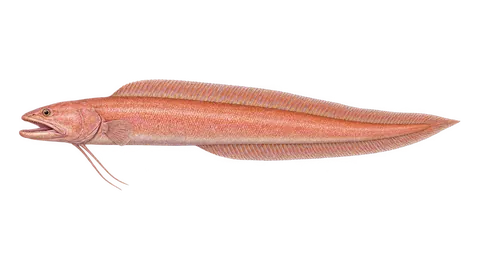
Elongated body, tapering toward the tail, covered in small, overlapping scales. The mark is the set of barbels: six on the snout and six on the chin. Dorsal and anal fins very long (109 to 117 rays in the dorsal and 86 to 90 in the anal). Pelvic fins dark, growing darker toward a nearly black edge. The brotula has a single short barbel on the chin, and the pink cusk-eel has none on the snout and pelvic fins reduced to two filaments. In the eastern Pacific there is a similar species, Brotula clarkae.

distribution

where found

open on the large map

Western Atlantic, from the southern US and the Gulf of Mexico to northern South America, with the Caribbean islands; in the eastern Atlantic, from Senegal to Angola. In Latin America it occurs from Mexico and Cuba to Colombia, Venezuela and the Guianas. In Brazil the latitude range covers the North and Northeast coasts, on the outer shelf and slope.

Habitat: Sand and mud bottoms of the continental shelf and slope, from 50 to 300 m (recorded down to 650 m); juveniles appear on reefs.

coast

North CoastNortheast Coastshelfoceanic
calendar and clock

when to fish

best season

time of year
JanFebSeaAprMayJunJulAugSepOctNovDec

No closed season. Fishing depends more on calm seas and weak current than on the season, and the sources consulted have no regional spawning data.

best time of day

0h6h12h18h sunrise ~6amsunset ~6pm

Any time. Between 50 and 300 m daylight changes the behavior little, and the sources show no peak feeding time. Bottom boat fishing produces all day, best with weak current.

weather, water and behavior

what affects the bearded brotula
sensitivity The little bars show how much each factor affects this species. Five full: it feels it a lot.

cold and cold fronts

Between 50 and 300 m the temperature barely changes; surface cold has little effect on the fish.

atmospheric pressure

Effect poorly documented; a rough sea after a cold front hurts the boat more than the fish.

moon

Little effect on the bottom.

rain

No direct effect on the bottom.

water level

Not applicable at sea.

noise

Bottom fish, not very sensitive to boat noise.

wind

Strong wind makes it hard to hold the boat over the spot and the line vertical.

tide

Strong current bends the line and calls for a heavier sinker; calmer water works better.

depth

From 50 to 300 m for most catches; juveniles live on shallower reefs.

technique, gear and bait

how to fish

rod
6'0" to 7'0", 30 to 50 lb, or a deep-sea rod
spinning / baitcasting reel
electric baitcasting reel or high-profile reel, with plenty of line for 100 to 300 m
line
braided line 50 to 80 lb
leader
monofilament 60 to 80 lb
hook
circle 5/0 to 8/0

lures

  • vertical jig of 150 to 400 g

natural baits

  • lula
  • sardinha
  • fish fillet

accessories

  • 300 to 800 g sinker
  • descender or bottom-fish release tool
  • alicate

tip from an angler

Use a heavy sinker so the line drops straight, and leave the bait still on the bottom; the fish bites and stays on the spot.

what the law says

rules for the bearded brotula

Summary of the regulations we found, with the source for each. Rules change; before keeping or transporting fish, check with the state environmental agency.
Conservation: Not on the Brazilian national list (Ministerial Ordinance GM/MMA No. 1.667/2026).

Mexico: up to 5 per species and 10 saltwater fish per day

5 specimens of the species per angler per day, within the limit of 10 saltwater fish

In recreational sport fishing in Mexican federal waters, each angler may keep up to 10 marine fish per day, with a maximum of 5 of the same species. The bearded brotula is not among the species with their own limit (billfish, sharks, giant croaker, tarpon, dorado, pez gallo and baya). Anything over the limit goes back alive into the water, and sport-caught fish may not be sold. Fishing from a boat requires a permit, and sport fishing is banned in closed zones and seasons.
Source: Amendment to NOM-017-PESC-1994 (recreational sport fishing in federal waters of Mexico), signed Oct 14, 2013, items 4.3, 4.9.1, 4.9.5, 4.10 and 4.11 (Sagarpa/Conapesca)

catch and release
catch and release Releasing the fish alive, quickly and with a wet hand. During a closed season it isn't always allowed: what the regulation says applies.

Brought up from 50 to 300 m, it suffers from decompression: use a descender or release device and let it go quickly. A fish that rises with an inflated swim bladder has little chance if it is tossed at the surface.

in the kitchen

FishBase records little commercial use. We found no documented traditional recipe in the sources consulted: treat it as a bottom fish, bleed it, chill it and eat it fresh.

calculator

how much it weighs without taking it out of the water

Length-weight relationship W = a·Lb (a = 0.00355, b = 3.19; FishBase (relação peso-comprimento bayesiana, estimativa da própria espécie)). It's an average: a fat or lean fish can vary by 10% to 20%.

estimated weight

—

sources and references

The season weights (months), the time of day and the sensitivities (cold, pressure, moon, wind, rain, tide, strong light, murky water and noise) are the app's editorial estimates, based on the literature below and on field experience from anglers and guides. They are not official data or measurements made for this species and may vary by region and year. Closed seasons and legal rules appear in the rules section, with the rule and link. The fishing depth range, the common size and the ideal water temperature range, when FishBase does not give a value, are editorial estimates based on the species' biology.

  1. scientific FishBase: Brotula barbata (ficha da espécie)Size, length-weight, depth, habitat, distribution, biology, and IUCN status. Page checked on Oct 13, 2026.
  2. scientific FishBase: nomes populares de Brotula barbataNames by country and language. The name brótula barbuda was adopted in this profile from Spanish and English (bearded brotula).
  3. official Portaria GM/MMA nº 1.667, de 27 de abril de 2026: Lista Nacional Oficial de Espécies da Fauna Ameaçadas de Extinção (peixes e invertebrados aquáticos)The species is not on the list. Checked in the DOU of April 28, 2026.
  4. official NOM-017-PESC-1994, Para regular las actividades de pesca deportivo-recreativa en las aguas de jurisdicción federal de los Estados Unidos Mexicanos (modificação de 2013)Daily limit of 10 marine fish and 5 per species (item 4.9.1), return of the excess (4.9.5), closed seasons (4.10) and sales ban (4.11). Text checked in the DOF on Oct 13, 2026.
don't confuse

similar species