Skip to content
fishing forecast

bighead carp

Hypophthalmichthys nobilis · Xenocyprididae · omnivore

Freshwaternon-native in Brazil

Bighead carp, with an enormous head, raised in fish farms and released into pay lakes. It filters plankton, exceeds 40 kg and rarely bites ordinary hook bait: the secret is the dough that breaks apart.

Also called: carpa-cabeçuda, carpa-cabeça-grande, cabeçuda

Scientific illustration of Bighead carp
common size
50–90 cm
maximum
146 cm
common weight
3–15 kg
record/max.
40.0 kg
depth
0.5–4 m
ideal water
22–30 °C
location

Sample location: choose yours to see the forecast for where you fish.

period

Reading the weather across 3 global models and 31 simulations…

the species

everything about the bighead carp

overview

who is the bighead carp

Native to China, it was brought to Brazil for fish farming, in polyculture with other carps, and is now common in pay lakes; it also turns up in açudes (small dams) and reservoirs. It lives filtering plankton, mainly zooplankton, in mid-water and at the surface, with long, numerous gill rakers; that is why it rarely takes bait the traditional way. It grows very large: FishBase records up to 146 cm standard length and 40 kg. To spawn in the wild it needs long, warm rivers with strong current, and FishBase does not consider it established in Brazil: stocks come from captive breeding. Even so, it has been caught outside the tanks, such as in the Patos Lagoon estuary (RS). Releasing it into a river, reservoir or lake without a licence is an environmental offence.

fun facts

  • Hypophthalmichthys means 'fish with eyes facing down'.
  • It has 240 to 300 long gill rakers, which work as a sieve for plankton.
how to recognize it

identification

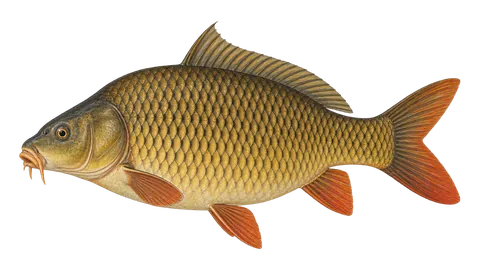
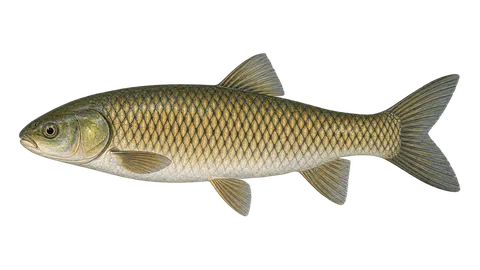
Huge head, about a third of the body, eyes low, below the mouth line, and a large upturned mouth, with no barbels. Small scales. Dark grey body with large, irregular black blotches on the flank, pale to yellowish belly and a keel of scales between the pelvic fins and the anus. The silver carp is pale, unspotted, with a keel from the throat; the common carp has barbels and large scales.

distribution

where found

open on the large map

Exotic, native to China. Raised in fish farms and released into pay lakes, açudes and reservoirs; listed as exotic in the rules of GO (Araguaia-Tocantins, Paranaíba and São Francisco), PR and MS, and already caught in Mirim Lagoon and the Patos Lagoon estuary (RS).

Habitat: Pay lakes, açudes, ponds and reservoirs; mid-water and surface.

introduced in

ParanáSoutheast AtlanticSouth AtlanticTocantins-AraguaiaSão Francisco

states

São Paulo, Paraná, Rio Grande do Sul, Minas Gerais, Goiás, Mato Grosso do Sul

calendar and clock

when to fish

best season

time of yearbest: Oct–Mar
JanFebSeaAprMayJunJulAugSepOctNovDec

Warm months, when plankton grows and it feeds more. In southern and southeastern winter it stays on the bottom and feeds little.

best time of day

0h6h12h18h sunrise ~6amsunset ~6pm

Daytime, with peaks at dawn and dusk. Feeds by day, most active early and late in the afternoon; on hot days it rises to the surface.

weather, water and behavior

what affects the bighead carp
sensitivity The little bars show how much each factor affects this species. Five full: it feels it a lot.

cold and cold fronts

Water below about 18 °C cuts feeding.

atmospheric pressure

Cold fronts knock the bite down; warm, stable days are best.

moon

Little effect.

rain

Cold rain slows activity; summer rain may activate it.

water level

Not very relevant at pay lakes.

noise

Wary of noise on the bank.

wind

Wind pushes plankton and concentrates fish on the downwind bank.

depth

Surface and mid-water, 0.5 to 2 m.

technique, gear and bait

how to fish

rod
7' to 9', medium-heavy action, 20 to 40 lb
spinning / baitcasting reel
spinning reel 5000 to 6000 with smooth drag and good line capacity
line
monofilament 0.40 to 0.50 mm
leader
optional
hook
chuveirinho (several small hooks, #10 to 14, attached to a ball of dough), where the pay lake allows it

natural baits

  • bran and feed dough that breaks apart in the water
  • ground feed groundbait

accessories

  • groundbait float
  • large landing net

tip from an angler

Soft dough that releases a cloud in the water, with the chuveirinho hidden inside. It sucks in the cloud: set the hook when the float sinks slowly and let it run on the first run.

what the law says

rules for the bighead carp

Summary of the regulations we found, with the source for each. Rules change; before keeping or transporting fish, check with the state environmental agency.
Conservation: In its native range, the global IUCN assessment is Data Deficient (DD, September 2, 2010).

GO: free capture and transport (exotic)

no size or bag limitGOTocantins-AraguaiaParanáSão Francisco

In Goiás, the bighead carp is on Annex II of the state rule in the Araguaia-Tocantins, Paranaíba and São Francisco basins: exotic species may be collected, killed and transported with no size or quantity limit. The same rule bans releasing exotic species into natural environments.

Source: IN Semad-GO nº 17/2026, art. 5º, art. 7º, § 5º, and Annex II

PR: bighead carp may not be released

catch free of size limits; release bannedPRParanáSoutheast Atlantic

In the inland basins of the Paraná, the bighead carp is on the list of non-native fish with permitted catch and exempt from size rules, and the ordinance bans releasing captured non-native fish.

Source: Portaria IAT nº 650/2025, art. 3º, § 1º, and Annex II

Releasing into the wild without a license is an offense

releasing or introducing fish into rivers, reservoirs and lakes is prohibitedconfirm with the agency

Introducing an exotic species, a hybrid or a fish outside its natural range without a technical opinion and licence is a federal environmental offence. This includes releasing fish from a tank, pay lake or aquarium into a river or reservoir.

Source: Lei federal nº 9.605/1998, art. 31, and Decreto federal nº 6.514/2008, art. 25

catch and release
catch and release Releasing the fish alive, quickly and with a wet hand. During a closed season it isn't always allowed: what the regulation says applies.

At a pay lake, follow the house rules. Outside it, don't take it to another water body; in Paraná, releasing non-native fish is banned.

in the kitchen

White, tasty flesh with intramuscular bones; the large head is used in broths.

calculator

how much it weighs without taking it out of the water

Length-weight relationship W = a·Lb (a = 0.00977, b = 3.1; FishBase). It's an average: a fat or lean fish can vary by 10% to 20%.

estimated weight

—

sources and references

The season weights (months), the time of day and the sensitivities (cold, pressure, moon, wind, rain, tide, strong light, murky water and noise) are the app's editorial estimates, based on the literature below and on the field experience of anglers and guides. They are not official data nor a measurement made for this species, and they may vary by region and year. Closed seasons and legal rules appear in the rules section, with the norm and a link.

  1. scientific FishBase — Hypophthalmichthys nobilis (ficha da espécie)Diagnosis, biology (plankton filtering and spawning requirements), maximum size and weight, length-weight relationship, introductions and country list. FishBase marks Brazil as a non-established introduction (no natural reproduction) and Mexico as present. Page checked on Oct 13, 2026.
  2. scientific IUCN Red List — Hypophthalmichthys nobilis (avaliação global: Dados Insuficientes, DD, 02/09/2010)Global assessment. Link given on the FishBase entry (Red List, version 2025-2).
  3. scientific Garcia, A. M.; Loebmann, D.; Vieira, J. P.; Bemvenuti, M. A. (2004). First records of introduced carps (Teleostei, Cyprinidae) in the natural habitats of Mirim and Patos Lagoon estuary, Rio Grande do Sul, Brazil. Revista Brasileira de Zoologia 21(1).Record of a bighead carp of 105 cm and 14.75 kg in the Patos Lagoon estuary (cited as Aristichthys nobilis).
  4. official IN Semad-GO nº 17/2026 — normas de pesca em GoiásAnnex II: Hypophthalmichthys nobilis (bighead carp) exotic in GO's three basins; art. 7º, § 5º. Page checked on Oct 13, 2026.
  5. official Portaria IAT nº 650/2025 — pesca nas bacias interiores do ParanáAnnex II (exotic bighead carp) and art. 3º, § 1º (release banned). Page checked on Oct 13, 2026.
  6. official Decreto estadual MS nº 15.166/2019 — pesca em Mato Grosso do SulArt. 7º, IV: carp (all species). Page checked on Oct 13, 2026.
  7. official Portaria MPA nº 532, de 23 de setembro de 2025 — nomes comuns das espécies de peixes de interesse comercialOfficial trade name: carpa-cabeça-grande. Page checked on Oct 13, 2026.
don't confuse

similar species