

grass carp
Ctenopharyngodon idella
A large herbivorous carp from China, raised in farm ponds and pay lakes. It exceeds 30 kg and gives one of the longest fights in lake fishing.
- common size
- 50–80 cm
- maximum
- 150 cm
- common weight
- 3–10 kg
- record/max.
- 45.0 kg
- depth
- 0.5–6 m
- ideal water
- 20–28 °C
how to recognize it
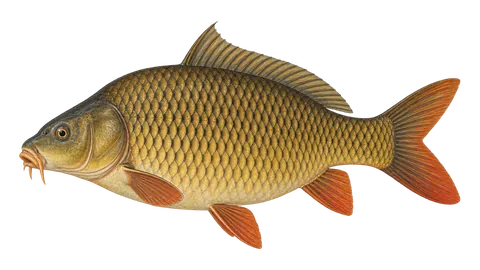
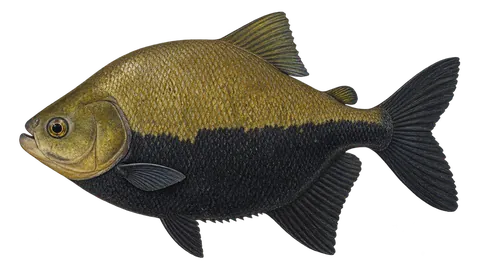
Elongated, rounded body with large dark-edged scales that form a net pattern; olive-green back and golden-silver flank. Mouth at the tip of the snout, no barbels, short snout and broad head. The common carp has barbels and a deeper body; silver and bighead carps have low-set eyes and small scales.
Also called: carpa-capim, carpa-chinesa, carpa-herbívora, carpa-do-limo
don't confuse with:
where found
open on the large mapWhere to look: Farm ponds, reservoirs, pay lakes and eddies with aquatic vegetation.
Exotic, native to East Asia. Raised in farm ponds, reservoirs and pay lakes; listed as exotic by the GO (Paranaíba and Araguaia-Tocantins) and MS rules, and recorded in the fish catalog of the upper Uruguay River.
introduced in
states
São Paulo, Paraná, Minas Gerais, Goiás, Mato Grosso do Sul, Santa Catarina, Rio Grande do Sul
famous destinations
when to fish
next 7 days
Loading the next 7 days…
best season
Spring and summer. In the southern winter it eats little.
best time of day
Daytime, with peaks at dawn and dusk. Feeds by day, most active early and in late afternoon; on hot days also at night.
what affects the grass carp
cold and cold fronts
Below about 15 °C it eats very little.
atmospheric pressure
A cold front shuts down activity.
moon
Little effect.
rain
Little effect.
water level
Little effect in farm ponds.
noise
Very wary: noise on the bank scares the fish away.
wind
Little effect.
depth
Mid-water and surface, 0.5 to 3 m.
how to fish
natural baits
- massa
- boiled corn
- grass or tender leaves
- bread
tip from an angler
Keep quiet on the bank and use vegetable bait on the surface or mid-water. Soft drag: the first run is long.
- rod
- 7' to 9', medium action, 20 to 40 lb
- spinning / baitcasting reel
- spinning reel 4000 to 6000 with smooth drag and good line capacity
- line
- monofilament 0.40 to 0.50 mm
- leader
- optional
- hook
- #1/0 to 4/0, strong
accessories
- groundbait float
- large landing net
catch and release
Large fish: use a landing net, wet your hands, support the body and release quickly. Do not release it into another body of water.
rules for the grass carp
Rules change; before keeping or transporting fish, check with the state environmental agency.
GO: free capture and transport (exotic)
no size or bag limitGO details
In Goiás the grass carp is in Annex II of the state rule: exotic, allochthonous and hybrid species may be collected, killed and transported without size or bag limits, even with the zero transport quota for native fish.
Source: IN Semad-GO nº 17/2026, art. 5º and Annex II (exotic, allochthonous and hybrid species)
MS: carp outside the native bag limit
specimens may be added to the limit, subject to the closed seasonMS details
In MS carp (all species) are on the list of exotic, allochthonous and hybrid species whose specimens may be added to the angler's bag limit, subject to the closed season.
Releasing into the wild without a license is an offense
releasing or introducing fish into rivers, reservoirs and lakes is prohibitedconfirm with the agency details
Introducing an exotic species without a technical opinion and license is a federal environmental offense. This includes releasing a fish from a tank, pay lake or aquarium into a river or reservoir.
Source: Lei federal nº 9.605/1998, art. 31, and Decreto federal nº 6.514/2008, art. 25
Conservation: In its native range, the global IUCN assessment is Least Concern (LC, Mar 30, 2020).
how much it weighs without taking it out of the water
estimated weight
—
how we calculate
Length-weight relationship W = a·Lb (a = 0.00933, b = 3.09; FishBase). It's an average: a fat or lean fish can vary by 10% to 20%.
more about the grass carp
Native to East Asia (China and the Amur River basin), the grass carp (carpa-capim) is one of the most farmed fish in the world and is also used to control aquatic plants in ponds and canals. It eats submerged plants and grass that falls into the water, and sometimes debris and invertebrates. It tolerates large temperature swings and low-oxygen water. In Brazil it is raised in farm ponds, private reservoirs and pay lakes, where it reaches large sizes. Goiás and Mato Grosso do Sul rules treat it as exotic, free capture. It demands heavy tackle and patience: it runs far and takes a long time to tire.
Family: Xenocyprididae · omnivore
fun facts
- It is used worldwide to clear farm ponds and canals overgrown with aquatic plants.
- Introductions of the species often brought along an Asian fish tapeworm (Bothriocephalus acheilognathi).
in the kitchen
White flesh with Y-shaped bones; good baked, fried in chunks or as scored fillets.
similar species
sources and references (6)
The season weights (months), the time of day and the sensitivities (cold, pressure, moon, wind, rain, tide, strong light, murky water and noise) are the app's editorial estimates, based on the literature below and on the field experience of anglers and guides. They are not official data nor a measurement made for this species, and they may vary by region and year. Closed seasons and legal rules appear in the rules section, with the norm and a link.
- scientific FishBase — Ctenopharyngodon idella (ficha da espécie)Names, distribution, biology, length-weight relationship and references. Page checked on October 13, 2026.
- scientific IUCN Red List — Ctenopharyngodon idella (avaliação global: Pouco Preocupante, LC, 30/03/2020)Global assessment. Link given on the FishBase entry (Red List, version 2025-2).
- technical CABI Compendium — Ctenopharyngodon idella (grass carp). Bonham, V. (2019).Data sheet for an introduced species. DOI checked in Crossref.
- scientific IUCN SSC Invasive Species Specialist Group — Global Invasive Species Database: Ctenopharyngodon idellaPage checked on Oct 13, 2026.
- scientific Zaniboni Filho, E.; Meurer, S.; Shibatta, O. A.; Nuñer, A. P. O. (2004). Catálogo ilustrado de peixes do alto rio Uruguai. Florianópolis: Editora da UFSC; Tractebel Energia. 128 p.Printed work; the URL is the bibliographic record on FishBase, which cites this work for the species.
- official IN Semad-GO nº 17/2026 — normas de pesca em Goiás (Anexos I e II)Annex II lists exotic, allochthonous and hybrid species with free capture and transport. Text checked on Oct 13, 2026.