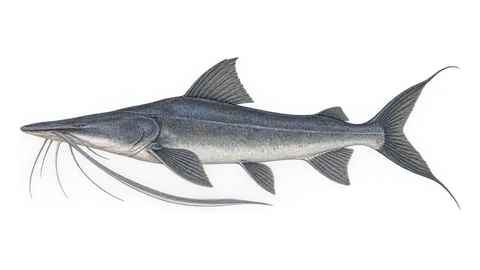
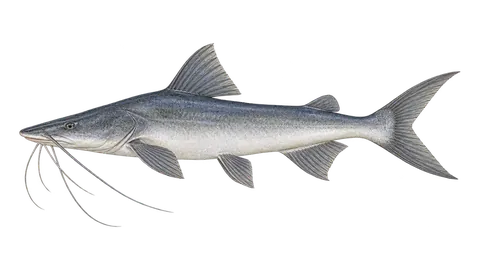
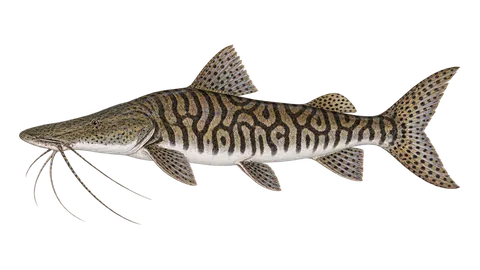
A large spotted catfish with flattened barbels, from the rivers of the Amazon and Orinoco. Rarely caught on hook; in Tocantins fishing is prohibited at any size.
Also called: coroatá, pirá-tucandira, surubim-chicote (nome da norma do Tocantins), mestiço
Choose the place and the species. The index, from 0 to 100, combines weather, sun, moon and tide with each fish's habits. Up to 28 days, with each day's confidence.
location
Sample location: choose yours to see the forecast for where you fish.
period
Reading the weather across 3 global models and 31 simulations…
0—
index Score from 0 to 100 for the fishing conditions of each hour. It reads weather, sun, moon, tide and the species' habits. It doesn't promise fish: it tells you when the water is on your side. 0–24 poor · 25–44 fair · 45–64 good · 65–84 very good · 85–100 excellent.
today
—
confidence —
confidence How much you can trust the weather forecast for the day. It drops with distance and when the models disagree. It is not the chance of catching fish.
models and trend Up to 16 days, three global weather models (the European ECMWF, the American GFS and a high-resolution blend) read hour by hour; when they disagree, the light band on the chart widens. Beyond that it's a trend: 31 runs of the American GEFS model. Confirm when it's 1 week out.
window Consecutive hours with the index near the day's peak and no danger alert. It is the time to have the bait in the water.
hour by hour
tap or drag on the chart to read each hour · on a keyboard, arrow keys
see hour-by-hour table
why this index at —?
next 7 days
choose the day
chart: bar height = day's index · line = variation between models · striped = trend · fainter = less confidence
Each card shows the day's index (0 to 100) and, below it, a strip with the index for each hour, from 0h to 23h. from poor to excellent.
4-week calendar
the fishing month at a glance
plan a trip
what's the best window for the crew?
Choose how many fishing days. We compare each stretch by its average index, discount days with a warning or closed season, and show the 3 best.
trend for the coming weeks
Line: the middle value of 31 simulations of the American GEFS model. Band: where 8 out of 10 fall. Narrow, firm trend; wide, high uncertainty.
the species
everything about the coroatá
overview
who is the coroatá
The coroatá is the only member of the genus Platynematichthys, a relative of Brachyplatystoma (dourada, piraíba). It lives in the Amazon and Orinoco basins and FishBase classifies it as a bottom-dwelling fish. Aquarium-hobby sources describe it as a fish-eating predator. Size varies by river: FishBase gives up to 80 cm standard length, and general literature mentions about 1 m in the Orinoco and about half that in the Amazon. It has commercial use. Tocantins' fishing rule prohibits catching it at any size, and the species is listed there as occurring in the Araguaia and Tocantins. We found no reports of targeted sport fishing: bait and technique data are scarce.
fun facts
It is the only member of the genus Platynematichthys, the sister group of Brachyplatystoma (dourada, piraíba).
The genus name comes from Greek and means 'broad-thread fish', after its flattened barbels.
In the Orinoco it reaches 1 m standard length, but in the Amazon about half that is reported.
how to recognize it
identification
A large catfish with smooth skin, fusiform body, brown back and whitish belly, with scattered dark blotches and spots but no stripes. The barbels are flattened and broad (the genus name means 'broad-thread fish'). Aquarists say the fins turn yellowish in adults and that the color varies a lot between specimens. It can be confused with the caparari and with young individuals of other spotted catfish, which have stripes or spots in rows and a much flatter head.
Rivers of the Amazon and Orinoco basins; there are records in the Negro and Branco rivers. Tocantins' fishing rule lists it among the species of the Araguaia and Tocantins. Outside Brazil, Colombia and Venezuela.
Habitat: Channels of large rivers, near the bottom; pools and deep stretches with current (estimate based on its bottom-dwelling habit).
native to the basins
AmazonTocantins-Araguaia
states
Amazonas, Roraima, Tocantins
calendar and clock
when to fish
best season
time of yearbest: Jul–Oct
JanFebSeaAprMayJunJulAugSepOctNovDec
No specific seasonal data. Like other channel catfish, it should be easier during falling water and the dry season, with low river levels (estimate). In Tocantins fishing is prohibited year-round.
best time of day
Night and twilight. No time-of-day studies. As a large bottom-dwelling predatory catfish, it should produce better at night (estimate).
weather, water and behavior
what affects the coroatá
sensitivity The little bars show how much each factor affects this species. Five full: it feels it a lot.
cold and cold fronts
Little effect in a tropical river; cold snaps (friagem) can reduce activity.
atmospheric pressure
Little known effect.
moon
No data.
rain
Little known effect.
water level
A falling river concentrates fish in the channels (estimate).
low-profile baitcaster 300 or 6000 spinning reel, with strong drag
line
40 to 60 lb braided line
leader
60 to 80 lb monofilament, 50 cm
hook
circle hook 6/0 to 8/0
natural baits
live fish or cut bait, local
accessories
long-nose pliers
luvas
damp cloth
tip from an angler
There are no reports of sport fishing for coroatá; use large bottom-catfish tackle. In Tocantins, if one comes up, release it right away.
what the law says
rules for the coroatá
Summary of the regulations we found, with the source for each. Rules change; before keeping or transporting fish, check with the state environmental agency. Conservation: Not on the Brazilian national list (Ministerial Ordinance GM/MMA No. 1.667/2026).
TO: fishing prohibited at any size
catching bannedTOTocantins-Araguaia
In Tocantins the coroatá (Platynematichthys notatus), also called surubim-chicote in the rule, appears in Annex III, species with fishing prohibited at any size. If you hook one, release it alive right away.
piracema closures in the basins where the species lives
Closed season in Goiás (state rule)
01/11 to 28/02GO
Allowed: Sport and guided fishing only in reservoirs, catch and release with barbless hooks (no keeping, transporting or eating). Subsistence: up to 5 kg per day, for household consumption only.
Spawning closure (piracema) in Mato Grosso (all basins)
01/10 to 31/01MT
Allowed: All fishing modalities are prohibited in rivers, including catch and release (Law 9.096/2009, art. 19-A). Exceptions: subsistence fishing from shore (3 kg or 1 fish, no transport or sale) and scientific fishing. Law 13.159/2025 now allows licensed sport fishing in UHE/PCH hydropower reservoirs, natural lakes and border rivers, subject to a scientific study and a license from the environmental agency. We have not confirmed whether these licenses are already being issued.
Spawning closure (piracema) in the Araguaia River basin
01/11 to 28/02GOTOPAMT
Allowed: Recreational fishing only in reservoirs, with handline, rod, or spinning or baitcasting reel. Fish may only be eaten on site, not transported. Competitions prohibited. Subsistence: 3 kg + 1 fish. State rules (GO and TO) may be stricter.
Spawning closure (piracema) in Tocantins (state rule)
01/11 to 28/02TO
Allowed: In 2025/26: catch and release with barbless hooks and recreational fishing card; subsistence fishing on foot or from a rowboat, with simple pole or handline.
Allowed: Recreational anglers with handline or rod, line and hook are outside the Annex II prohibitions, with a bag limit of 5 kg + 1 fish, unless a stricter state rule applies.
catch and release Releasing the fish alive, quickly and with a wet hand. During a closed season it isn't always allowed: what the regulation says applies.
In Tocantins, release it without delay. Anywhere: hold the fish from below, with its body horizontal, without lifting it by the head; remove the hook with long-nose pliers and release it into the current.
in the kitchen
According to FishBase it is a commercial fishing species. In Tocantins catch is prohibited, and we found no notes on preparation or market specific to the species.
calculator
how much it weighs without taking it out of the water
Length-weight relationship W = a·Lb (a = 0.00933, b = 3.08; FishBase (relação peso-comprimento bayesiana, estimativa)). It's an average: a fat or lean fish can vary by 10% to 20%.
estimated weight
—
sources and references
The season weights (months), the time of day and the sensitivities (cold, pressure, moon, wind, rain, tide, strong light, murky water and noise) are the app's editorial estimates, based on the literature below and on the field experience of anglers and guides. They are not official data nor a measurement made for this species, and they may vary by region and year. Closed seasons and legal rules appear in the rules section, with the norm and a link.
scientificFishBase: Platynematichthys notatus (ficha da espécie)Size, length-weight, depth, habitat, distribution, biology and IUCN status. Page checked on October 13, 2026. The maximum weight and the typical sizes and weights on the page are editorial estimates made with the length-weight relationship, because FishBase does not publish a maximum weight for the species.
technicalPractical Fishkeeping: Platynematichthys notatusFish-eating habit, color variation, records in the Negro and Branco rivers, and size cited from FishBase (80 cm). Aquarium-hobby source, not scientific; page checked on October 13, 2026.
technicalWikipédia (en): PlatynematichthysMonotypic genus of the tribe Brachyplatystomatini; size in the Orinoco (up to 1 m) and in the Amazon (about half). Open encyclopedia; page checked on October 13, 2026.
technicalWikipédia (pt): Platynematichthys notatusCommon names (mestiço, caravataí, coroatá, coronel) and color (brown back, whitish belly with dark blotches). Open encyclopedia; page checked on October 13, 2026.
The weather comes from three independent global models, cross-checked hour by hour: when they agree, confidence goes up; when they diverge, the band between them shows on the chart. Beyond 16 days, we use the GEFS ensemble of 31 simulations: if 20 of the 31 predict rain, the chance of rain is 65%. Sun and moon are calculated astronomically, with no uncertainty.
The index adds up, weighted for each species: time of day (species curve anchored to real sunrise and sunset), moon (transits, rise and set, phase), pressure (3 h trend and 24 h swing), water temperature (in rivers, estimated from air temperature; at sea, estimated by an ocean model), wind, rain, clouds, tide and the month in the species' cycle.
Accuracy measured in the reference project (4 regions, 93 days, forecast vs. observed): maximum temperature is off by 0.6 °C on average the next day and 1.7 °C at 7 days; rain of 5 mm or more is detected 76% of the time the next day and 57% at 7 days. Detection isn't everything: the false alarm rate isn't published here yet, and 93 days in 4 regions is still a small sample. We now also measure every day, at the app's destinations:
where are you going fishing?
Your location is saved only on this device and feeds the forecast, the map and the "today" on the home page.