MG: minimum 30 cm
30 cmMGSão Francisco
Minimum size for corvina (Pachyurus francisci) in Minas Gerais.
Source: Portaria IEF-MG nº 111/2003 (IEF minimum size table)
Pachyurus francisci · Sciaenidae · predator
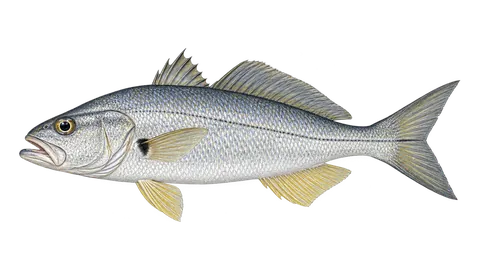
The corvina native to the São Francisco, with its mouth under the snout. A sand-bottom fish, good eating and common in bank fishing.
Also called: corvina, curvina, corvina-de-água-doce, pescada, sofia


Choose the place and the species. The index, from 0 to 100, combines weather, sun, moon and tide with each fish's habits. Up to 28 days, with each day's confidence.
Reading the weather across 3 global models and 31 simulations…
Each card shows the day's index (0 to 100) and, below it, a strip with the index for each hour, from 0h to 23h. from poor to excellent.
Choose how many fishing days. We compare each stretch by its average index, discount days with a warning or closed season, and show the 3 best.
Line: the middle value of 31 simulations of the American GEFS model. Band: where 8 out of 10 fall. Narrow, firm trend; wide, high uncertainty.
Freshwater croaker endemic to the São Francisco basin, a relative of the corvinas and croakers of the sea. It lives in the channel and in eddies over sandy bottoms, where it feeds close to the bottom. It is commercially valuable in the region and a common catch for bottom anglers using worms and shrimp. The IUCN global assessment rates it Data Deficient. Don't confuse it with the pescada-do-piauí (Plagioscion squamosissimus), which has a large terminal mouth and also appears in São Francisco reservoirs.
Elongated, silvery body, rounded snout projecting over the mouth, which sits underneath. Lateral line extending onto the tail and a dorsal fin split in two. The pescada-do-piauí has a large mouth at the tip of the snout and canine teeth.
Endemic to the São Francisco basin, from the main channel in Minas Gerais to the lower course.
Habitat: Channel and eddies with sandy bottoms; reservoirs.
native to the basins
states
Minas Gerais, Bahia, Pernambuco, Alagoas, Sergipe
Bites all year; best during falling water and with a clear river, August to October.
Dawn and dusk. Most active at dawn and dusk, near the bottom.
Strong cold reduces the bite.
A cold front shuts down activity for a day or two.
Little effect.
Little effect, except in very muddy water.
Stable or falling river.
Moderately sensitive.
Little effect.
Bottom, 1 to 6 m.
lures
natural baits
accessories
Lure dragged slowly along the sandy bottom late in the afternoon.
Summary of the regulations we found, with the source for each. Rules change; before keeping or transporting fish, check with the state environmental agency.
Conservation: Not on the national list (Portaria GM/MMA 1.667/2026). Global IUCN assessment: Data Deficient (DD).
Minimum size for corvina (Pachyurus francisci) in Minas Gerais.
Source: Portaria IEF-MG nº 111/2003 (IEF minimum size table)
Allowed: Only exotic or hybrid species, 3 kg + 1 fish per day, with handline, rod, simple pole, or spinning or baitcasting reel. Nets prohibited. Keep the minimum distances from dams and reservoirs.
Source: Portarias IEF nº 154/2011 (São Francisco), 155/2011 (East) and 156/2011 (Grande/Paranaíba)
Allowed: Sport and guided fishing only in reservoirs, catch and release with barbless hooks (no keeping, transporting or eating). Subsistence: up to 5 kg per day, for household consumption only.
Allowed: Recreational fishing from a boat or from shore with handline, rod, spinning or baitcasting reel, up to 5 kg + 1 fish. Prohibited within 1,000 m of dams, waterfalls and rapids, and within 500 m of confluences. Floodplain lakes have a longer closed season (see next item).
Source: Portaria IBAMA nº 50/2007
Allowed: No fishing in the floodplain lakes during the period.
Source: Portaria IBAMA nº 50/2007
Bottom fish: reel in slowly, unhook in the water and release.
White, soft flesh; fried as fillets or steaks.
Length-weight relationship W = a·Lb (a = 0.00776, b = 3.15; FishBase). It's an average: a fat or lean fish can vary by 10% to 20%.
estimated weight
—
The season weights (months), the time of day and the sensitivities (cold, pressure, moon, wind, rain, tide, strong light, murky water and noise) are the app's editorial estimates, based on the literature below and on the field experience of anglers and guides. They are not official data nor a measurement made for this species, and they may vary by region and year. Closed seasons and legal rules appear in the rules section, with the norm and a link.
The weather comes from three independent global models, cross-checked hour by hour: when they agree, confidence goes up; when they diverge, the band between them shows on the chart. Beyond 16 days, we use the GEFS ensemble of 31 simulations: if 20 of the 31 predict rain, the chance of rain is 65%. Sun and moon are calculated astronomically, with no uncertainty.
The index adds up, weighted for each species: time of day (species curve anchored to real sunrise and sunset), moon (transits, rise and set, phase), pressure (3 h trend and 24 h swing), water temperature (in rivers, estimated from air temperature; at sea, estimated by an ocean model), wind, rain, clouds, tide and the month in the species' cycle.
Accuracy measured in the reference project (4 regions, 93 days, forecast vs. observed): maximum temperature is off by 0.6 °C on average the next day and 1.7 °C at 7 days; rain of 5 mm or more is detected 76% of the time the next day and 57% at 7 days. Detection isn't everything: the false alarm rate isn't published here yet, and 93 days in 4 regions is still a small sample. We now also measure every day, at the app's destinations:
Your location is saved only on this device and feeds the forecast, the map and the "today" on the home page.