Size window in Tocantins
20 cm (maximum 45 cm)TOTocantins-Araguaia
In Tocantins the white pescada may only be kept between 20 and 45 cm.
Source: Portaria NATURATINS/GABIN nº 47/2026 (annexes amended by Portaria nº 105/2026)
Plagioscion squamosissimus
Freshwater croaker from the Amazon and Parnaíba, now common in reservoirs of the Paraná and the Northeast. Bites well in the afternoon and at night.
Also called: pescada, pescada-branca, corvina de água doce, curvina

The pescada-do-piauí is a freshwater croaker, a relative of the sea pescadas. It is native to the Amazon, Araguaia-Tocantins and Parnaíba basins, and was introduced to Northeastern reservoirs and to the Paraná and São Francisco reservoirs, where it adapted very well. It lives in open, deep water near the bottom and hunts shrimp and small fish, mostly in late afternoon and at night. It forms schools over rocky stretches, channels and reservoir headwaters. It produces a grunting sound with its swim bladder. It is a popular food fish and fun on light tackle, with natural bait or jigs.
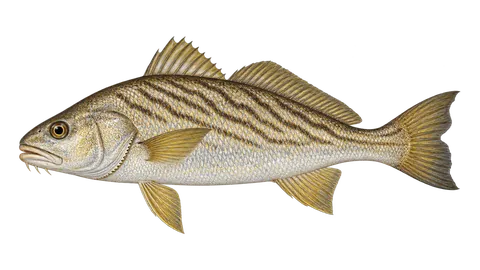
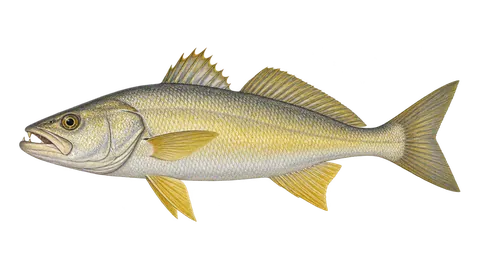
Elongated, silvery body, greyish back and two dorsal fins, the first with spines. Dark spot at the base of the pectoral fin. Lateral line extending onto the tail, which is pointed. Large, oblique mouth. The sea croaker has small chin barbels and oblique stripes. The yellow pescada lives in the sea and estuaries, much larger and yellowish in tone.
Loading the next 7 days…
Each card shows the day's index (0 to 100) and, below it, a strip with the index for each hour, from 0h to 23h. from poor to excellent.
Native to the Amazon, Araguaia-Tocantins and Parnaíba. Introduced into reservoirs in the Northeast and into Paraná reservoirs (Tietê, Grande, Paranapanema, Itaipu) and the São Francisco.
Habitat: Open water and channels of rivers and reservoirs, rocky stretches and deep submerged brush piles, reservoir headwaters.
native to the basins
introduced in
states
Amazonas, Pará, Amapá, Acre, Rondônia, Roraima, Tocantins, Mato Grosso, Maranhão, Piauí, Ceará, Rio Grande do Norte, Paraíba, Pernambuco, Bahia, Minas Gerais, São Paulo, Paraná, Mato Grosso do Sul, Goiás, Sergipe, Alagoas
In Southeastern reservoirs, spring and summer produce more. In the Amazon, the dry season concentrates schools in channels.
Night and twilight. Best from late afternoon into the night; by day it bites on the bottom, in channels and rocky stretches.
A cold front on a reservoir greatly reduces activity.
Stable pressure helps.
Full-moon nights tend to produce at the surface of reservoirs.
Little effect.
In the Amazon, a falling river concentrates fish in channels.
Moderate.
Strong wind makes it harder to control the lure on the bottom.
3 to 15 m by day; rises at night.
lures
natural baits
accessories
Find the school on the sonar and work the jig vertically, with short taps near the bottom.
Boat fishing in large reservoirs in SP, MG, GO, MS and PR, where blue and yellow peacock bass were introduced. Clear water, pressured fish and plenty of submerged structure.
guideUnderstand how sonar sees underwater, what each mark on the screen means, and how to adjust the unit to find bottom, structure and fish.
Summary of the regulations we found, with the source for each. Rules change; before keeping or transporting fish, check with the state environmental agency.
Conservation: Not on the national list (Portaria GM/MMA 1.667/2026). Non-native in the Paraná, São Francisco and eastern Northeast basins.
In Tocantins the white pescada may only be kept between 20 and 45 cm.
Source: Portaria NATURATINS/GABIN nº 47/2026 (annexes amended by Portaria nº 105/2026)
In the Madeira River basin in Rondônia, pescada is on the list of species with fishing banned from Nov 15 to Mar 15.
On the Madeira River, the closed season protects pescada, surubim, caparari, pirapitinga and jatuarana. In the Guaporé-Mamoré sub-basin it applies to all species, except those listed in the rule.
Source: Portaria IBAMA nº 48/2007
Source: IN Semad-GO nº 17/2026, Annex I, Araguaia-Tocantins basin (on-site consumption only; zero transport)
Source: Portaria Naturatins nº 47/2026, Annex I, as amended by Portaria nº 105/2026
Source: INIs MPA/MMA nº 12/2011 (Araguaia) and 13/2011 (Tocantins), minimum size annexes
Allowed: Sport and guided fishing only in reservoirs, catch and release with barbless hooks (no keeping, transporting or eating). Subsistence: up to 5 kg per day, for household consumption only.
Allowed: All fishing modalities are prohibited in rivers, including catch and release (Law 9.096/2009, art. 19-A). Exceptions: subsistence fishing from shore (3 kg or 1 fish, no transport or sale) and scientific fishing. Law 13.159/2025 now allows licensed sport fishing in UHE/PCH hydropower reservoirs, natural lakes and border rivers, subject to a scientific study and a license from the environmental agency. We have not confirmed whether these licenses are already being issued.
Allowed: Recreational fishing only in reservoirs, with handline, rod, or spinning or baitcasting reel. Fish may only be eaten on site, not transported. Competitions prohibited. Subsistence: 3 kg + 1 fish. State rules (GO and TO) may be stricter.
Allowed: Recreational fishing only in reservoirs, with on-site consumption. Subsistence: 5 kg + 1 fish. State rules may be stricter.
Allowed: In 2025/26: catch and release with barbless hooks and recreational fishing card; subsistence fishing on foot or from a rowboat, with simple pole or handline.
Source: Portaria Naturatins nº 244/2025 (2025/26 season); INIs MPA/MMA nº 12 and 13/2011
Allowed: Recreational fishing from a boat or from shore with handline, rod, spinning or baitcasting reel, up to 5 kg + 1 fish per day. Prohibited within 1,500 m of dams, waterfalls and rapids. Competitions prohibited.
Source: IN MMA nº 40/2005
Allowed: Recreational fishing from a boat or from shore with handline or rod, up to 5 kg or 1 fish. Transport only within the municipality. Competitions prohibited.
Source: Portaria IBAMA nº 85/2003
Allowed: The same recreational-angler exceptions as in Portaria 48/2007 apply (handline or rod, 5 kg + 1 fish), unless a stricter state rule applies.
Source: Portaria IBAMA nº 48/2007
Allowed: Recreational anglers with handline or rod, line and hook are outside the Annex II prohibitions, with a bag limit of 5 kg + 1 fish, unless a stricter state rule applies.
Source: Portaria IBAMA nº 48/2007
Allowed: Subsistence fishing only.
Source: Portaria IBAMA nº 48/2007
Allowed: See the exceptions in Portaria 48/2007 and the state rules for each bank.
Source: Portaria IBAMA nº 48/2007
A fish hauled up from depth can suffer decompression; release it quickly. Where it is non-native, keeping it for food is a good option.
White, soft, tasty flesh, as fried fillets, baked or in moqueca. Widely sold in markets in the North and Northeast.
Length-weight relationship W = a·Lb (a = 0.00871, b = 3.08; FishBase (bayesiano, dados da espécie)). It's an average: a fat or lean fish can vary by 10% to 20%.
estimated weight
—
The season weights (months), the time of day and the sensitivities (cold, pressure, moon, wind, rain, tide, strong light, murky water and noise) are the app's editorial estimates, based on the literature below and on the field experience of anglers and guides. They are not official data nor a measurement made for this species, and they may vary by region and year. Closed seasons and legal rules appear in the rules section, with the norm and a link.
Your location is saved only on this device and feeds the forecast, the map and the "today" on the home page.