

escolar
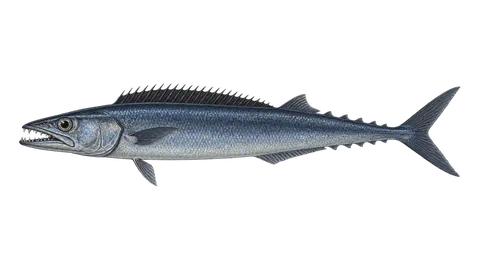
Lepidocybium flavobrunneum · Gempylidae · predator
Deep-water fish, dark brown to almost black, that rises at night to feed. Its flesh has about 20% indigestible oil that can cause oily diarrhea: eat little or avoid it.
Also called: escolar-preto, escolar, escolar-da-fundura, escolar-de-natura, black oilfish

- common size
- 100–150 cm
- maximum
- 200 cm
- common weight
- 11–36 kg
- record/max.
- 45.0 kg
- depth
- 200–1,100 m
- ideal water
- 8–15 °C

the right time
to be on the water
Choose the place and the species. The index, from 0 to 100, combines weather, sun, moon and tide with each fish's habits. Up to 28 days, with each day's confidence.
Reading the weather across 3 global models and 31 simulations…
—
hour by hour
slide your finger or mouse over the chart to see each hoursee hour-by-hour table
why this index at —?
choose the day
Each card shows the day's index (0 to 100) and, below it, a strip with the index for each hour, from 0h to 23h. from poor to excellent.
the fishing month at a glance
what's the best window for the crew?
Choose how many fishing days. We compare each stretch by its average index, discount days with a warning or closed season, and show the 3 best.
trend for the coming weeks
Line: the middle value of 31 simulations of the American GEFS model. Band: where 8 out of 10 fall. Narrow, firm trend; wide, high uncertainty.
everything about the escolar
who is the escolar
The escolar lives in tropical and temperate seas worldwide, near the continental slope, from 200 to 1,100 m, on the bottom and above it. At night it rises to feed on squid, crustaceans and a wide variety of fish. It reaches 200 cm and 45 kg, and FishBase gives 150 cm as its common length. It is rarely targeted on purpose; it usually comes up as bycatch from tuna longlines, but FishBase lists it as a sport fish. The muscle may contain about 20% indigestible wax ester oil (gempylotoxin), which acts as a laxative and can cause oily diarrhea. There is a recent study (Fisheries Oceanography, 2026) on its habitat in the Southwest Atlantic, with researchers from Brazil and Uruguay taking part.
fun facts
- About 20% of the muscle can be indigestible oil.
- It has been sold as white tuna, butterfish, snook and other names, so many people eat it without knowing it.
- It rises near the surface at night and sinks by day.
identification
Long, sturdy body, almost uniformly dark brown, darkening with age until nearly black. On the caudal peduncle there is a strong lateral keel, with smaller keels above and below, and behind the soft dorsal and anal fins there are four to six finlets. The pelvic fins are well developed (one spine and five rays), and the dorsal fin has 8 or 9 spines. The peixe-prego (oilfish, Ruvettus pretiosus) is similar in color, but its skin is very rough, with bony tubercles between the scales, and it has a keel along the middle of the belly.
where found
Cosmopolitan in tropical and temperate seas. In Brazil it lives off the shelf, on the slope and in open sea, from about 200 m, and there is a recent study on its habitat in the Southwest Atlantic; we found no map of fishing spots in the country.
Habitat: Continental slope and open sea, 200 to 1,100 m, on the bottom and above it; rises at night to hunt.
coast
when to fish
best season
No set season in deep, open waters. We found no closed season or specific rule in Brazil.
best time of day
Nighttime. It stays deep by day and migrates upward at night to feed; the dark hours are the best time.
what affects the escolar
sensitivity The little bars show how much each factor affects this species. Five full: it feels it a lot.
cold and cold fronts
It lives in deep, cold, stable water; a cold front only bothers it through rough seas.
atmospheric pressure
A cold front brings rough seas and makes it hard to hold position over the spot at night.
moon
The species rises at night to feed; moonlight may change the depth it stays at, but we found no measurement.
rain
No effect at depth.
water level
Not applicable at sea.
noise
Not very sensitive to noise at that depth.
wind
Strong wind and fast drift keep the bait from staying on the bottom.
tide
Strong current drags the line; with moderate current the bait stays on the bottom.
depth
From 200 to 1,100 m; rises at night.
how to fish
- rod
- 6' to 6'6", 50 to 80 lb, or electric gear for bottom fishing
- spinning / baitcasting reel
- electric reel or high-profile reel, for line over 300 m
- line
- braided line 80 to 130 lb
- leader
- fluorocarbon or monofilament 100 to 150 lb, 2 to 3 m
- hook
- circle 8/0 to 12/0
lures
- slow pitch jig 300 to 600 g
natural baits
- whole squid
- fish steak
accessories
- descender (descending device) for release
- luvas
- long-nose pliers
tip from an angler
Fish at dusk and at night, when the escolar rises; use a heavy leader, because the species has a large mouth and teeth. If you're not going to eat it, release it with a descender.
rules for the escolar
Summary of the regulations we found, with the source for each. Rules change; before keeping or transporting fish, check with the state environmental agency.
Conservation: Not on the Brazilian national list (Ministerial Ordinance GM/MMA No. 1.667/2026).
We found no species-specific rule beyond the region's general rules.
catch and release
catch and release Releasing the fish alive, quickly and with a wet hand. During a closed season it isn't always allowed: what the regulation says applies.
If it comes from more than 200 m, it arrives with barotrauma and rarely survives without help. If you're going to release it, use a descender and send the fish back down quickly. If you're going to eat it, bleed and chill it right away.
in the kitchen
White, tender and very oily flesh. The fat is made of waxes that the human body cannot digest: in large portions it can cause oily diarrhea, cramps and nausea a few hours later (Health Canada). No safe dose has been defined; anyone who has never eaten it should start with a small portion. Pregnant women, children, the elderly and people with bowel problems should avoid it. Grilling to drain off the fat helps, but heat does not destroy the wax. Japan has banned its sale since 1977, and Italy has too, according to a secondary source. We found no specific Brazilian rule.
how much it weighs without taking it out of the water
Length-weight relationship W = a·Lb (a = 0.01175, b = 2.98; FishBase (relação peso-comprimento bayesiana, estimativa da própria espécie)). It's an average: a fat or lean fish can vary by 10% to 20%.
estimated weight
—
sources and references
The season weights (months), the time of day and the sensitivities (cold, pressure, moon, wind, rain, tide, strong light, murky water and noise) are the app's editorial estimates, based on the literature below and on field experience from anglers and guides. They are not official data or measurements made for this species and may vary by region and year. Closed seasons and legal rules appear in the rules section, with the rule and link. The common size and weight ranges, water temperature and typical depth are also editorial estimates, anchored in FishBase data.
- scientific FishBase: Lepidocybium flavobrunneum (ficha da espécie)Size, length-weight, depth, habitat, distribution, biology and IUCN status. Page checked on 13/10/2026. Common size and weight ranges, water temperatures and typical depths are editorial estimates based on FishBase data. Entry name: 'escolar-preto' is one of the Portuguese names FishBase lists (along with 'escolar-da-fundura' and 'escolar-de-natura', from Portugal and the Azores). We did not confirm the name used by Brazilian fishers.
- scientific FishBase: nomes populares de Lepidocybium flavobrunneumNames by country and language.
- official Portaria GM/MMA nº 1.667, de 27 de abril de 2026: Lista Nacional Oficial de Espécies da Fauna Ameaçadas de Extinção (peixes e invertebrados aquáticos)The species is not on the list. Checked in the DOU of April 28, 2026.
- official Health Canada: Escolar and Adverse Reactions (página de 08/04/2026)The escolar and the oilfish both have about 20% indigestible wax ester oil (gempylotoxin) in the muscle, which has a laxative effect. Symptoms begin within a few hours and clear up in 24 to 48 hours; pregnant women, children, the elderly and people with bowel problems should avoid it. No safe dose has been defined.
- technical Wikipedia: Escolar (Lepidocybium flavobrunneum)Secondary source, used for the nightly migration, the average size of about 1.5 m, and the sales restrictions in other countries (Japan has banned it since 1977 and Italy has too). These data were not checked against an official source in the countries cited.
- technical NOAA Fisheries: Return 'Em Right, soltura de peixes de recife pescados em fundo (barotrauma e dispositivos de descida)Guidance for releasing deep-water fish: barotrauma comes from rapid ascent, and specialists prefer descending devices to needle venting.
- scientific Rodrigues, L. et al. (2026). Mapping Escolar (Lepidocybium flavobrunneum) in Motion: Oceanographic Forces Shaping Its Habitat in the Southwestern South Atlantic, With Insights From Fishers' Perceptions. Fisheries Oceanography 35(3): 445-461.Recent study with participation from institutions in Brazil and Uruguay on the escolar's habitat in the Southwest Atlantic. Bibliographic record checked in a research portal; the article text was not read.
similar species


where each number comes from
The weather comes from three independent global models, cross-checked hour by hour: when they agree, confidence goes up; when they diverge, the band between them shows on the chart. Beyond 16 days, we use the GEFS ensemble of 31 simulations: if 20 of the 31 predict rain, the chance of rain is 65%. Sun and moon are calculated astronomically, with no uncertainty.
The index adds up, weighted for each species: time of day (species curve anchored to real sunrise and sunset), moon (transits, rise and set, phase), pressure (3 h trend and 24 h swing), water temperature (in rivers, estimated from air temperature; at sea, estimated by an ocean model), wind, rain, clouds, tide and the month in the species' cycle.
sources for this lookup
how accurate the forecast is
Accuracy measured in the reference project (4 regions, 93 days, forecast vs. observed): maximum temperature is off by 0.6 °C on average the next day and 1.7 °C at 7 days; rain of 5 mm or more is detected 76% of the time the next day and 57% at 7 days. Detection isn't everything: the false alarm rate isn't published here yet, and 93 days in 4 regions is still a small sample. We now also measure every day, at the app's destinations: