Skip to content
fishing forecast

mackerel scad

Decapterus macarellus · Carangidae · forage fish

Sea

Small, slender schooling carangid that lives in blue water near islands and reef edges. It is worth more as live bait or in strips than as a sport fish.

Also called: garapau, olhão, oião, cavalinha-de-reis, mackerel scad, cigarfish

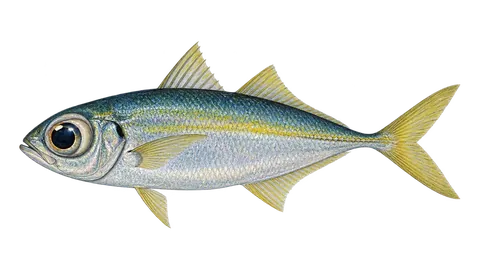
Scientific illustration of Mackerel scad
common size
25–35 cm
maximum
46 cm
common weight
0.2–0.5 kg
record/max.
— kg
depth
40–200 m
ideal water
22–28 °C
location

Sample location: choose yours to see the forecast for where you fish.

period

Reading the weather across 3 global models and 31 simulations…

the species

everything about the mackerel scad

overview

who is the mackerel scad

The garapau (mackerel scad) is a small, slender schooling carangid that lives in clear and oceanic waters worldwide. In the western Atlantic it ranges from Nova Scotia and Bermuda to around Rio de Janeiro, and FishBase says it seems to be absent from the Gulf of Mexico. It prefers blue water near islands, usually between 40 and 200 m, in fast schools along reef edges near deep water, sometimes near the surface. It feeds mainly on zooplankton. It reaches 46 cm, with a common length of 30 cm. It is caught with purse seines and trawls and sold fresh, salted or dried; FishBase lists its use as bait. Ciguatera has been recorded. Artisanal fishers in Ceará and Pernambuco call it garapau, olhão and oião.

fun facts

  • FishBase records the use of garapau as bait ('bait: usually').
  • In the Northeast, 'garapau' is also a local name for the bigeye scad, which mixes the two species in dockside talk.
  • Schools race at high speed along the edge of reefs that drop into the deep sea (FishBase).
how to recognize it

identification

Spindle-shaped, slender carangid, blue-green on the back and silvery below, with a small black spot on the upper edge of the gill cover and a yellow-green tail. No teeth. The last ray of the dorsal and anal fins forms a loose finlet. Bony scutes on the straight part of the lateral line. The membrane in front of the upper jaw is white in adults. The bigeye scad (Selar crumenophthalmus) is deeper-bodied, with a much larger eye; in the Northeast, 'garapau' is also a local name for the bigeye scad.

distribution

where found

open on the large map

In Brazil, from the North to the Southeast, down to around Rio de Janeiro, according to FishBase; artisanal fishers in Ceará and Pernambuco know it. In Latin America, FishBase's list includes Mexico, Central America, the Caribbean, Colombia, Venezuela, the Guianas and Ecuador.

Habitat: Clear blue water near islands and along reef edges that drop into deep water, usually 40 to 200 m; sometimes near the surface.

coast

North CoastNortheast CoastSoutheast Coastshelfoceanic
calendar and clock

when to fish

best season

time of year
JanFebSeaAprMayJunJulAugSepOctNovDec

Present all year in tropical water; closer to islands and shoals when the water is blue and warm in summer.

best time of day

0h6h12h18h sunrise ~6amsunset ~6pm

Daytime, with peaks at dawn and dusk. Schools by day; rises nearer the surface in late afternoon and at dawn.

weather, water and behavior

what affects the mackerel scad
sensitivity The little bars show how much each factor affects this species. Five full: it feels it a lot.

cold and cold fronts

A warm, blue-water fish: it leaves the fishing zone when the water cools or turns green.

atmospheric pressure

Small effect.

moon

Small effect; the school concentrates in spring tide currents.

rain

Little effect in open sea; muddy river water pushes the school away.

water level

Not applicable at sea. The equivalent is clear blue water over the reef edge.

noise

Small effect.

wind

Rough seas make it hard to hold position over the school marked on the sonar.

tide

Current over points and reef edges concentrates plankton and schools.

depth

40 to 200 m for most catches; on the sonar it shows as patches over the reef edge.

technique, gear and bait

how to fish

rod
6' to 7', fast action, 8 to 15 lb
spinning / baitcasting reel
spinning reel 2500 to 4000
line
braided line 10 to 20 lb
leader
fluorocarbon 15 to 25 lb, 1 m
hook
sabiki with small hooks or a simple hook no. 4 to 1/0

lures

  • feather or glow sabiki
  • small jig, 10 to 30 g

natural baits

  • squid strips
  • shrimp
  • fish pieces

accessories

  • live well with circulating water
  • bucket with aerator
  • alicate

tip from an angler

Mark the school on the sonar, drop the sabiki to depth and reel up slowly with pauses. For live bait, keep the garapau in a live well with running water.

what the law says

rules for the mackerel scad

Summary of the regulations we found, with the source for each. Rules change; before keeping or transporting fish, check with the state environmental agency.
Conservation: Not on the Brazilian national list (Portaria GM/MMA nº 1.667/2026). Outside Mexico we found no specific rule for the species.

Mexico: up to 5 per species and 10 saltwater fish per day

5 specimens of the species per angler per day, within the limit of 10 saltwater fish

In recreational fishing in Mexican federal waters, each angler may keep up to 10 marine fish per day, no more than 5 of the same species. The garapau is not among the species reserved for recreational fishing and has no quota of its own. Fish over the limit go back into the water alive, and fish caught in recreational fishing may not be sold. Anyone fishing from a boat needs the recreational fishing permits set out in the rule.

Source: Amendment to NOM-017-PESC-1994 (recreational sport fishing in federal waters of Mexico), published in the DOF on Nov 25, 2013, items 4.3, 4.9.1, 4.9.5 and 4.11 (Sagarpa/Conapesca)

catch and release
catch and release Releasing the fish alive, quickly and with a wet hand. During a closed season it isn't always allowed: what the regulation says applies.

Small, delicate fish that stresses out of the water: release it quickly, with wet hands, or use it as live bait. Cut the leader close to the mouth if the hook is deep.

in the kitchen

Small, with dark, firm flesh, sold fresh, salted or dried. FishBase records ciguatera cases in this species: check with local fishers before eating it.

calculator

how much it weighs without taking it out of the water

Length-weight relationship W = a·Lb (a = 0.01202, b = 2.99; FishBase (relação peso-comprimento bayesiana, estimativa da própria espécie)). It's an average: a fat or lean fish can vary by 10% to 20%.

estimated weight

—

sources and references

The season weights (months), the time of day and the sensitivities (cold, pressure, moon, wind, rain, tide, strong light, murky water and noise) are the app's editorial estimates, based on the literature below and on the field experience of anglers and guides. They are not official data nor a measurement made for this species, and they may vary by region and year. Closed seasons and legal rules appear in the rules section, with the norm and a link.

  1. scientific FishBase: Decapterus macarellus (ficha da espécie)Size, length-weight, depth, habitat, distribution, biology and IUCN status. Page checked Oct 13, 2026. The common size range is an editorial estimate around the common length of 30 cm reported by FishBase.
  2. scientific FishBase: nomes populares de Decapterus macarellusNames by country and language.
  3. official Portaria GM/MMA nº 1.667, de 27 de abril de 2026: Lista Nacional Oficial de Espécies da Fauna Ameaçadas de Extinção (peixes e invertebrados aquáticos)The species is not on the list. Checked in the DOU of April 28, 2026.
  4. scientific Pinto, M. F.; Mourão, J. S.; Alves, R. R. N. (2015). Use of ichthyofauna by artisanal fishermen at two protected areas along the coast of Northeast Brazil. Journal of Ethnobiology and Ethnomedicine.Common names recorded from artisanal fishers in Tamandaré (PE) and the Batoque Extractive Reserve (CE).
  5. official NOM-017-PESC-1994 (pesca deportivo-recreativa em águas de jurisdição federal do México), modificação publicada no DOF em 25/11/2013 (Sagarpa/Conapesca)Limit of 10 marine fish per angler per day, no more than 5 of the same species (item 4.9.1), return of the excess (4.9.5) and ban on selling sport-caught fish (4.11). Text checked Oct 13, 2026. The rule sets no quota of its own for this species.
don't confuse

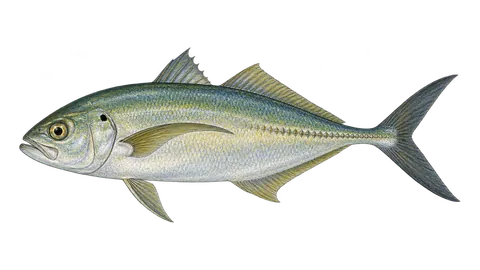
similar species