MS: minimum 35 cm
35 cmMS
Minimum size for jurupensém in MS.
Source: Decreto estadual MS nº 15.375/2020 (amends Decreto nº 15.166/2019), art. 9º - Semadesc/Imasul
Sorubim lima · Pimelodidae · predator
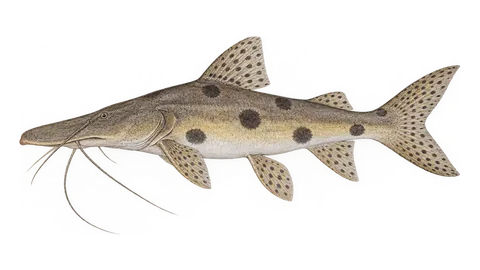
The bico-de-pato: a catfish with a flattened snout, a dark stripe on the flank and nocturnal habits. A classic of bank fishing in the Pantanal and the Araguaia.
Also called: jurupensém, jurupecém, bico-de-pato, colhereiro, boca-de-colher, surubim-lima


Choose the place and the species. The index, from 0 to 100, combines weather, sun, moon and tide with each fish's habits. Up to 28 days, with each day's confidence.
Reading the weather across 3 global models and 31 simulations…
Each card shows the day's index (0 to 100) and, below it, a strip with the index for each hour, from 0h to 23h. from poor to excellent.
Choose how many fishing days. We compare each stretch by its average index, discount days with a warning or closed season, and show the 3 best.
Line: the middle value of 31 simulations of the American GEFS model. Band: where 8 out of 10 fall. Narrow, firm trend; wide, high uncertainty.
Medium-sized leather catfish, with the upper jaw much longer than the lower, giving a duck-bill snout. Lives in schools and hunts mostly at night, eating fish and crustaceans near the banks and the bottom. In the Pantanal, growth rings on the pectoral spine form once a year, in the dry season. Young lie motionless head-down among the vegetation, mimicking leaves and twigs. In the upper Paraná it is non-native, arriving after the formation of the Itaipu lake. In recreational fishing it is caught at night with tuvira, lambari and worm.
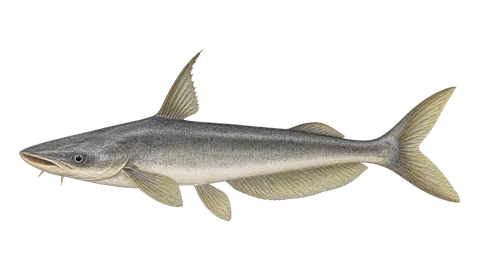
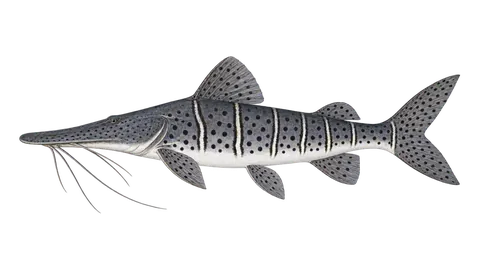
Elongated, scaleless body, dark grey on the back and white belly, separated by a dark band from snout to tail. Broad, flattened snout, with the upper jaw protruding and tooth plates visible. Long barbels. Forked tail with rounded lobes. The jurupoca has spots on its body and lips of equal shape.
Amazon, Tocantins-Araguaia, Paraguay (Pantanal) and Parnaíba basins. In the upper Paraná it is non-native, present since the formation of Itaipu; in Goiás the rule lists it as allochthonous in the Paranaíba basin.
Habitat: Cutbanks, slack water, bays and beaches; river channel at night.
native to the basins
introduced in
states
Amazonas, Pará, Acre, Rondônia, Mato Grosso, Mato Grosso do Sul, Tocantins, Goiás, Maranhão, Piauí, Paraná, São Paulo
famous destinations
Falling water and the dry season (May to October in the Pantanal and the Araguaia) concentrate the fish on cutbanks and channels.
Nighttime. Active at night; the best time runs from dusk to early morning.
A cold front keeps the fish still for two or three days.
Stable pressure helps.
New moon and cloudy nights often produce more.
Light rain doesn't bother it.
A falling river concentrates the school on the cutbanks.
Avoid pointing a flashlight at the water.
Little effect.
Bottom and mid-water, 1 to 6 m.
natural baits
accessories
Bait on the bottom, against the cutbank, right after dark. The strike is strong and quick.
Summary of the regulations we found, with the source for each. Rules change; before keeping or transporting fish, check with the state environmental agency.
Conservation: Not on the national list (Portaria GM/MMA 1.667/2026).
Minimum size for jurupensém in MS.
Source: Decreto estadual MS nº 15.375/2020 (amends Decreto nº 15.166/2019), art. 9º - Semadesc/Imasul
Minimum size for jurupensém in the Paraguay basin in MT. In MT, anglers may only kill for consumption on site (up to 2 kg or 1 fish, art. 19-C); the rule applies to that kill.
Source: Lei estadual MT nº 9.096/2009, Annex I, Paraguay basin (as amended by Lei nº 9.895/2013) - Sema-MT
In Goiás the bico-de-pato may only be killed between 30 and 35 cm in the Araguaia-Tocantins basin, and only for consumption on site. In the Paranaíba basin it is listed as allochthonous, with open catch (Annex II).
Source: IN Semad-GO nº 17/2026, Annex I (in force May 28, 2026; on-site consumption only, zero transport)
Above 35 cm the bico-de-pato must be returned to the water in the Goiás part of the Araguaia-Tocantins.
Source: IN Semad-GO nº 17/2026, Annex I (in force May 28, 2026; on-site consumption only, zero transport)
In Tocantins the jurupensém (bico-de-pato) may only be kept between 25 and 40 cm. In TO anglers may not transport fish until Feb 28, 2029, except 1 native fish; they may consume up to 3 kg on site (Naturatins Ordinance 44/2026).
Source: Portaria Naturatins nº 47/2026, Annex I, as amended by Portaria nº 105/2026
Above 40 cm the jurupensém must be returned to the water in Tocantins.
Source: Portaria Naturatins nº 47/2026, Annex I, as amended by Portaria nº 105/2026
Allowed: Sport and guided fishing only in reservoirs, catch and release with barbless hooks (no keeping, transporting or eating). Subsistence: up to 5 kg per day, for household consumption only.
Allowed: Subsistence fishing by riverside residents and authorized scientific fishing. Decree 15.166/2019 (art. 11, §5) allows catch and release only in February and only in the channels of the Paraguay and Paraná rivers. For the rest of the period, not even catch and release is allowed. Check the Imasul portaria for each season.
Source: Decreto estadual MS nº 15.166/2019, art. 11; IN IBAMA nº 201/2008
Allowed: All fishing modalities are prohibited in rivers, including catch and release (Law 9.096/2009, art. 19-A). Exceptions: subsistence fishing from shore (3 kg or 1 fish, no transport or sale) and scientific fishing. Law 13.159/2025 now allows licensed sport fishing in UHE/PCH hydropower reservoirs, natural lakes and border rivers, subject to a scientific study and a license from the environmental agency. We have not confirmed whether these licenses are already being issued.
Allowed: Recreational fishing only in reservoirs, with handline, rod, or spinning or baitcasting reel. Fish may only be eaten on site, not transported. Competitions prohibited. Subsistence: 3 kg + 1 fish. State rules (GO and TO) may be stricter.
Allowed: Recreational fishing only in reservoirs, with on-site consumption. Subsistence: 5 kg + 1 fish. State rules may be stricter.
Allowed: In 2025/26: catch and release with barbless hooks and recreational fishing card; subsistence fishing on foot or from a rowboat, with simple pole or handline.
Source: Portaria Naturatins nº 244/2025 (2025/26 season); INIs MPA/MMA nº 12 and 13/2011
Allowed: Recreational fishing from a boat or from shore with handline, rod, spinning or baitcasting reel, up to 5 kg + 1 fish per day. Prohibited within 1,500 m of dams, waterfalls and rapids. Competitions prohibited.
Source: IN MMA nº 40/2005
Allowed: The same recreational-angler exceptions as in Portaria 48/2007 apply (handline or rod, 5 kg + 1 fish), unless a stricter state rule applies.
Source: Portaria IBAMA nº 48/2007
Allowed: Recreational anglers with handline or rod, line and hook are outside the Annex II prohibitions, with a bag limit of 5 kg + 1 fish, unless a stricter state rule applies.
Source: Portaria IBAMA nº 48/2007
Allowed: Subsistence fishing only.
Source: Portaria IBAMA nº 48/2007
Allowed: See the exceptions in Portaria 48/2007 and the state rules for each bank.
Source: Portaria IBAMA nº 48/2007
Hold it from below, away from the pectoral spines, and release it facing the current.
White, tasty meat without intramuscular bones; fried in steaks or baked.
Length-weight relationship W = a·Lb (a = 0.00468, b = 3.13; FishBase). It's an average: a fat or lean fish can vary by 10% to 20%.
estimated weight
—
The season weights (months), the time of day and the sensitivities (cold, pressure, moon, wind, rain, tide, strong light, murky water and noise) are the app's editorial estimates, based on the literature below and on the field experience of anglers and guides. They are not official data nor a measurement made for this species, and they may vary by region and year. Closed seasons and legal rules appear in the rules section, with the norm and a link.
The weather comes from three independent global models, cross-checked hour by hour: when they agree, confidence goes up; when they diverge, the band between them shows on the chart. Beyond 16 days, we use the GEFS ensemble of 31 simulations: if 20 of the 31 predict rain, the chance of rain is 65%. Sun and moon are calculated astronomically, with no uncertainty.
The index adds up, weighted for each species: time of day (species curve anchored to real sunrise and sunset), moon (transits, rise and set, phase), pressure (3 h trend and 24 h swing), water temperature (in rivers, estimated from air temperature; at sea, estimated by an ocean model), wind, rain, clouds, tide and the month in the species' cycle.
Accuracy measured in the reference project (4 regions, 93 days, forecast vs. observed): maximum temperature is off by 0.6 °C on average the next day and 1.7 °C at 7 days; rain of 5 mm or more is detected 76% of the time the next day and 57% at 7 days. Detection isn't everything: the false alarm rate isn't published here yet, and 93 days in 4 regions is still a small sample. We now also measure every day, at the app's destinations:
Your location is saved only on this device and feeds the forecast, the map and the "today" on the home page.