Skip to content
fishing forecast

chere-chere grunt

Haemulon steindachneri · Haemulidae · predator

Sea

A small grunt of sand and gravel bottoms, with a large dark spot at the base of the tail. It lives in the Atlantic and the American Pacific and is used as bait.

Also called: macasso, macassa, chere-chere grunt, latin grunt

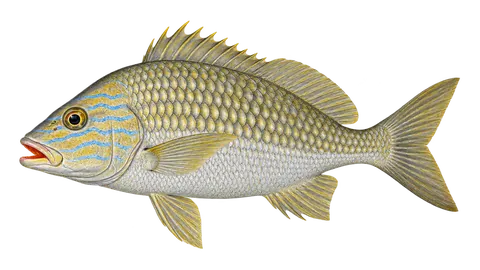
Scientific illustration of Chere-chere grunt
common size
15–25 cm
maximum
30 cm
common weight
0.1–0.2 kg
record/max.
0.3 kg
depth
0–50 m
ideal water
22–28 °C
location

Sample location: choose yours to see the forecast for where you fish.

period

Reading the weather across 3 global models and 31 simulations…

the species

everything about the chere-chere grunt

overview

who is the chere-chere grunt

The macasso (chere-chere grunt) is a small grunt, up to 30 cm and 0.3 kg, which FishBase gives on two coasts of the Americas: in the Atlantic, from Panama to Santa Catarina, and in the Pacific, from Mexico to Peru. Recent studies show these are two species: H. steindachneri in the strict sense is Pacific, and the Atlantic fish was described in 2020 as Haemulon atlanticus; this entry follows the FishBase page, which still describes both coasts together. It lives from 0 to 50 m, on sand and gravel bottoms, sometimes on reefs, in schools. Juveniles stay near the beach, in seagrass. It eats bottom invertebrates and is used as bait.

fun facts

  • For a long time it was treated as a single species in both oceans; in 2020 the Atlantic population was given its own name, Haemulon atlanticus.
  • FishBase records that it is used as bait (bait: usually).
  • A 2021 DNA study showed that the Atlantic fish is clearly separate from the Pacific fish.
how to recognize it

identification

Elongated, low-bodied grunt, gray-silver to brown on the back and silvery on the flanks, with dark lines following the scale rows and a large black spot at the base of the tail. Preopercle with a black spot on the lower part. Dorsal with 11 to 12 spines and 15 to 17 soft rays; anal fin with 3 spines and 9 soft rays; large, terminal mouth. It is smaller and more elongated than the macassa (Haemulon parra), which has yellowish spots on the scales.

distribution

where found

open on the large map

In Brazil, from Amapá to Santa Catarina, on sand and gravel bottoms and on coastal reefs, with more collection records from Rio de Janeiro to Santa Catarina. Outside Brazil, the broad FishBase reading includes the Atlantic from Panama to the Guianas and the Pacific from Mexico to Peru (the Pacific population is now H. steindachneri in the strict sense).

Habitat: Sand and gravel bottoms, sometimes coral reefs and rocky areas; juveniles near the beach, over sand next to seagrass.

coast

North CoastNortheast CoastSoutheast CoastSouth Coastcoastal

states

Amapá, Pará, Maranhão, Ceará, Rio Grande do Norte, Paraíba, Pernambuco, Alagoas, Bahia, Espírito Santo, Rio de Janeiro, São Paulo, Paraná, Santa Catarina

calendar and clock

when to fish

best season

time of yearbest: Nov–Mar
JanFebSeaAprMayJunJulAugSepOctNovDec

Fished all year; in the Southeast and South it produces better in warm water, from late spring to autumn.

best time of day

0h6h12h18h sunrise ~6amsunset ~6pm

Night and twilight. In schools; eats bottom invertebrates and is most active from late afternoon into the night.

weather, water and behavior

what affects the chere-chere grunt
sensitivity The little bars show how much each factor affects this species. Five full: it feels it a lot.

cold and cold fronts

Cold water from a front pushes the school off the shallows and out of the seagrass.

atmospheric pressure

Small effect; rough seas after the front make rock and beach fishing hard.

moon

Small effect.

rain

Not very relevant at sea; murky water near the river mouth gets in the way.

water level

Follows the tide over sand and gravel bottoms.

noise

Medium sensitivity; footsteps and motor noise in the shallows drive them away.

wind

Heavy seas prevent beach and rock fishing.

tide

A rising tide brings the school onto shallow bottoms; the falling tide concentrates it in the channels.

depth

Usually to 30 m; juveniles much closer to the beach.

technique, gear and bait

how to fish

rod
cane or rod 6'0" to 7'0", 6 to 12 lb
spinning / baitcasting reel
spinning reel 2000 to 3000
line
monofilament 0.20 to 0.30 mm or braided line 8 to 12 lb
leader
fluorocarbon 0.25 to 0.35 mm, 50 cm
hook
chinu 4 to 8 or maruseigo 8 to 12

natural baits

  • shrimp pieces
  • sea worm (polychaete)
  • marisco
  • sardine strips

accessories

  • light sinker
  • live bait bucket

tip from an angler

Small hook and well-secured bait: the macasso steals bait with quick bites.

what the law says

rules for the chere-chere grunt

Summary of the regulations we found, with the source for each. Rules change; before keeping or transporting fish, check with the state environmental agency.
Conservation: Not on the Brazilian national list (Portaria GM/MMA nº 1.667/2026). We found no specific Brazilian federal rule for the species. The IUCN also assessed H. atlanticus separately, in 2020.

Mexico: up to 10 marine fish per angler per day, no more than 5 of the same species

10 marine specimens per angler per day; no more than 5 of the same species

In Mexican federal waters, recreational fishing for marine species has a limit of 10 fish per angler per day, with no more than 5 of the same species. Fish over the limit may only be kept if released alive. Recreational catch belongs to the angler who holds the permit and may not be sold; fish may not be landed as fillets (filleting is allowed only on board, for consumption during the trip). In spearfishing the limit is 5 fish per day. Fishing from a boat requires a permit. It also applies to the Mexican Pacific, where the species occurs.
Source: Amendment to NOM-017-PESC-1994 (recreational sport fishing in federal waters of Mexico), signed Oct 14, 2013 and published in the DOF on Nov 25, 2013, items 4.9.1, 4.9.4, 4.9.5, 4.11 and 4.12 (Sagarpa/Conapesca)

catch and release
catch and release Releasing the fish alive, quickly and with a wet hand. During a closed season it isn't always allowed: what the regulation says applies.

Small, hardy fish: wet your hands, remove the hook quickly and release it carefully.

in the kitchen

Edible, sold fresh on a small scale; often used as bait for larger fish.

calculator

how much it weighs without taking it out of the water

Length-weight relationship W = a·Lb (a = 0.0138, b = 3.03; FishBase (relação peso-comprimento bayesiana, estimativa da própria espécie)). It's an average: a fat or lean fish can vary by 10% to 20%.

estimated weight

—

sources and references

The season weights (months), the time of day and the sensitivities (cold, pressure, moon, wind, rain, tide, strong light, murky water and noise) are the app's editorial estimates, based on the literature below and on the field experience of anglers and guides. They are not official data nor a measurement made for this species, and they may vary by region and year. Closed seasons and legal rules appear in the rules section, with the norm and a link.

  1. scientific FishBase: Haemulon steindachneri (ficha da espécie)Size, length-weight, depth, habitat, distribution, biology and IUCN status. Page checked Oct 13, 2026. The common weight was calculated from the length-weight relationship.
  2. scientific FishBase: nomes populares de Haemulon steindachneriNames by country and language. FishBase lists 'macassa' and 'macasso' as Portuguese names; this entry uses 'macasso' so as not to repeat the name of the Haemulon parra entry.
  3. official Portaria GM/MMA nº 1.667, de 27 de abril de 2026: Lista Nacional Oficial de Espécies da Fauna Ameaçadas de Extinção (peixes e invertebrados aquáticos)The species is not on the list. Checked in the DOU of April 28, 2026.
  4. scientific IUCN Red List: Haemulon steindachneri (avaliação global: Pouco Preocupante, LC, 14/07/2020)Global assessment. Link given on the FishBase entry (Red List, version 2025-2).
  5. official ICMBio/SALVE: Ficha de Haemulon steindachneri (avaliação nacional do risco de extinção)Record from the ICMBio national assessment in the SALVE system; the DOI was checked on Crossref. The national category should be confirmed on the record itself: the species is not in Portaria GM/MMA nº 1.667/2026.
  6. scientific GBIF: registros de Haemulon steindachneri no BrasilChecked on October 13, 2026 in the open GBIF database (country = Brazil). The records come from collections and observations and show where the species has been seen, not how abundant it is. The Brazilian records carry this name, but today they belong to the Atlantic species (Haemulon atlanticus).
  7. scientific Carvalho, P. H.; Marceniuk, A. P.; Oliveira, C.; Wosiacki, W. B. (2020). Integrative taxonomy of the species complex Haemulon steindachneri (Eupercaria; Haemulidae) with a description of a new species. Zoology 142: 125782.DOI checked in Crossref. The abstract and conclusion (Haemulon steindachneri restricted to the Pacific; Haemulon atlanticus described for the Atlantic) were checked in the following study, by Cerqueira et al. (2021); the original article was not read in full.
  8. scientific Cerqueira, N. N. C. D.; Rotundo, M. M.; Marceniuk, A. P.; Cruz, V. P.; Foresti, F.; Oliveira, C. (2021). Molecular identification of Brachygenys and Haemulon species (Perciformes: Haemulidae) from the Brazilian coast. Neotropical Ichthyology 19(2): e200109.It says H. steindachneri is restricted to the Pacific and that H. atlanticus was described for the Atlantic; samples from Brazil came from Pará, Ceará, Alagoas and São Paulo.
  9. scientific Carpenter, K. E. (org.) (2002). The living marine resources of the Western Central Atlantic. Vol. 3: Bony fishes part 2 (Opistognathidae to Molidae). FAO Species Identification Guide for Fishery Purposes. Roma: FAO.Reference identification guide for the western Atlantic (Haemulidae chapter).
  10. official Modificação da NOM-017-PESC-1994, para regular a pesca deportivo-recreativa nas águas de jurisdição federal do México (DOF, 25/11/2013)Text read in the DOF: items 4.2 to 4.12 (quotas, underwater fishing, sales and fillets).
don't confuse

similar species