

bluestriped grunt
Haemulon sciurus
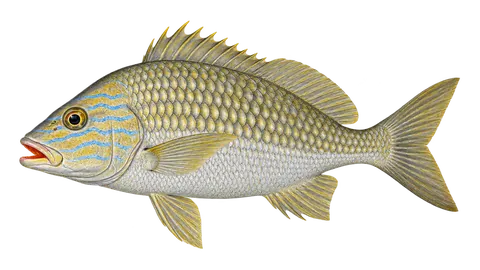
A yellow grunt with fine blue stripes, from shallow reefs and seagrass. It moves in small groups and takes natural bait on the bottom.
- common size
- 20–30 cm
- maximum
- 46 cm
- common weight
- 0.1–0.4 kg
- record/max.
- 0.8 kg
- depth
- 0–20 m
- ideal water
- 24–29 °C
how to recognize it
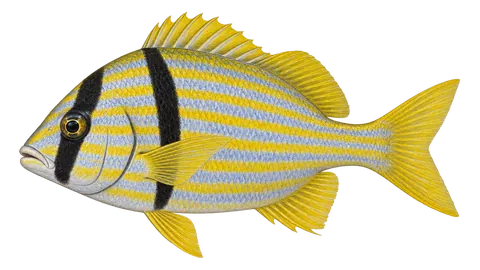
Head and body yellow, marked lengthwise by narrow blue stripes; the stripe under the eye forms a distinctive arc. Spiny dorsal fin yellow, soft dorsal and tail blackened, anal fin dark yellow. Dorsal fin with 12 spines and 16 to 17 soft rays; anal fin with 3 spines and 9 rays. Scales below the lateral line slightly oblique. It differs from the biquara (Haemulon plumierii) by its bright yellow and by its fine, continuous blue stripes.
Also called: boca-de-fogo, macassa, mibaco, bluestriped grunt, yellow grunt
don't confuse with:
where found
open on the large mapWhere to look: Coral and rock reefs, bottom breaks and seagrass (juveniles), from 0 to 30 m, usually down to 20 m.
In Brazil there are few collection records, in Pará, Bahia and Rio de Janeiro; FishBase gives the species down to latitude 19°S. Outside Brazil, from Florida to the Gulf of Mexico, the Bahamas, the Caribbean and the Guianas.
coast
states
Pará, Bahia, Rio de Janeiro
when to fish
next 7 days
Loading the next 7 days…
best season
There is no well-documented seasonality; it is fishable all year where it occurs, with more comfortable fishing in warm, calm water.
best time of day
Night and twilight. It rests in groups near shelter by day and goes out to feed from late afternoon into the night; it also bites by day, but more cautiously.
what affects the bluestriped grunt
cold and cold fronts
Cold water pushes the groups out of the shallows.
atmospheric pressure
Choppy seas after a front get in the way; the bite returns when it calms down.
moon
Small effect.
rain
Not very relevant at sea; very muddy water gets in the way.
water level
Follows the tide over the flat rock and the reef.
noise
Small groups are wary of shadow and noise in the shallows.
wind
Rough sea prevents fishing on the reefs.
tide
Moderate current during the tide change makes the fish more active.
depth
Usually down to 20 m.
how to fish
lures
- small jig, 10 to 30 g
natural baits
- shrimp
- small crab
- marisco
- squid strip
tip from an angler
Small natural bait close to the bottom, on the reef edge, in the late afternoon.
- rod
- 6'0" to 7'0", 8 to 20 lb
- spinning / baitcasting reel
- spinning reel 2500 to 3500
- line
- braided line 10 to 20 lb
- leader
- fluorocarbon 20 to 30 lb, 1 m
- hook
- chinu 2 to 5 or circle 1/0
accessories
- sinker of 20 to 60 g
- landing net
catch and release
Release it quickly; if it came from more than 15 m and floats, use a descender. Watch the dorsal spines.
rules for the bluestriped grunt
Rules change; before keeping or transporting fish, check with the state environmental agency.
Mexico: up to 10 marine fish per angler per day, no more than 5 of the same species
10 marine specimens per angler per day; no more than 5 of the same species details
In Mexico's federal waters, sport and recreational fishing for marine species has a limit of 10 specimens per angler per day, with no more than 5 of any one species. Fish over the limit may only be taken if released alive. Sport-caught fish belong to the permit holder and may not be sold; fish may not be landed as fillets (they may only be filleted on board for consumption during the trip). For spearfishing the limit is 5 fish per day. Fishing from a boat requires a permit.
Conservation: Not on the Brazilian national list (Portaria GM/MMA nº 1.667/2026). We found no specific Brazilian federal rule for the species.
how much it weighs without taking it out of the water
estimated weight
—
how we calculate
Length-weight relationship W = a·Lb (a = 0.01549, b = 2.97; FishBase (relação peso-comprimento bayesiana, estimativa da própria espécie)). It's an average: a fat or lean fish can vary by 10% to 20%.
more about the bluestriped grunt
The boca-de-fogo is a brightly colored grunt of the western Atlantic: body and head yellow with fine blue stripes. It lives from 0 to 30 m, usually down to 20 m, in small groups over coral and rock reefs and on reef edges and bottom breaks. Juveniles are abundant in seagrass and also occur in mangroves. It eats crustaceans and bivalves and sometimes small fish. It reaches 46 cm and 0.75 kg; the common size is 25 cm, and the maximum recorded age is 12 years. It is rarely recorded in Brazil, with few specimens in collections from Rio de Janeiro, Bahia and Pará.
Family: Haemulidae · predator
fun facts
- It has several English names: bluestriped grunt, yellow grunt, boar grunt, redmouth grunt and golden grunt.
- Like other grunts, it makes a sound by grinding its pharyngeal teeth.
- The maximum age recorded by FishBase is 12 years.
in the kitchen
Edible, sold fresh on a small scale. FishBase records ciguatera cases: on the Caribbean, be wary of large reef specimens and ask local fishers.
similar species


sources and references (8)
The season weights (months), the time of day and the sensitivities (cold, pressure, moon, wind, rain, tide, strong light, murky water and noise) are the app's editorial estimates, based on the literature below and on the field experience of anglers and guides. They are not official data nor a measurement made for this species, and they may vary by region and year. Closed seasons and legal rules appear in the rules section, with the norm and a link.
- scientific FishBase: Haemulon sciurus (ficha da espécie)Size, length-weight, depth, habitat, distribution, biology and IUCN status. Page checked Oct 13, 2026. The common weight was calculated from the length-weight relationship.
- scientific FishBase: nomes populares de Haemulon sciurusNames by country and language. FishBase gives 'boca-de-fogo', 'macassa' and 'mibaco' as Portuguese names for the species.
- official Portaria GM/MMA nº 1.667, de 27 de abril de 2026: Lista Nacional Oficial de Espécies da Fauna Ameaçadas de Extinção (peixes e invertebrados aquáticos)The species is not on the list. Checked in the DOU of April 28, 2026.
- scientific IUCN Red List: Haemulon sciurus (avaliação global: Pouco Preocupante, LC, 10/10/2015)Global assessment. Link given on the FishBase entry (Red List, version 2025-2).
- scientific GBIF: registros de Haemulon sciurus no BrasilChecked Oct 13, 2026 in GBIF's open database (country = Brazil). Records come from collections and observations and show where the species has been seen, not how abundant it is. There are only 12 records in Brazil (Rio de Janeiro, Bahia and Pará): the species is uncommon here.
- scientific Carpenter, K. E. (org.) (2002). The living marine resources of the Western Central Atlantic. Vol. 3: Bony fishes part 2 (Opistognathidae to Molidae). FAO Species Identification Guide for Fishery Purposes. Roma: FAO.Reference identification guide for the western Atlantic (Haemulidae chapter).
- official Code of Federal Regulations, 50 CFR Part 622, Subpart S: Porto Rico (NOAA Fisheries, EUA)Consolidated text in the eCFR, checked Oct 13, 2026. Among the grunts, the federal rule's reef fish table lists only Haemulon plumierii; Haemulon sciurus is not on it, so Puerto Rico's federal limits do not apply to the species.
- official Modificação da NOM-017-PESC-1994, para regular a pesca deportivo-recreativa nas águas de jurisdição federal do México (DOF, 25/11/2013)Text read in the DOF: items 4.2 to 4.12 (quotas, underwater fishing, sales and fillets).