Skip to content
fishing forecast

dorada

Brycon moorei · Bryconidae · omnivore

FreshwaterIUCN global: VU · vulnerable

A Colombian relative of the matrinxã, with a golden back and yellowish fins, endemic to the Magdalena basin. It lives in fast, clear water, is classified as Vulnerable, and has a minimum size of 35 cm.

Also called: matrinxã-do-Magdalena

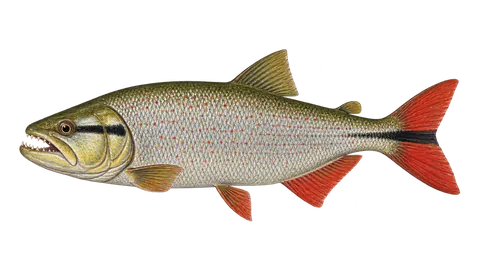
Scientific illustration of Dorada
common size
25–45 cm
maximum
53 cm
common weight
0.3–2 kg
record/max.
4.9 kg
depth
0.5–4 m
ideal water
23–28 °C
location

Sample location: choose yours to see the forecast for where you fish.

period

Reading the weather across 3 global models and 31 simulations…

the species

everything about the dorada

overview

who is the dorada

Characin of the genus Brycon, the same genus as the matrinxã, endemic to Colombia: it occurs in the Magdalena River basin, including the Cauca, San Jorge, Cesar, La Miel, and Manso rivers, and in a separate population in the Ranchería River, on the Caribbean coast. It mainly inhabits the middle course of rivers, in fast, clear water over bottoms of large rocks and pebbles, up to about 400 m elevation, and only occasionally appears in the ciénagas of the lower basin. It eats fish, insects, and fruits and seeds that fall into the water. It makes local migrations of 100 to 500 km and spawns from February to March, at the end of the dry season. It reaches 50 cm total length, is prized for its flesh, and is sold in the artisanal fisheries of the Magdalena. Not very abundant, it suffers from fishing and from heavy alteration of the basin: it is listed as Vulnerable by the IUCN (2014) and in the Red Book of Freshwater Fishes of Colombia (2012).

fun facts

  • On the Magdalena, fishers call it dorada, mueluda, or sardinata; on the Ranchería, lisa.
  • On the Magdalena it migrates together with the bocachico and the bagre rayado (striped catfish), over movements of 100 to 500 km.
  • According to FishBase, the species has already been farmed commercially in Peru, and farming the dorada is being studied in Colombia.
how to recognize it

identification

Fusiform body, golden and shiny on the back, with red, yellow, and blue reflections on the flanks; the fins are usually yellowish or reddish, and the tail has a broad black band on the central rays. It has 27 to 30 rays in the anal fin and 55 to 68 scales in the lateral line, an adipose fin, and a small mouth, as in the genus. The picuda (Salminus affinis, Magdalena dorado) is more elongated, with a large mouth and predatory conical teeth. The sabaleta (Brycon henni), a smaller relative from the same region, is banned from fishing in Antioquia.

distribution

where found

open on the large map

Not found in Brazil. Endemic to Colombia: Magdalena River basin (sub-basins of the Cauca, San Jorge, Cesar, La Miel, and Manso) and the Ranchería River, on the Caribbean coast, from about 400 m elevation downward. FishBase cites only the Magdalena basin.

Habitat: Middle course of mountain and foothill rivers, in fast, clear water, with a bottom of large rocks and pebbles and current breaks; occasionally in lower-basin ciénagas.

calendar and clock

when to fish

best season

time of yearbest: Dec–Mar
JanFebSeaAprMayJunJulAugSepOctNovDec

Bites best in the dry months (December to March), with low, clear rivers. Spawning occurs from February to March, at the end of the dry season, and fish make local migrations of 100 to 500 km: this is when releasing the fish matters most.

best time of day

0h6h12h18h sunrise ~6amsunset ~6pm

Daytime. The genus is diurnal and the species orients by sight in clear water; we found no study on a specific time of day for the dorada.

weather, water and behavior

what affects the dorada
sensitivity The little bars show how much each factor affects this species. Five full: it feels it a lot.

cold and cold fronts

Tropical mountain river: colder water after heavy rains reduces activity.

atmospheric pressure

No known effect.

moon

Little effect.

rain

Heavy rain muddies the water and ruins fishing; the species lives in clear water.

water level

Low, clear river water in the dry season concentrates fish in the current stretches.

noise

Wary in clear water; approach slowly.

wind

Little effect.

depth

From 0.5 to 3 m, in current stretches with rocks.

technique, gear and bait

how to fish

rod
6' to 7', medium-fast action, 6 to 14 lb; or fly #5 to #7
spinning / baitcasting reel
spinning reel 2500 to 3000
line
monofilament 0.25 to 0.30 mm or braided line 10 to 20 lb
leader
fluorocarbon 10 to 15 lb
hook
#4 to 1/0, barbless

lures

  • small spoon 5 to 10 g
  • spinner #2 to 3
  • 5 to 7 cm minnow
  • flies that imitate fruit, insects, and small baitfish

natural baits

  • small fruit from the bank
  • minhoca

accessories

  • alicate
  • soft-mesh landing net
  • polarized glasses

tip from an angler

Look for current stretches with rocks and fruit trees on the bank, cast above the current break, and let the lure drift. Release the fish without delay: the species is vulnerable.

what the law says

rules for the dorada

Summary of the regulations we found, with the source for each. Rules change; before keeping or transporting fish, check with the state environmental agency.
Conservation: IUCN: Vulnerable (VU A2bd), assessed on Oct 7, 2014. In the Red Book of Freshwater Fishes of Colombia (Mojica et al., 2012): Vulnerable (VU A2c,d) at the national level and Critically Endangered (CR A2c) in the Ranchería basin. We did not check whether it appears in the current official list of threatened wild species (MADS Resolution 126/2024, which repealed 1912/2017), because the annex was not consulted.

Colombia: minimum size of 35 cm (standard length) in the Magdalena basin

35 cm standard length (SL)confirm with the agency

The AUNAP table of current minimum sizes for the Magdalena, Cauca, and San Jorge basins lists the sardinata, muelada, or dorada (Brycon moorei) at 35 cm standard length, measured from the snout to the end of the backbone (without the tail), and attributes it to INDERENA Resolution 025 of January 27, 1971. The Red Book of Freshwater Fishes (2012) cites the same value but attributes it to INDERENA Agreement 15 of 1987. The AUNAP document is from 2018; we found no later rule that changes the value. Below 35 cm SL, release the fish.

Source: AUNAP, Normatividad tallas mínimas vigentes (update of Aug 8, 2018): Resolución INDERENA 025/1971 for the Magdalena, Cauca and San Jorge basins

Colombia: recreational fishing is in a legal transition (C-148/2022 and Law 2501/2025)

check with AUNAP whether recreational or tourism fishing is authorized where you plan to fishconfirm with the agency

On April 27, 2022, the Constitutional Court (ruling C-148/2022) declared unenforceable the rules that provided for recreational fishing as a fishing method (art. 273, no. 4, of Decree-Law 2811/1974 and art. 8, no. 2, c, of Law 13/1990), and ruled that it is not an exception to the ban on animal cruelty; the effects were postponed by one year. Law 2501, of July 28, 2025, created "tourism fishing" as an additional category and tasked the government, through AUNAP, with regulating it within one year. We have not found a regulation published as of Oct 13, 2026, nor the current status of AUNAP Resolution 549/2022, which dealt with recreational fishing. Before fishing, confirm the rules and permit with AUNAP or the local environmental authority.

Source: Judgment C-148/2022 (Constitutional Court, Apr 27, 2022); Law 2501 of Jul 28, 2025 (Congress of Colombia), art. 3

catch and release
catch and release Releasing the fish alive, quickly and with a wet hand. During a closed season it isn't always allowed: what the regulation says applies.

Vulnerable species: prefer to release it, especially from February to March, when it migrates and spawns. Use a barbless hook and pliers, keep the fish in the water, and release it facing the current. Fish under 35 cm SL must go back into the water.

in the kitchen

Valued for local consumption in both basins and sold in the artisanal fisheries of the Magdalena, according to the Red Book. Because it is vulnerable, releasing it is better.

calculator

how much it weighs without taking it out of the water

Length-weight relationship W = a·Lb (a = 0.01549, b = 3.11; FishBase (relação peso-comprimento bayesiana, estimativa da própria espécie)). It's an average: a fat or lean fish can vary by 10% to 20%.

estimated weight

—

sources and references

The season factors (months), the time of day, and the sensitivities (cold, pressure, moon, wind, rain, tide, strong light, murky water, and noise) are editorial estimates by the app, based on the literature cited below and on field experience of anglers and guides. They are not official data or measurements made for this species and may vary by region and year. Closed seasons and legal rules appear in the rules section, with the standard and link. Time of day, depth, water temperature, gear, and baits are editorial recommendations, based on the habits of the genus Brycon; there is no source on recreational fishing for the dorada.

  1. scientific FishBase: Brycon moorei (ficha da espécie)Size, length-weight, depth, habitat, distribution, biology, and IUCN status. Page checked on Oct 13, 2026.
  2. scientific FishBase: nomes populares de Brycon mooreiNames by country and language.
  3. scientific IUCN Red List: Brycon moorei (avaliação global: Vulnerável, VU A2bd, 07/10/2014)Global assessment. Link given on the FishBase entry (Red List, version 2025-2).
  4. scientific Mojica, J. I.; Usma, J. S.; Álvarez-León, R.; Lasso, C. A. (eds.) (2012). Libro rojo de peces dulceacuícolas de Colombia 2012. Instituto Humboldt, ICN-Universidad Nacional, WWF Colombia e Universidad de Manizales. Ficha de Brycon moorei (pp. 100-101), por Mojica e UsmaNational category (VU A2c,d) and regional category (Ranchería, CR A2c), common names, description (color, anal fin rays, lateral line scales), distribution, ecology (middle course of rivers, up to 400 m, diet, spawning in February and March), migration, threats, and the 35 cm SL minimum size. The profile gives no times or baits. Page checked on Oct 13, 2026.
  5. official AUNAP: Normatividad tallas mínimas vigentes (atualização de 08/08/2018)Table for the Magdalena, Cauca, and San Jorge basins: sardinata, muelada, or dorada (Brycon moorei), 35 cm SL, attributed to INDERENA Resolution 025/1971. Page checked on Oct 13, 2026.
  6. official AUNAP: Normatividad vedas vigentesThe list (2021 version) has no closed season for Brycon moorei; it does include the permanent ban on the sabaleta (Brycon henni) in Antioquia (INDERENA Resolution 0670/1971) and the closed season for the bagre rayado of the Magdalena (May 1 to 30 and September 15 to October 15). Page checked on Oct 13, 2026.
  7. official Corte Constitucional da Colômbia: Sentença C-148/22, de 27 de abril de 2022 (pesca esportiva)Operative part: art. 273, no. 4, of Decree-Law 2811/1974 and art. 8, no. 2, letter c, of Law 13/1990 declared unenforceable; the word "deportiva" (recreational) in art. 8 of Law 84/1989 declared enforceable, read as meaning that recreational fishing is not an exception to the ban on animal cruelty; effects deferred for one year from notification. Page checked on Oct 13, 2026.
  8. official Lei 2501 de 28 de julho de 2025: cria e regulamenta a pesca de turismoArt. 3: includes tourism fishing among the purposes of fishing and gives the government, under AUNAP, one year to regulate it. We have not found the published regulation. Page checked on Oct 13, 2026.
  9. official Resolução MADS 0126 de 2024: listado oficial das espécies silvestres ameaçadas da ColômbiaStandard that repealed Resolution 1912/2017. Only the page of the standard was checked; the annex with the species list was not consulted, so the profile does not state the dorada's current category on the official list.
  10. scientific David-Ruales, C. A. et al. (2020). Relaciones alométricas en estadios tempranos de Brycon moorei en condiciones controladas. Actualidades Biológicas 42(113)Laboratory culture study (larvae and juveniles up to 15 days old); used only to point to interest in farming the species. Page checked on Oct 13, 2026.
don't confuse

similar species