Skip to content
fishing forecast

argentine hake

Merluccius hubbsi · Merlucciidae · predator

Sea

The South Atlantic hake (Argentine hake): a silvery fish with an elongated body and two dorsal fins, living on the shelf and slope from southeastern Brazil to Patagonia, between 100 and 200 m. It is mainly a commercial fishery species: we found no organized recreational fishing for it.

Also called: merluza, merluza-argentina, Argentine hake

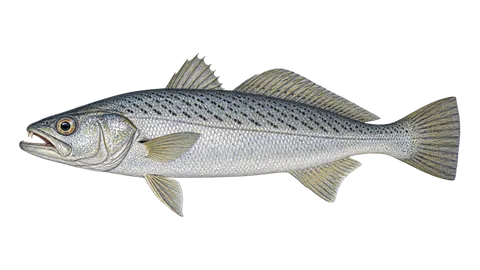
Scientific illustration of Argentine hake
common size
35–60 cm
maximum
95 cm
common weight
0.3–1.5 kg
record/max.
— kg
depth
100–200 m
ideal water
8–14 °C
location

Sample location: choose yours to see the forecast for where you fish.

period

Reading the weather across 3 global models and 31 simulations…

the species

everything about the argentine hake

overview

who is the argentine hake

The Argentine hake is a fish of the family Merlucciidae, typical of the shelf and slope of the South Atlantic: it occurs from southeastern and southern Brazil, roughly between 21°S and 34°S, to Argentina and the Malvinas/Falklands, down to 54°S. Adults live mainly between 100 and 200 m, move closer to the coast in spring and summer, head for deep water after spawning, and make daily vertical migrations. Large fish eat other fish (anchovies, hakes, notothenioids, lanternfishes), squid and zooplankton; small ones eat mysids and amphipods. It grows to 95 cm. It is the basis of large commercial fisheries in Argentina and Uruguay, and in Brazil it became a target of the trawl fleet from 2001; stocks in all three countries show signs of overfishing.

fun facts

  • In Brazil, Portaria MPA nº 532/2025 groups all hakes (genus Merluccius) under the common name "merluza".
  • Brazilian fishing directed at hake only gained importance in 2001, when the trawl fleet began to work deeper areas (Vaz-dos-Santos).
  • FishBase records a maximum age of 6 years for the species.
how to recognize it

identification

Elongated silvery body with a golden sheen on the back and a whitish-silver belly. Two dorsal fins (the second and the anal fin long), short pectoral fins that do not reach the origin of the anal fin, and short, blunt gill rakers. No barbel on the chin and no filament on the pelvic fins, which separates hake from the codling (Urophycis) and many weakfishes (Cynoscion). Lives deeper than the coastal weakfishes.

distribution

where found

open on the large map

Southwestern Atlantic, from southeastern Brazil (around 21°S) to Argentina and the Malvinas/Falklands, down to 54°S (FishBase). In Brazil there are two stocks: the Southeast, between 21°S and 29°S, and the South, between 29°S and 34°S, the latter shared with Uruguay (Vaz-dos-Santos, 2006).

Habitat: Continental shelf and slope, on the bottom and above it (benthopelagic), mainly between 100 and 200 m (50 to 800 m overall). It moves closer to the coast in spring and summer, and to deep water in winter, after spawning.

coast

Southeast CoastSouth Coastshelfoceanic
calendar and clock

when to fish

best season

time of yearbest: Oct–Feb
JanFebSeaAprMayJunJulAugSepOctNovDec

It moves closer to the coast in spring and summer, when it is easier to reach for anglers fishing from a boat; in winter it goes to deep water, after spawning. In Brazil, spawning follows a north-south gradient, most intense in summer at 21°S and in winter at 34°S.

best time of day

0h6h12h18h sunrise ~6amsunset ~6pm

Any time. It makes daily vertical migrations; deep bottom fishing does not follow daylight well, and current and drift matter more.

weather, water and behavior

what affects the argentine hake
sensitivity The little bars show how much each factor affects this species. Five full: it feels it a lot.

cold and cold fronts

Temperate-water species: a cold front at the surface hardly changes the bottom, but the seasons shift the position of the school on the shelf.

atmospheric pressure

Small effect at 100 m or deeper; the problem with the front is the rough sea.

moon

Little influence at this depth.

rain

Little effect on the fish.

water level

Does not apply at sea. The equivalent is the bottom current.

noise

At this depth the boat's noise barely reaches the fish.

wind

Strong wind, common in the South Atlantic, pulls the line off plumb and stops the drift. Prefer calm seas.

tide

Tidal and shelf currents set the drift; the direct effect on the fish is small.

depth

Concentrated between 100 and 200 m; it rises in the water column at night, following the food.

technique, gear and bait

how to fish

rod
5'6" to 6'6", medium to heavy action, 30 to 50 lb
spinning / baitcasting reel
deep-sea baitcasting reel 4/0 to 6/0 or electric, with 250 to 400 m of line
line
braid 40 to 65 lb
leader
fluorocarbon 40 to 60 lb, 2 m, with a dropper of two to three hooks
hook
circle hook 3/0 to 6/0

lures

  • bottom jig of 100 to 250 g
  • LED light above the leader

natural baits

  • squid strips
  • sardine or anchovy in pieces
  • fish pieces

accessories

  • sinker of 200 to 500 g depending on the current
  • descender
  • luvas

tip from an angler

Look for the outer shelf bottom and lower the bait until it touches the bottom, then reel up a little: hake stays near the bottom and just above it.

what the law says

rules for the argentine hake

Summary of the regulations we found, with the source for each. Rules change; before keeping or transporting fish, check with the state environmental agency.
Conservation: It is not on the Brazilian national list (Portaria GM/MMA nº 1.667/2026) and has not been assessed by the IUCN. In the three countries where it is fished (Brazil, Uruguay and Argentina), stocks show clear signs of overfishing. We found no minimum size, bag limit or Brazilian federal closed season specific to recreational fishing for this species.

Argentina-Uruguay Common Fishing Zone: hake closed season from Jul 1 to Sep 30, 2026

hake fishing and bottom trawl gear banned from Jul 1 to Sep 30, 2026, in a defined sectorconfirm with the agency

The Joint Technical Commission of the Maritime Front banned, from July 1 to September 30, 2026, hake fishing and the use of bottom trawl gear in a sector of the Argentina-Uruguay Common Fishing Zone, between 35°00'S and 37°38'S, and also the use of midwater nets at night in the sector. The measure targets the commercial fleet and protects spawning adults and juveniles. The commission repeats similar closures in other quarters and years (for example, Res. 1/20, from Apr 1 to Jun 30, 2020), so check the resolution in force.

Source: Resolución CTMFM nº 3/2026, of Jun 18, 2026 (Official Bulletin of Argentina, Jun 24, 2026), arts. 1º and 2º

catch and release
catch and release Releasing the fish alive, quickly and with a wet hand. During a closed season it isn't always allowed: what the regulation says applies.

Brought up from 100 m or deeper, it arrives with barotrauma. The best approach is to keep only what you will take. If you release it, use a descending device, which returns the fish to the bottom. Release any under 35 cm, Uruguay's minimum; FishBase gives about 30 cm as the size at first maturity.

in the kitchen

White, soft and delicate flesh, sold fresh or frozen; it is the fish used for hake fillets, good fried, baked or in fish stew.

calculator

how much it weighs without taking it out of the water

Length-weight relationship W = a·Lb (a = 0.00501, b = 3.09; FishBase (relação peso-comprimento bayesiana, estimativa da própria espécie)). It's an average: a fat or lean fish can vary by 10% to 20%.

estimated weight

—

sources and references

The season weights (months), the time of day and the sensitivities (cold, pressure, moon, wind, rain, tide, strong light, murky water and noise) are the app's editorial estimates, based on the literature below and on the field experience of anglers and guides. They are not official data nor a measurement made for this species, and they may vary by region and year. Closed seasons and legal rules appear in the rules section, with the norm and a link.

  1. scientific FishBase: Merluccius hubbsi (ficha da espécie)Size, length-weight, depth, habitat, distribution, biology, and IUCN status. Page checked on Oct 13, 2026.
  2. scientific FishBase: nomes populares de Merluccius hubbsiNames by country and language.
  3. official Portaria GM/MMA nº 1.667, de 27 de abril de 2026: Lista Nacional Oficial de Espécies da Fauna Ameaçadas de Extinção (peixes e invertebrados aquáticos)The species is not on the list. Checked in the DOU of April 28, 2026.
  4. official Portaria MPA nº 532, de 23 de setembro de 2025: nomes científicos e nomes comuns das principais espécies de peixes de interesse comercialAnnex: "Merluccius spp.", name "Merluza" (checked in the Annex text).
  5. scientific Vaz-dos-Santos, A. M. (2006). Identificação de estoques de Merluccius hubbsi na região Sudeste-Sul do Brasil. Tese de doutorado em Oceanografia Biológica, Instituto Oceanográfico da USP.Southeast (21°S to 29°S) and South (29°S to 34°S) stocks, spawning gradient and trawl fishing directed at hake from 2001. Data checked in the thesis abstract and in the article derived from it; the full text was not reviewed.
  6. official Decreto nº 149/997 do Uruguai: medidas mínimas de desembarque e de comercialização (art. 49)Original 1997 text (IMPO); we did not check later amendments.
  7. official Resolução CTMFM nº 3/2026: veda de inverno da merluza na Zona Comum de Pesca (Boletín Oficial da Argentina, 24/06/2026)Text of Res. 3/2026 checked (closed season Jul 1 to Sep 30, 2026). We did not check whether the commission has a resolution for October to December 2026.
  8. official Resolução CTMFM nº 1/20: veda de outono da merluza na Zona Comum de Pesca (1º/04 a 30/06 de 2020)An example of the commission renewing the closure every year; it applies only to 2020.
  9. official Instrução Normativa MMA nº 53, de 22 de novembro de 2005: tamanhos mínimos de captura no litoral do ES ao RSThe species is not in Annexes I and II (checked in the consolidated reproduction of the rule), so there is no federal minimum size under that rule. We found no other federal minimum-size rule or specific quota for the species.
don't confuse

similar species