Skip to content
fishing forecast

miraguaia

Pogonias courbina · Sciaenidae · predator

EstuarySeanational list: CR · critically endangered

The giant of the South Atlantic drums. Critically Endangered: fishing prohibited.

Also called: miraguaia, burriquete (jovem)

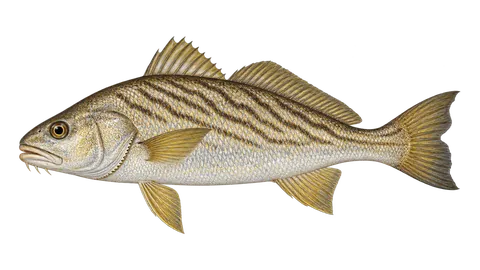
Scientific illustration of Miraguaia
common size
60–100 cm
maximum
130 cm
common weight
5–15 kg
record/max.
30.0 kg
depth
1–30 m
ideal water
17–25 °C
location

Sample location: choose yours to see the forecast for where you fish.

period

Reading the weather across 3 global models and 31 simulations…

the species

everything about the miraguaia

overview

who is the miraguaia

The miraguaia is the giant of the South Atlantic drums, over 1.2 m and 20 kg. It lives in estuaries, coastal lagoons and beaches from Rio de Janeiro to Rio Grande do Sul, with the main population linked to Lagoa dos Patos and the Plata estuary. It has crushing teeth in its throat and eats shellfish, mussels, crabs and shrimp. It grows slowly, lives many years and forms spawning aggregations in spring, which left it exposed to fishing. The population collapsed and the species is Critically Endangered on the national list: fishing prohibited. Juveniles, called burriquetes, still turn up in croaker surf casting and must be released on the spot.

fun facts

  • It has molar-like tooth plates in its throat that can crush shellfish shells.
  • Striped juveniles are called burriquetes in the South.
how to recognize it

identification

Deep body with a strongly arched back and mouth underneath, with many short barbels on the chin. Juveniles (burriquetes) with 4 to 5 dark vertical bands; adults dark grey to tan, without stripes. Difference from the croaker: much deeper body, more numerous barbels, no oblique stripes and much larger size.

distribution

where found

open on the large map

From Rio de Janeiro to Rio Grande do Sul, with the main area of occurrence at Lagoa dos Patos and the Rio Grande do Sul coast.

Habitat: Estuaries and coastal lagoons with shellfish beds, channels, jetties and beaches near inlets.

native to the basins

South Atlantic

coast

Southeast CoastSouth Coastcoastal

states

Rio de Janeiro, São Paulo, Paraná, Santa Catarina, Rio Grande do Sul

calendar and clock

when to fish

best season

time of yearbest: Oct–Dec
JanFebSeaAprMayJunJulAugSepOctNovDec

Spawning aggregations in spring and early summer, at the mouth of Lagoa dos Patos and nearby beaches. Biological note: catching it is prohibited year-round.

best time of day

0h6h12h18h sunrise ~6amsunset ~6pm

Night and twilight. Feeds more in the late afternoon and at night, rooting along the bottom.

weather, water and behavior

what affects the miraguaia
sensitivity The little bars show how much each factor affects this species. Five full: it feels it a lot.

cold and cold fronts

Intense cold drives it away from the shore.

atmospheric pressure

Little studied; follows the drum pattern, more active before a front.

moon

Small effect.

rain

Tolerates murky water.

water level

High flows from Lagoa dos Patos push the fish toward the inlet.

noise

Not very relevant.

wind

Heavy surf makes any beach fishing difficult.

tide

Enters the lagoon and estuary with the rising tide and leaves on the falling tide; the running tide concentrates fish in the inlet channels.

depth

1 to 10 m in channels and inlets.

technique, gear and bait

how to fish

rod
Catch prohibited: if it shows up in croaker surf casting, release it.
spinning / baitcasting reel
—
line
—
leader
—
hook
Prefer circle hooks on bottom baits: it makes it easier to release a hooked burriquete.

accessories

  • long-nose pliers for quick release

tip from an angler

Miraguaia or burriquete hooked by accident: remove the hook in the water, without lifting it by the line, and release it on the spot.

what the law says

rules for the miraguaia

Summary of the regulations we found, with the source for each. Rules change; before keeping or transporting fish, check with the state environmental agency.
Conservation: On the previous list (Portaria MMA 148/2022) it appeared as Pogonias cromis, Endangered.

Critically endangered species: fishing prohibited

catching, transport, holding and trade prohibitedRJSPPRSCRSSoutheast CoastSouth Coast

The miraguaia (Pogonias courbina) is Critically Endangered (CR) on the national list. Catching, transport, storage and trade are prohibited. A fish hooked by accident must be released alive on the spot. The 65 cm minimum size in IN MMA 53/2005 does not authorize catching.

Source: Portaria GM/MMA nº 1.667/2026 (list, CR) and Portaria GM/MMA nº 1.666/2026 (art. 3º)

Miraguaia: Critically Endangered, catching prohibited

Southeast CoastSouth Coast

Pogonias courbina is CR on the 2026 list (EN in 2022, under the name P. cromis). Catching, transport and sale are prohibited. The old minimum size from IN MMA 53/2005 (65 cm) does not authorize catching.

Source: Portaria GM/MMA nº 1.666/2026 (art. 3º) and nº 1.667/2026

catch and release
catch and release Releasing the fish alive, quickly and with a wet hand. During a closed season it isn't always allowed: what the regulation says applies.

Don't take it out of the water. Cut the line close to the mouth if the hook is deep. A large fish cannot be lifted by the mouth.

in the kitchen

Catch and trade prohibited.

calculator

how much it weighs without taking it out of the water

Length-weight relationship W = a·Lb (a = 0.00794, b = 3.04; FishBase (estimativa bayesiana por forma da família, comprimento total)). It's an average: a fat or lean fish can vary by 10% to 20%.

estimated weight

—

sources and references

The season weights (months), the time of day and the sensitivities (cold, pressure, moon, wind, rain, tide, strong light, murky water and noise) are the app's editorial estimates, based on the literature below and on the field experience of anglers and guides. They are not official data nor a measurement made for this species, and they may vary by region and year. Closed seasons and legal rules appear in the rules section, with the norm and a link.

  1. scientific FishBase — Pogonias courbina (ficha da espécie)Names, distribution, biology, length-weight relationship and references. Page checked on October 13, 2026.
  2. official Portaria GM/MMA nº 1.667, de 27 de abril de 2026 — Lista Nacional Oficial de Espécies da Fauna Ameaçadas de Extinção (peixes e invertebrados aquáticos)The species is listed as CR (checked in the text published in Brazil's Official Gazette (DOU) of Apr 28, 2026, section 1, p. 96).
  3. official Portaria MMA nº 148, de 7 de junho de 2022 — atualização da Lista Nacional de Espécies Ameaçadas de ExtinçãoPrevious national list, cited in this species' conservation history.
  4. official ICMBio/SALVE — Ficha de Pogonias courbina (avaliação nacional do risco de extinção)National assessment by ICMBio, published in 2024. DOI verified on Crossref.
  5. scientific IUCN Red List — busca por Pogonias courbinaAccording to FishBase (2025-2 version of the Red List), the species has not been assessed by the IUCN. Search for 'Pogonias courbina' on the site.
  6. scientific Machado, R. C.; Cortinhas, M. C. S.; Proietti, M. C.; Haimovici, M. (2020). Genetic connectivity of black drum (Pogonias courbina) stocks in the southwestern Atlantic Ocean. Environmental Biology of Fishes 103: 913–926.
  7. scientific Menezes, N. A.; Buckup, P. A.; Figueiredo, J. L.; Moura, R. L. (orgs.) (2003). Catálogo das espécies de peixes marinhos do Brasil. São Paulo: Museu de Zoologia da USP. 160 p.Lists the species as Pogonias cromis (name used before P. courbina was revalidated). List of the marine species recorded in Brazil. Printed work; the URL is the bibliographic record in FishBase, which cites the catalogue for the species.
don't confuse

similar species