Federal minimum size (25 cm) in the Southeast and South
25 cm (TL)ESRJSPPRSCRSSoutheast CoastSouth Coast
Fishing for, keeping on board or landing croaker under 25 cm total length is prohibited on the coast of ES, RJ, SP, PR, SC and RS.
Micropogonias furnieri
The most fished fish on the beaches of the South and Southeast. Bites shrimp and corrupto on the bottom, by day and at night.
Also called: corvina, cururuca (Norte e Nordeste), corvineta (pequena)

The whitemouth croaker (corvina) is the most fished fish on beaches in the South and Southeast and one of the main resources of artisanal and industrial fishing. It lives on sand and mud bottoms, from beaches to estuaries and lagoons, and down to about 40 m. It eats shrimp, polychaetes, crabs and small fish it digs for on the bottom. It drums: it contracts muscles on the swim bladder and makes a drumming sound, heard from spawning schools. Strong fishing is in spring and summer, when it enters beaches and inlets to spawn; in winter it moves to deeper water. In surf casting it bites well in channels and gutters with the tide flooding, by day and especially at night.
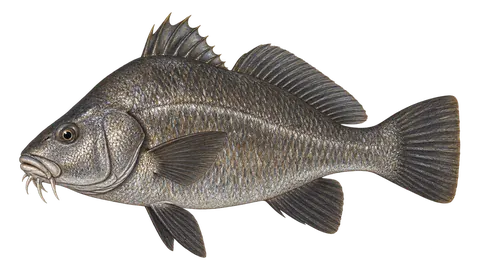
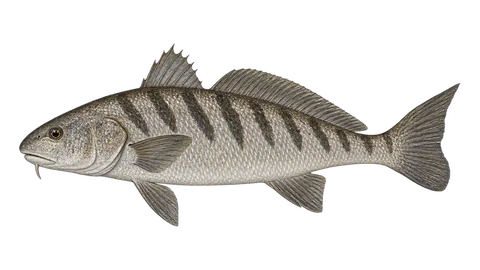
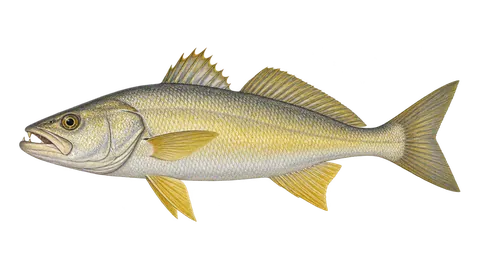
Elongated body, arched back, mouth underneath the snout with 3 to 5 pairs of small barbels on the chin. Silvery-golden back with dark oblique stripes following the scale rows; serrated preopercle. Difference from the miraguaia: this one is much taller and has many barbels. From the betara: the betara has a single thick barbel. From the weakfish: the weakfish has no barbel.
Loading the next 7 days…
Each card shows the day's index (0 to 100) and, below it, a strip with the index for each hour, from 0h to 23h. from poor to excellent.
The whole coast, most abundant from Rio de Janeiro to Rio Grande do Sul, including Lagoa dos Patos. In the North and Northeast it is called cururuca.
Habitat: Sand and mud bottoms of beaches, surf channels, estuaries, coastal lagoons and bays.
native to the basins
coast
states
Amapá, Pará, Maranhão, Piauí, Ceará, Rio Grande do Norte, Paraíba, Pernambuco, Alagoas, Sergipe, Bahia, Espírito Santo, Rio de Janeiro, São Paulo, Paraná, Santa Catarina, Rio Grande do Sul
Spring and summer (October to March) concentrate the croaker on beaches, bars and estuaries in the South and Southeast. In winter it moves off into deeper bottoms and beach fishing drops.
Night and twilight. Bites by day, but does best in the late afternoon and at night, especially on murky beaches.
Water below 16 °C drives the croaker away from the shore.
Before a cold front the bite improves; soon after, rough seas and cold water shut it down.
New-moon nights and big tides often produce on the beach.
Rain doesn't bother it; slightly murky water even helps.
A very dirty surge changes the channels; two or three days later, when the sea calms, the beach is usually very good.
Not very sensitive on the beach; from a boat, avoid bumping the hull over the school.
Strong onshore wind makes waves and drags the sinker; use a grapnel sinker.
On the beach, the two hours before and after high tide are best: the rising tide fills the gutters and brings food. On the falling tide, fish the mouths of the return channels. At low-tide slack the bite drops.
Channels and gutters 1 to 4 m on the beach; 5 to 40 m from a boat.
lures
natural baits
accessories
Find the gutter: on the beach, the croaker moves along the deeper channels between the sandbars. Cast beyond the second break and keep the line taut; the bite comes in dry taps.
Sand fishing with sinker and natural bait beyond the surf, after pompano, betara and croaker.
ready-made kitBoat or kayak fishing in mangroves, channels, brackish rivers and under bridges, with artificial lures and live shrimp, following the tide.
guideUnderstand how sonar sees underwater, what each mark on the screen means, and how to adjust the unit to find bottom, structure and fish.
guideFind troughs, sandbars and rip currents, choose tide and time, and fish the rocky shore without risking your life.
guideSpring and neap tides, high and low tide, slack water, rising and falling tide, tide tables and solunar theory: what really matters and how to use it without fanaticism.
Summary of the regulations we found, with the source for each. Rules change; before keeping or transporting fish, check with the state environmental agency.
Conservation: Not on the national list of threatened species; stocks are under heavy commercial fishing.
Fishing for, keeping on board or landing croaker under 25 cm total length is prohibited on the coast of ES, RJ, SP, PR, SC and RS.
Source: IN MMA nº 53/2005 (coast from ES to RS; total length)
A small croaker hooked deep swallows the hook: use a circle hook, cut the line close if it won't come out easily, and release quickly.
White, tasty meat. Fried in steaks, stewed, baked or escabeche.
Length-weight relationship W = a·Lb (a = 0.00955, b = 3.02; FishBase (estimativa bayesiana, comprimento total)). It's an average: a fat or lean fish can vary by 10% to 20%.
estimated weight
—
The season weights (months), the time of day and the sensitivities (cold, pressure, moon, wind, rain, tide, strong light, murky water and noise) are the app's editorial estimates, based on the literature below and on the field experience of anglers and guides. They are not official data nor a measurement made for this species, and they may vary by region and year. Closed seasons and legal rules appear in the rules section, with the norm and a link.
Your location is saved only on this device and feeds the forecast, the map and the "today" on the home page.